Godman Ashok Kharat Allegedly Used Followers' KYC For Bogus Accounts
Ashok Kharat, a self-styled godman, allegedly used his followers' KYC documents to open fake accounts. He sold ordinary products at high prices, claiming they had divine powers.
'%3E%3Crect%20width%3D'96'%20height%3D'96'%20fill%3D'%23B3261E'%2F%3E%3Ccircle%20cx%3D'30'%20cy%3D'24'%20r%3D'44'%20fill%3D'%23fff'%20opacity%3D'.12'%2F%3E%3Ccircle%20cx%3D'60'%20cy%3D'74'%20r%3D'40'%20fill%3D'%23000'%20opacity%3D'.10'%2F%3E%3C%2Fg%3E%3Cg%20fill%3D'%23fff'%3E%3Crect%20x%3D'29'%20y%3D'49'%20width%3D'8'%20height%3D'19'%20rx%3D'1'%2F%3E%3Crect%20x%3D'39'%20y%3D'40'%20width%3D'9'%20height%3D'28'%20rx%3D'1'%2F%3E%3Crect%20x%3D'50'%20y%3D'45'%20width%3D'8'%20height%3D'23'%20rx%3D'1'%2F%3E%3Crect%20x%3D'60'%20y%3D'53'%20width%3D'7'%20height%3D'15'%20rx%3D'1'%2F%3E%3Crect%20x%3D'41'%20y%3D'34'%20width%3D'5'%20height%3D'6'%2F%3E%3C%2Fg%3E%3C%2Fsvg%3E)
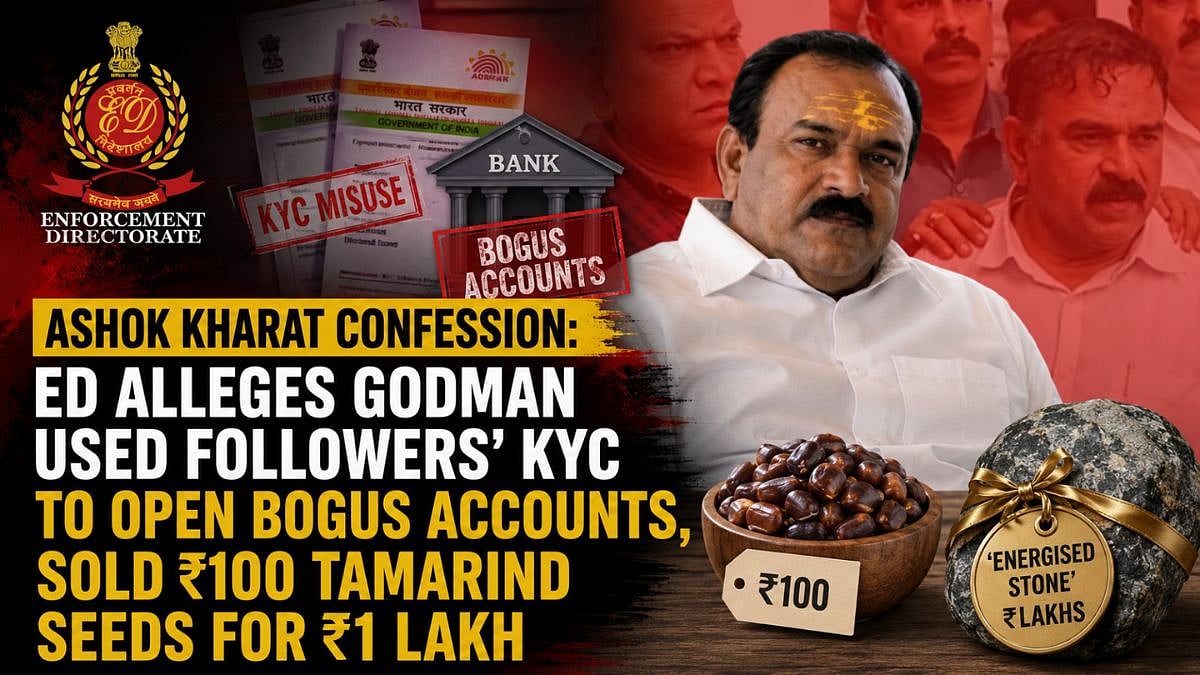
Ashokkumar Eknath Kharat, also known as 'Captain', a self-styled godman, has been arrested by the Enforcement Directorate (ED) in a Rs 42.88-crore money laundering case. During questioning, Kharat admitted to collecting Know Your Customer (KYC) documents from his followers, allegedly on the pretext of arranging pilgrimage bookings, and using them to open dozens of bank accounts without their knowledge.
The ED's prosecution complaint includes Kharat's statement, in which he claims to have controlled several of these accounts. However, he repeatedly stated that he could not produce documentary proof regarding the source of large cash deposits, investments, and donations received through entities linked to him.
According to the statement, Kharat told investigators that followers were asked to submit their Aadhaar and PAN cards, which were then used to open around 60 bogus bank accounts and 48 special savings accounts at two different banks. Of the 34 accounts opened at one of the banks, 32 were allegedly benami and opened without the knowledge or consent of the account holders.
The ED alleges that Kharat's operation involved a carefully cultivated religious persona, where he projected himself as an incarnation of Lord Shiva and claimed supernatural powers to instil fear among devotees. He also allegedly administered sedative-laced 'prasad' or drinks to female devotees before sexually assaulting them.
Kharat has denied any wrongdoing. However, investigators claim that devotees were persuaded to buy ordinary products, such as tamarind seeds, gemstones, and 'sacred honey', which were sold at exorbitant prices after being claimed to possess supernatural properties. For example, ordinary tamarind seeds were sold for Rs 1 lakh, claiming they had divine powers.
The ED's investigation has revealed that Kharat's alleged extortion, cheating, and money laundering operation was carried out over several years, with fear and psychological dependence created among devotees. The agency has alleged that Kharat used this fear to extract money from his followers.
The case against Kharat is a significant one, highlighting the need for vigilance against fraudulent activities carried out by self-styled godmen. The ED's investigation has shed light on the alleged modus operandi of Kharat, which involved exploiting the trust and faith of his followers for financial gain.
In recent years, there have been several cases of self-styled godmen being accused of financial irregularities and exploitation of their followers. The case against Kharat serves as a reminder of the need for regulatory bodies to keep a close watch on such activities and to take swift action against those who engage in fraudulent practices.
The ED's prosecution complaint against Kharat is a significant step towards bringing those responsible for financial irregularities to justice. The agency's investigation has highlighted the need for greater awareness and vigilance among the public, particularly when dealing with self-styled godmen who claim to possess supernatural powers.
In conclusion, the case against Ashok Kharat is a significant one, highlighting the need for vigilance against fraudulent activities carried out by self-styled godmen. The ED's investigation has shed light on the alleged modus operandi of Kharat, and the agency's prosecution complaint is a step towards bringing those responsible for financial irregularities to justice.
The alleged misuse of KYC documents by Kharat is a serious issue, and regulatory bodies must take swift action to prevent such activities in the future. The public must also be aware of the risks involved in dealing with self-styled godmen and must be cautious when investing in products or services that claim to possess supernatural powers.
The ED's investigation into Kharat's alleged money laundering activities is ongoing, and the agency is likely to file further charges against him in the coming days. The case against Kharat is a significant one, and it is likely to have far-reaching implications for the regulation of self-styled godmen and their activities in India.
The Mumbai police have also been investigating Kharat's activities, and they have filed several cases against him in the past. The ED's investigation has been carried out in coordination with the Mumbai police, and the agency has been working closely with other regulatory bodies to gather evidence against Kharat.
In the end, the case against Ashok Kharat serves as a reminder of the need for vigilance against fraudulent activities carried out by self-styled godmen. The ED's investigation has highlighted the need for greater awareness and vigilance among the public, and the agency's prosecution complaint is a step towards bringing those responsible for financial irregularities to justice.
What it means for Mumbai is that the city's residents must be cautious when dealing with self-styled godmen and must be aware of the risks involved in investing in products or services that claim to possess supernatural powers. The city's regulatory bodies must also take swift action to prevent such activities in the future and must work closely with other agencies to gather evidence against those who engage in fraudulent practices.
The case against Kharat is a significant one, and it is likely to have far-reaching implications for the regulation of self-styled godmen and their activities in Mumbai. The ED's investigation has shed light on the alleged modus operandi of Kharat, and the agency's prosecution complaint is a step towards bringing those responsible for financial irregularities to justice.
Frequently asked questions
What is the ED's case against Ashok Kharat?
The ED has alleged that Kharat used his followers' KYC documents to open fake accounts and sold ordinary products at high prices, claiming they had divine powers.
What is the amount of money involved in the ED's case against Kharat?
The ED has alleged that Kharat was involved in a Rs 42.88-crore money laundering case.