Maharashtra Leads India's Economic Growth
Maharashtra drives India's economy, contributing 14.3% to nominal GDP. The state's economic success is shaped by collective regional contributions.
'%3E%3Crect%20width%3D'96'%20height%3D'96'%20fill%3D'%23B3261E'%2F%3E%3Ccircle%20cx%3D'30'%20cy%3D'24'%20r%3D'44'%20fill%3D'%23fff'%20opacity%3D'.12'%2F%3E%3Ccircle%20cx%3D'60'%20cy%3D'74'%20r%3D'40'%20fill%3D'%23000'%20opacity%3D'.10'%2F%3E%3C%2Fg%3E%3Cg%20fill%3D'%23fff'%3E%3Crect%20x%3D'29'%20y%3D'49'%20width%3D'8'%20height%3D'19'%20rx%3D'1'%2F%3E%3Crect%20x%3D'39'%20y%3D'40'%20width%3D'9'%20height%3D'28'%20rx%3D'1'%2F%3E%3Crect%20x%3D'50'%20y%3D'45'%20width%3D'8'%20height%3D'23'%20rx%3D'1'%2F%3E%3Crect%20x%3D'60'%20y%3D'53'%20width%3D'7'%20height%3D'15'%20rx%3D'1'%2F%3E%3Crect%20x%3D'41'%20y%3D'34'%20width%3D'5'%20height%3D'6'%2F%3E%3C%2Fg%3E%3C%2Fsvg%3E)
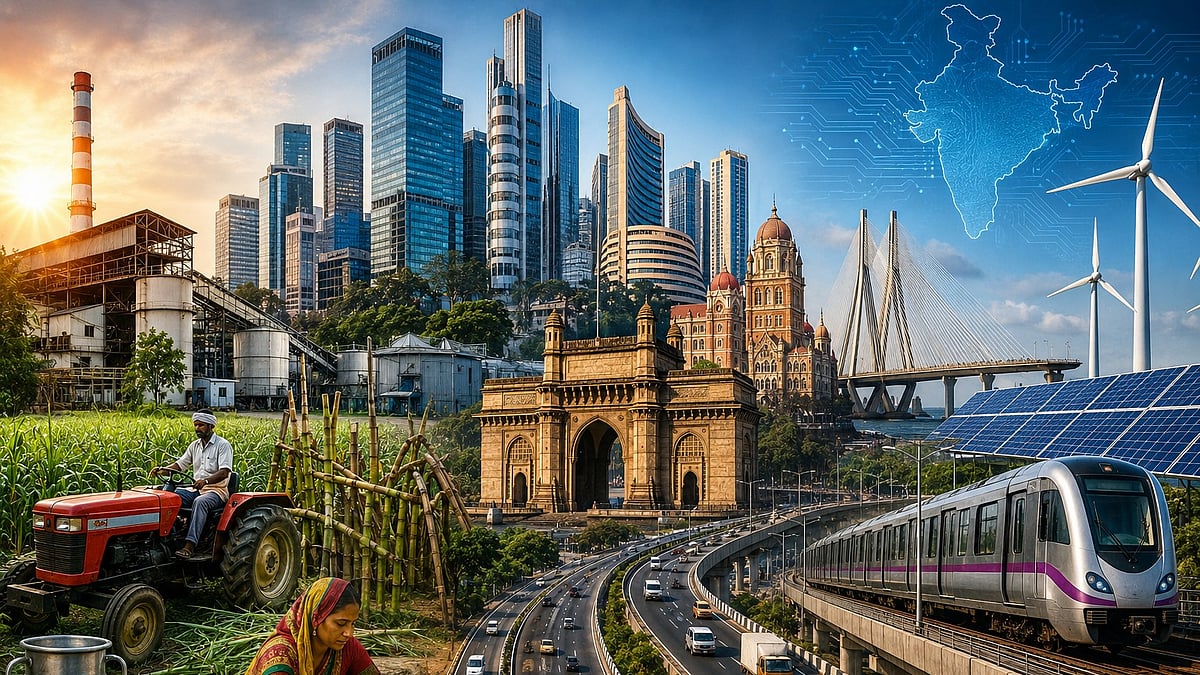
Maharashtra has been the driving force of India's economy for over six decades. The state's economic success can be attributed to the collective contribution of every region, with Mumbai establishing itself as the country's financial and commercial capital.
The cooperative movement has played a significant role in transforming rural Maharashtra through sugar factories, dairy cooperatives, and cooperative banks. This movement has empowered farmers, created rural employment, and connected agricultural producers directly with markets.
The state's first Chief Minister, Yashwantrao Chavan, laid the foundation for a development model that balanced agriculture with industrialisation. His vision was to ensure that prosperity was not confined to cities but reached villages as well.
During the 1960s and 1970s, the cooperative movement became the backbone of rural Maharashtra. The movement strengthened the rural economy and nurtured entrepreneurship across the state. The state's commitment to grassroots governance was further strengthened through the enactment of the Maharashtra Zilla Parishads and Panchayat Samitis Act, 1961.
The establishment of the Maharashtra Industrial Development Corporation (MIDC) transformed the industrial landscape by creating industrial estates across almost every district. This policy laid the foundation for thriving industrial centres in Pune, Nashik, Nagpur, and Chhatrapati Sambhaji Nagar.
As per the Economic Survey for FY2025-26, Maharashtra contributes 14.3% to the country's nominal GDP and remains the nation's largest state economy. The state accounts for around 31% of India's total Foreign Direct Investment (FDI) and has consistently remained the country's leading FDI destination.
Maharashtra's leadership in manufacturing, finance, information technology, services, innovation, and infrastructure has consistently made it India's foremost economic powerhouse. The state's economic growth is a result of the collective efforts of its regions, making it a model for other states to follow.
The state's economic success has been shaped by its ability to diversify and strengthen its economy. From the cooperative movement to industrial and technological growth, Maharashtra has continuously evolved to remain India's leading economic powerhouse.
In conclusion, Maharashtra's economic growth is a testament to the state's ability to balance regional development and nurture entrepreneurship. The state's commitment to grassroots governance and its leadership in various sectors have made it a model for other states to follow.
Maharashtra's economic success has significant implications for the country as a whole. As the nation's largest state economy, Maharashtra's growth contributes substantially to India's overall economic development. The state's ability to attract foreign investment and create employment opportunities has made it a hub for economic activity.
The state's economic growth is expected to continue, with the government focusing on preparing Maharashtra for the next era of the global economy. With its strong foundation in various sectors, Maharashtra is well-positioned to remain India's leading economic powerhouse.
Frequently asked questions
What is Maharashtra's contribution to India's nominal GDP?
Maharashtra contributes 14.3% to India's nominal GDP.
What percentage of India's total FDI does Maharashtra account for?
Maharashtra accounts for around 31% of India's total Foreign Direct Investment (FDI).