Black Holes Collision Confirms Hawking Theory
A cosmic collision 1.3 billion light-years away validates a 50-year-old prediction. Scientists confirm Hawking's theory.
'%3E%3Crect%20width%3D'96'%20height%3D'96'%20fill%3D'%23B3261E'%2F%3E%3Ccircle%20cx%3D'30'%20cy%3D'24'%20r%3D'44'%20fill%3D'%23fff'%20opacity%3D'.12'%2F%3E%3Ccircle%20cx%3D'60'%20cy%3D'74'%20r%3D'40'%20fill%3D'%23000'%20opacity%3D'.10'%2F%3E%3C%2Fg%3E%3Cg%20fill%3D'%23fff'%3E%3Crect%20x%3D'29'%20y%3D'49'%20width%3D'8'%20height%3D'19'%20rx%3D'1'%2F%3E%3Crect%20x%3D'39'%20y%3D'40'%20width%3D'9'%20height%3D'28'%20rx%3D'1'%2F%3E%3Crect%20x%3D'50'%20y%3D'45'%20width%3D'8'%20height%3D'23'%20rx%3D'1'%2F%3E%3Crect%20x%3D'60'%20y%3D'53'%20width%3D'7'%20height%3D'15'%20rx%3D'1'%2F%3E%3Crect%20x%3D'41'%20y%3D'34'%20width%3D'5'%20height%3D'6'%2F%3E%3C%2Fg%3E%3C%2Fsvg%3E)
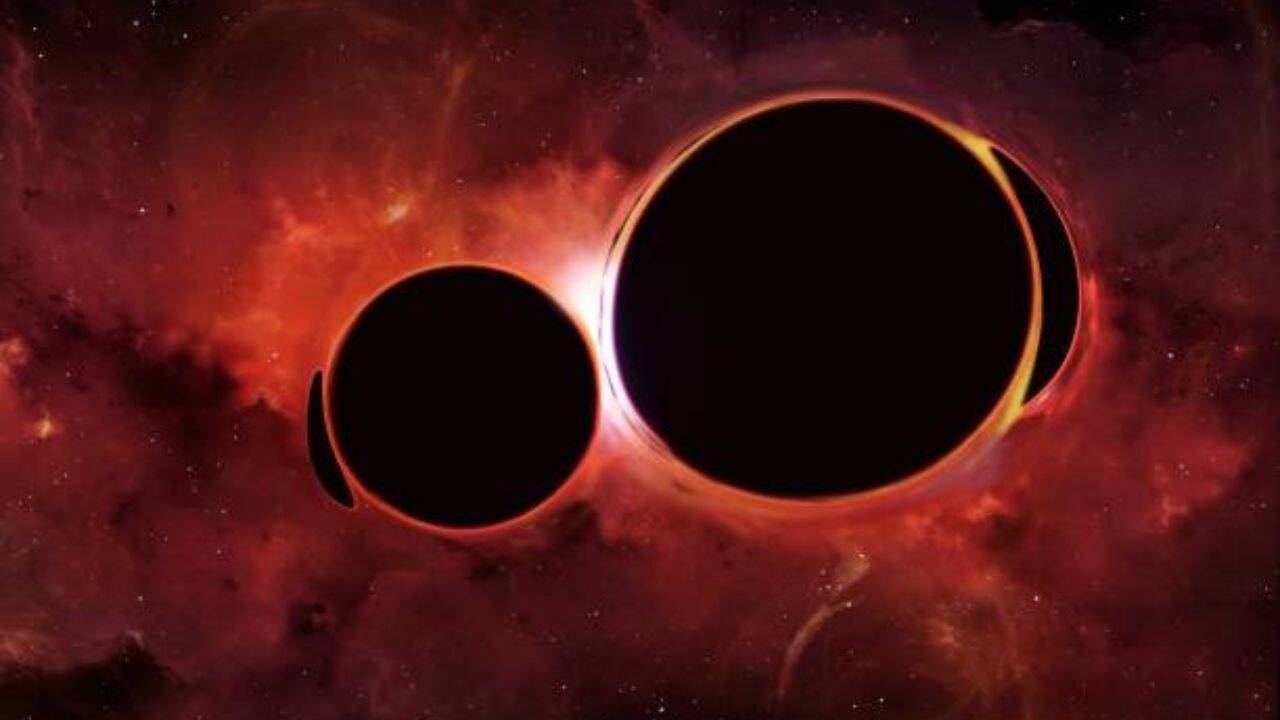
A groundbreaking cosmic event has confirmed a fifty-year-old prediction made by renowned physicist Stephen Hawking. The collision of two black holes, observed 1.3 billion light-years away, has provided conclusive evidence for Hawking's black hole area law.
The merger of the two black holes resulted in a significant increase in the area of the newly formed black hole, precisely matching theoretical calculations. This observation has been hailed as the most accurate evidence for Hawking's theory, which was first proposed in the 1970s.
The discovery was made possible through the collaboration of scientists from LIGO, Virgo, and KAGRA, who worked together to analyze the gravitational wave signal emitted by the cosmic collision. The precise data collected from this event has reinforced our understanding of fundamental principles in modern physics and cosmology.
Hawking's black hole area law proposes that the surface area of a black hole always increases when two black holes merge. This theory has been widely accepted, but until now, it lacked conclusive observational evidence. The recent cosmic collision has filled this gap, providing scientists with a unique opportunity to test Hawking's prediction.
The observation of gravitational waves from the collision has been a major breakthrough in the field of astrophysics. The data collected from this event has not only confirmed Hawking's theory but also provided valuable insights into the behavior of black holes and the fundamental laws of physics.
The collaboration between LIGO, Virgo, and KAGRA has been instrumental in making this discovery possible. The combined efforts of scientists from these organizations have enabled the collection of precise data, which has been used to validate Hawking's prediction.
The confirmation of Hawking's black hole area law has significant implications for our understanding of the universe. It reinforces our knowledge of the fundamental principles of physics and cosmology, providing a deeper understanding of the behavior of black holes and the universe as a whole.
In conclusion, the cosmic collision of two black holes has provided conclusive evidence for Hawking's black hole area law, confirming a fifty-year-old prediction. This discovery has been made possible through the collaboration of scientists from LIGO, Virgo, and KAGRA, and has significant implications for our understanding of the universe.
The validation of Hawking's theory is a testament to the power of human curiosity and the importance of continued scientific research. As scientists continue to explore the universe, they may uncover even more evidence to support or challenge existing theories, ultimately leading to a deeper understanding of the cosmos.