Delhi HC Seeks Response On Plea For Sonam Wangchuk's Medical Help
Climate activist Sonam Wangchuk on hunger strike, Delhi HC seeks government response.
'%3E%3Crect%20width%3D'96'%20height%3D'96'%20fill%3D'%231A5276'%2F%3E%3Ccircle%20cx%3D'30'%20cy%3D'24'%20r%3D'44'%20fill%3D'%23fff'%20opacity%3D'.12'%2F%3E%3Ccircle%20cx%3D'60'%20cy%3D'74'%20r%3D'40'%20fill%3D'%23000'%20opacity%3D'.10'%2F%3E%3C%2Fg%3E%3Cg%20fill%3D'%23fff'%3E%3Cpath%20d%3D'M31%2041%20L48%2031%20L65%2041%20Z'%2F%3E%3Crect%20x%3D'33'%20y%3D'43'%20width%3D'4'%20height%3D'17'%2F%3E%3Crect%20x%3D'41'%20y%3D'43'%20width%3D'4'%20height%3D'17'%2F%3E%3Crect%20x%3D'51'%20y%3D'43'%20width%3D'4'%20height%3D'17'%2F%3E%3Crect%20x%3D'59'%20y%3D'43'%20width%3D'4'%20height%3D'17'%2F%3E%3Crect%20x%3D'30'%20y%3D'62'%20width%3D'36'%20height%3D'4'%20rx%3D'1'%2F%3E%3C%2Fg%3E%3C%2Fsvg%3E)
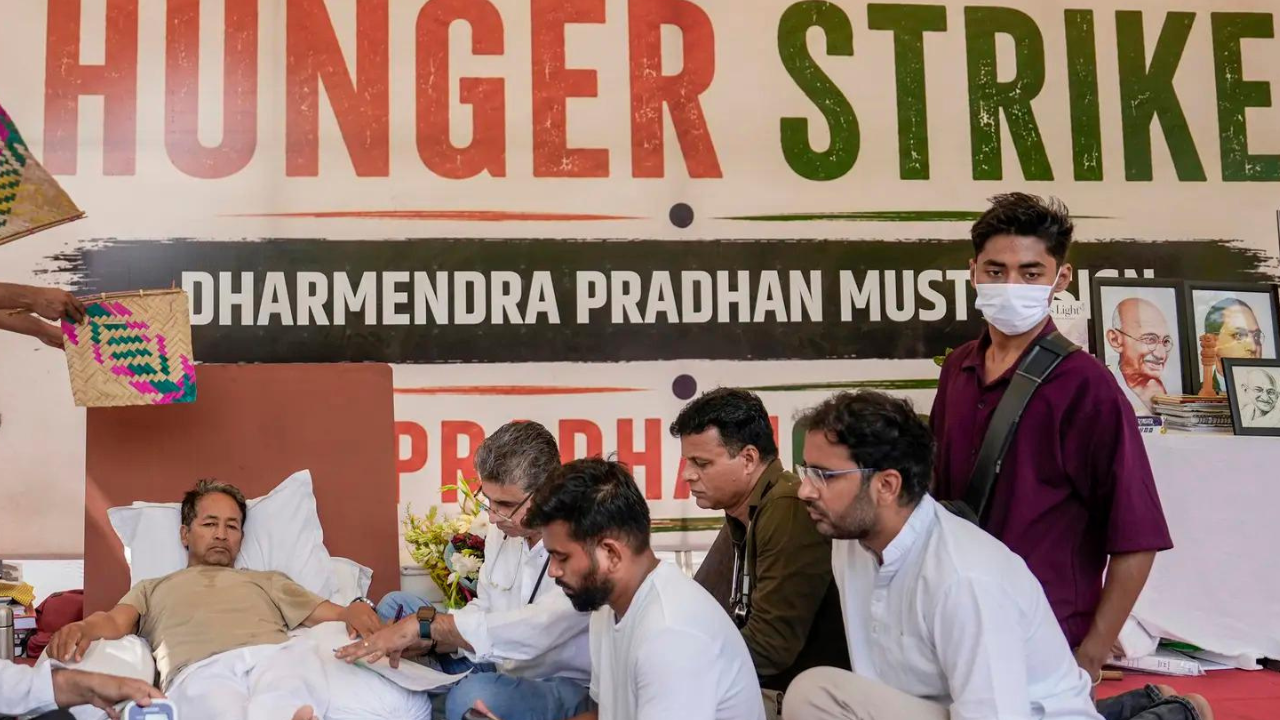
The Delhi High Court has asked the central government and the Delhi government to respond to a public interest litigation (PIL) regarding the health of climate activist Sonam Wangchuk.
Wangchuk has been on an indefinite hunger strike since June 28, demanding the resignation of the Education Minister due to alleged examination irregularities.
The PIL was filed by activist-lawyer Rakesh Kumar Saini, who is seeking urgent medical intervention for Wangchuk, including hospitalisation and supervised treatment.
The court's decision to seek a response from the governments indicates that it is taking the matter seriously and is concerned about Wangchuk's health.
Wangchuk's hunger strike has been ongoing for several weeks, and his health is reportedly deteriorating.
The Education Minister's resignation is being demanded due to allegations of examination irregularities, which have sparked widespread outrage and protests.
The Delhi High Court's response to the PIL is being closely watched, as it could have significant implications for the government's handling of the situation.
The court's decision may also set a precedent for how the government responds to hunger strikes and other forms of protest in the future.
In recent years, there have been several high-profile hunger strikes in India, including those by activists and politicians.
The Indian government has a responsibility to protect the health and well-being of its citizens, including those who are engaging in peaceful protest.
The outcome of this case will be closely watched, as it could have significant implications for the rights of protesters and the government's response to dissent.
The Delhi High Court is expected to hear the case again in the coming days, and a decision is likely to be made soon.
For now, Wangchuk's health remains a concern, and the government's response to the PIL will be closely watched.
The situation highlights the need for the government to balance its responsibility to maintain law and order with its duty to protect the rights and well-being of its citizens.
In the end, the Delhi High Court's decision will have significant implications for the future of protest and dissent in India.