India Domestic Aviation Sees 4.8% Traffic Drop in July
India's domestic aviation sector experienced a temporary contraction in July. Passenger traffic fell by 4.8% to 1.2 crore travellers.
'%3E%3Crect%20width%3D'96'%20height%3D'96'%20fill%3D'%23B3261E'%2F%3E%3Ccircle%20cx%3D'30'%20cy%3D'24'%20r%3D'44'%20fill%3D'%23fff'%20opacity%3D'.12'%2F%3E%3Ccircle%20cx%3D'60'%20cy%3D'74'%20r%3D'40'%20fill%3D'%23000'%20opacity%3D'.10'%2F%3E%3C%2Fg%3E%3Cg%20fill%3D'%23fff'%3E%3Crect%20x%3D'29'%20y%3D'49'%20width%3D'8'%20height%3D'19'%20rx%3D'1'%2F%3E%3Crect%20x%3D'39'%20y%3D'40'%20width%3D'9'%20height%3D'28'%20rx%3D'1'%2F%3E%3Crect%20x%3D'50'%20y%3D'45'%20width%3D'8'%20height%3D'23'%20rx%3D'1'%2F%3E%3Crect%20x%3D'60'%20y%3D'53'%20width%3D'7'%20height%3D'15'%20rx%3D'1'%2F%3E%3Crect%20x%3D'41'%20y%3D'34'%20width%3D'5'%20height%3D'6'%2F%3E%3C%2Fg%3E%3C%2Fsvg%3E)
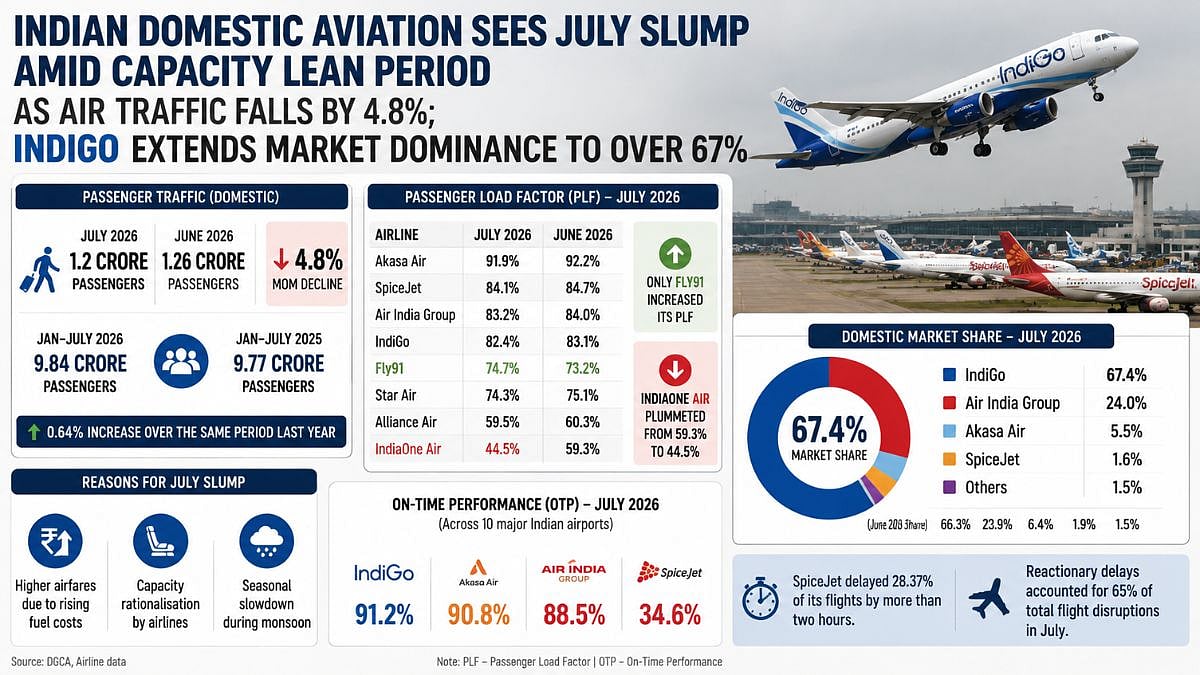
India's domestic aviation sector experienced a temporary contraction in July 2026, driven by seasonal demand shifts and operational adjustments. The month-on-month passenger traffic slipped by 4.8% to 1.2 crore travellers compared to 1.26 crore in June.
Despite the dip, year-to-date performance remained stable, with airlines carrying 9.84 crore passengers in the first seven months of 2026 – recording a marginal 0.64% increase over the 9.77 crore recorded during the same period last year.
A widespread drop in passenger load factors (PLF) reflected the broader slump in passenger volumes. Virtually every scheduled domestic carrier reported lower seat occupancy compared to June 2026. Akasa Air had the highest overall PLF at 91.9%, but it was slightly down from 92.2% in June.
SpiceJet, Air India Group and IndiGo recorded marginal drops to 84.1%, 83.2% and 82.4%, respectively. Regional carriers like Star Air and Alliance Air slipped slightly to 74.3% and 59.5%, while IndiaOne Air plummeted massively from 59.3% to 44.5%. The sole exception to the trend was Goa-based regional operator Fly91, which increased its PLF from 73.2% in June to 74.7% in July.
According to industry insiders, the fall in traffic is driven by several factors like higher airfares due to rising fuel costs and capacity rationalisation by airlines. This has been fuelled by the seasonal slowdown during monsoon.
IndiGo continued to expand its market dominance, commanding a 67.4% share of the domestic market in July – up from 66.3% in June – after carrying 80.82 lakh passengers. Air India Group’s share increased by a fraction from 23.9% to 24%, while Akasa Air’s market share dropped significantly from 6.4% to 5.5%.
The low-cost carrier also led operational reliability among major airlines, securing the top spot for on-time performance (OTP) at 91.2% across ten major Indian airports. Akasa Air followed closely in punctuality with an impressive 90.8% OTP, while Air India Group achieved an 88.5% OTP.
SpiceJet struggled significantly with operational timelines, reporting an OTP of just 34.6%, while delaying 28.37% of its flights by more than two hours. Across all operators, reactionary delays accounted for 65% of total flight disruptions during the month.
The decline in passenger traffic and load factors is a significant development in the Indian domestic aviation sector. It highlights the challenges faced by airlines in managing capacity and demand during lean periods. As the sector continues to evolve, it will be important to monitor how airlines adapt to these challenges and respond to changing market conditions.
In the context of the Indian economy, the aviation sector plays a critical role in facilitating travel and trade. The decline in passenger traffic may have implications for related industries, such as tourism and hospitality. However, the stable year-to-date performance and marginal increase in passenger traffic compared to last year suggest that the sector remains resilient.
Overall, the July slump in India's domestic aviation sector is a reminder of the complexities and challenges faced by the industry. As airlines continue to navigate these challenges, it will be important to monitor their performance and adaptability in response to changing market conditions.
The significance of this development for Mumbai and India lies in its potential impact on the economy and related industries. The decline in passenger traffic may have implications for employment and economic growth in the region. However, the stable year-to-date performance and marginal increase in passenger traffic compared to last year suggest that the sector remains resilient and poised for growth.
In conclusion, the July slump in India's domestic aviation sector is a significant development that highlights the challenges faced by airlines in managing capacity and demand during lean periods. As the sector continues to evolve, it will be important to monitor how airlines adapt to these challenges and respond to changing market conditions.
Frequently asked questions
What was the decline in passenger traffic in India's domestic aviation sector in July 2026?
The passenger traffic declined by 4.8% to 1.2 crore travellers in July 2026.
Which airline extended its market dominance in July 2026?
IndiGo extended its market dominance to 67.4% in July 2026.