Maharashtra Bans Junk Food Near Schools
Maharashtra and Karnataka ban junk food in schools and nearby areas.
'%3E%3Crect%20width%3D'96'%20height%3D'96'%20fill%3D'%23B3261E'%2F%3E%3Ccircle%20cx%3D'30'%20cy%3D'24'%20r%3D'44'%20fill%3D'%23fff'%20opacity%3D'.12'%2F%3E%3Ccircle%20cx%3D'60'%20cy%3D'74'%20r%3D'40'%20fill%3D'%23000'%20opacity%3D'.10'%2F%3E%3C%2Fg%3E%3Cg%20fill%3D'%23fff'%3E%3Crect%20x%3D'29'%20y%3D'49'%20width%3D'8'%20height%3D'19'%20rx%3D'1'%2F%3E%3Crect%20x%3D'39'%20y%3D'40'%20width%3D'9'%20height%3D'28'%20rx%3D'1'%2F%3E%3Crect%20x%3D'50'%20y%3D'45'%20width%3D'8'%20height%3D'23'%20rx%3D'1'%2F%3E%3Crect%20x%3D'60'%20y%3D'53'%20width%3D'7'%20height%3D'15'%20rx%3D'1'%2F%3E%3Crect%20x%3D'41'%20y%3D'34'%20width%3D'5'%20height%3D'6'%2F%3E%3C%2Fg%3E%3C%2Fsvg%3E)
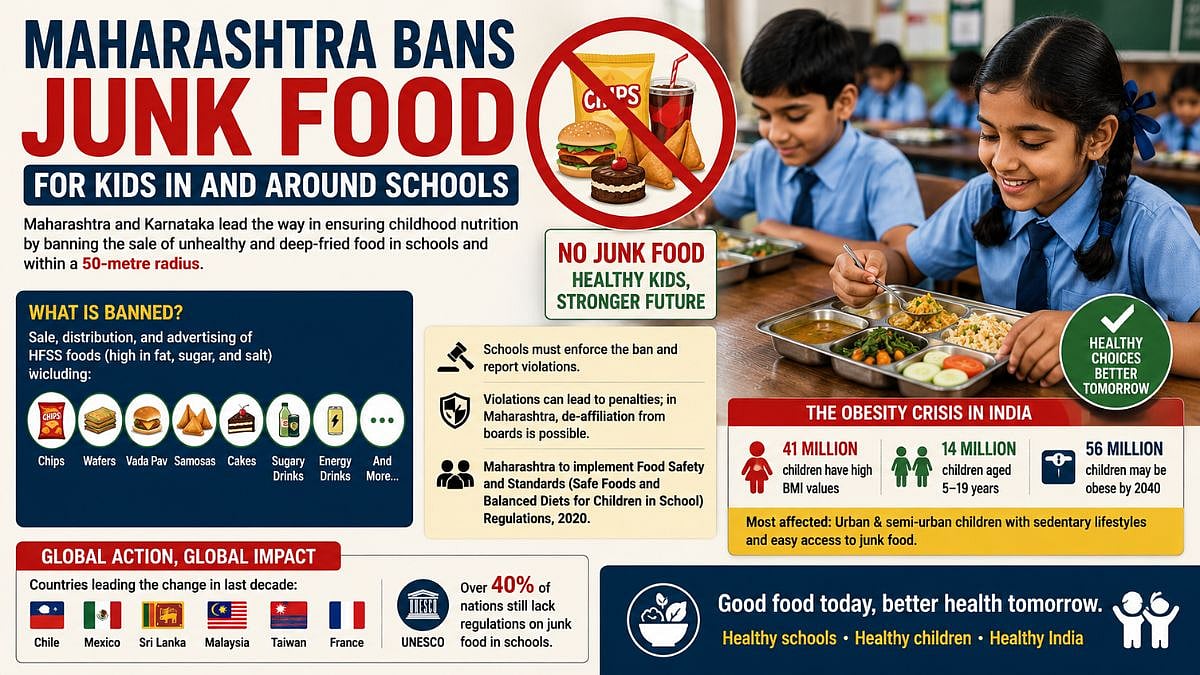
The Maharashtra government has taken a significant step towards promoting childhood nutrition by banning the sale, distribution, and advertising of junk food in school canteens and within a 50-metre radius of all schools in the state. This move aims to prevent the sale of high-fat, high-sugar, and high-salt foods, commonly referred to as HFSS foods, which include items like chips, sugary drinks, and energy drinks.
The Food and Drug Administration in Maharashtra will be responsible for enforcing this ban, and school managements will be held liable for any violations. The state will invoke the Food Safety and Standards (Safe Foods and Balanced Diets for Children in School) Regulations, 2020, to ensure compliance. Schools that fail to report tuck shops selling junk food or violate the regulations within their premises may face de-affiliation from their respective boards.
This decision is expected to benefit over two crore children in schools across Maharashtra, who will now have access to healthier food options at least once a day. The move is also likely to reduce the temptation for children to spend their pocket money on junk food outside schools.
The need for this ban cannot be overstated, as India is currently facing a major public health crisis due to childhood obesity. With a staggering 41 million children having high BMI values, of which 14 million are between five and 19 years of age, it is essential to take drastic measures to promote healthy eating habits. Most obese children are found in urban or semi-urban areas, where there is little space for physical activities and sedentary lifestyles are prevalent.
Other states should follow the lead of Maharashtra and Karnataka in banning junk food near schools. The projection of 56 million children in India battling obesity by 2040 should serve as a wake-up call for policymakers to take action. Countries like Chile, Mexico, Sri Lanka, Malaysia, Taiwan, and France have already introduced strict policies to restrict or ban high-calorie, ultra-processed junk foods and soft drinks in school canteens and near schools.
A worldwide report by UNESCO's Global Education Monitoring team last year highlighted the issue, stating that over 40 per cent of nations do not have regulations to restrict the sale of junk food near schools. Most of these countries are low- or middle-income countries, which makes it even more challenging to promote healthy eating habits.
In conclusion, the ban on junk food near schools in Maharashtra is a timely and necessary measure to promote childhood nutrition and prevent obesity. It is essential for other states to follow suit and for policymakers to take a proactive approach to addressing this public health crisis.
The FDA Commissioner of Maharashtra, Tukaram Mundhe, has emphasized the importance of this ban, stating that schools that violate the regulations will face severe penalties. This move is expected to have a significant impact on the health and wellbeing of children in Maharashtra, and it is hoped that other states will soon follow suit.
As the world grapples with the issue of childhood obesity, it is essential to take a comprehensive approach to promoting healthy eating habits. This includes not only banning junk food near schools but also promoting physical activity, providing nutrition education, and encouraging healthy lifestyle choices.
In the long run, this ban is expected to have a positive impact on the health and wellbeing of children in Maharashtra, and it is hoped that it will serve as a model for other states to follow. With the support of policymakers, educators, and parents, it is possible to promote healthy eating habits and prevent obesity among children in India.
The ban on junk food near schools in Maharashtra is a significant step towards promoting childhood nutrition, and it is essential to monitor its effectiveness and make adjustments as needed. By working together, it is possible to create a healthier and more sustainable food environment for children in India.
Maharashtra's decision to ban junk food near schools is a crucial step towards addressing the public health crisis of childhood obesity. It is essential for other states to follow suit and for policymakers to take a proactive approach to promoting healthy eating habits and preventing obesity among children.
In the end, the ban on junk food near schools in Maharashtra is a positive step towards promoting childhood nutrition and preventing obesity. It is hoped that other states will soon follow suit, and that together, we can create a healthier and more sustainable food environment for children in India.
The move to ban junk food near schools in Maharashtra is a significant one, and it is expected to have a positive impact on the health and wellbeing of children in the state. It is essential to continue monitoring the situation and making adjustments as needed to ensure that the ban is effective in promoting healthy eating habits and preventing obesity.
As India continues to grapple with the issue of childhood obesity, it is essential to take a comprehensive approach to promoting healthy eating habits. This includes not only banning junk food near schools but also promoting physical activity, providing nutrition education, and encouraging healthy lifestyle choices.
In conclusion, the ban on junk food near schools in Maharashtra is a timely and necessary measure to promote childhood nutrition and prevent obesity. It is essential for other states to follow suit and for policymakers to take a proactive approach to addressing this public health crisis.
Frequently asked questions
Why has Maharashtra banned junk food near schools?
To promote childhood nutrition and prevent obesity.
What types of food are banned under this regulation?
High-fat, high-sugar, and high-salt foods, including chips, sugary drinks, and energy drinks.