1868 Eclipse Reveals Helium
Astronomers discover helium in 1868, 27 years before Earth find. Pierre Jules Janssen makes key observation.
'%3E%3Crect%20width%3D'96'%20height%3D'96'%20fill%3D'%23B3261E'%2F%3E%3Ccircle%20cx%3D'30'%20cy%3D'24'%20r%3D'44'%20fill%3D'%23fff'%20opacity%3D'.12'%2F%3E%3Ccircle%20cx%3D'60'%20cy%3D'74'%20r%3D'40'%20fill%3D'%23000'%20opacity%3D'.10'%2F%3E%3C%2Fg%3E%3Cg%20fill%3D'%23fff'%3E%3Crect%20x%3D'29'%20y%3D'49'%20width%3D'8'%20height%3D'19'%20rx%3D'1'%2F%3E%3Crect%20x%3D'39'%20y%3D'40'%20width%3D'9'%20height%3D'28'%20rx%3D'1'%2F%3E%3Crect%20x%3D'50'%20y%3D'45'%20width%3D'8'%20height%3D'23'%20rx%3D'1'%2F%3E%3Crect%20x%3D'60'%20y%3D'53'%20width%3D'7'%20height%3D'15'%20rx%3D'1'%2F%3E%3Crect%20x%3D'41'%20y%3D'34'%20width%3D'5'%20height%3D'6'%2F%3E%3C%2Fg%3E%3C%2Fsvg%3E)
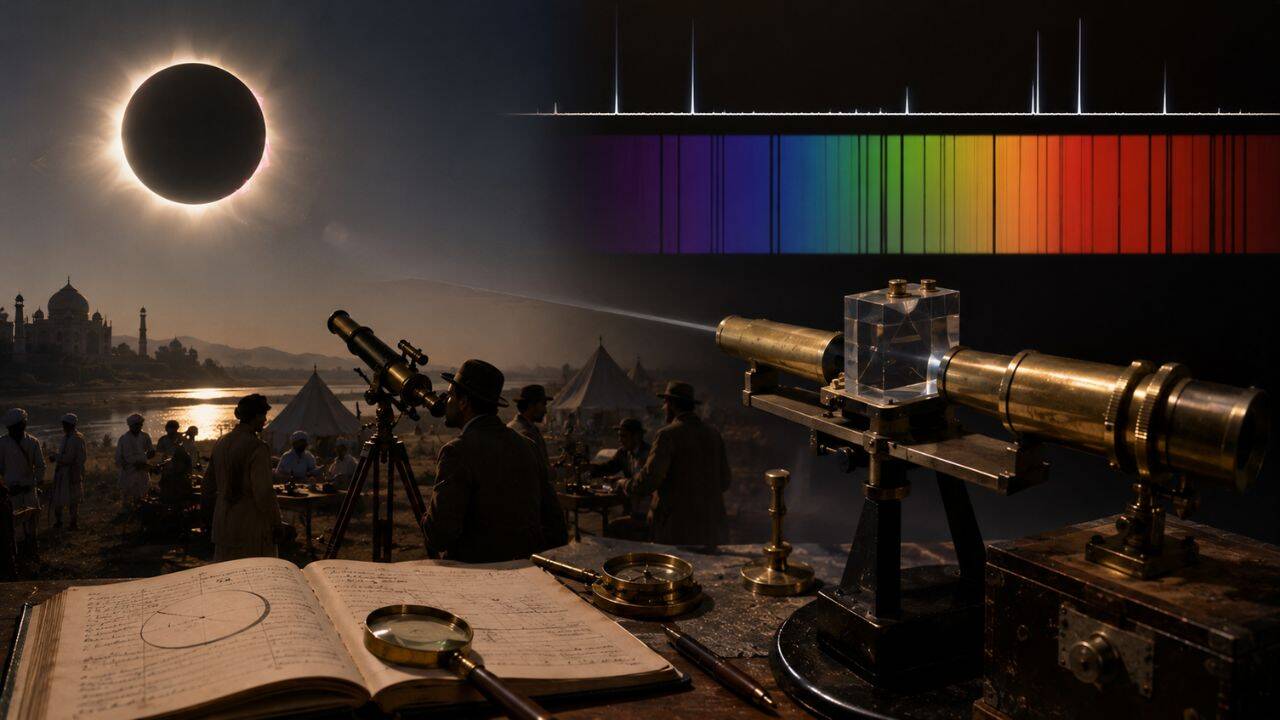
On August 18, 1868, a total solar eclipse occurred in India, providing astronomers with a rare opportunity to study the Sun's corona. During this event, French astronomer Pierre Jules Janssen observed a mysterious yellow spectral line in the Sun's corona. Although the significance of this discovery was not immediately understood, it marked the beginning of a new era in astronomy.
Janssen's observation was soon followed by British astronomer Norman Lockyer, who analyzed the spectral line and proposed that it was caused by an unknown element. Lockyer named this element helium, after the Greek word for sun.
For nearly three decades, helium was only known to exist in the Sun. It wasn't until 1895 that Scottish chemist William Ramsay verified the presence of helium on Earth. Ramsay extracted helium from a mineral called cleveite, solidifying Janssen's pioneering approach to studying solar prominences.
The discovery of helium during the 1868 solar eclipse in India was a groundbreaking moment in the history of astronomy. It demonstrated the importance of solar eclipses in understanding the composition of the Sun and paved the way for future discoveries.
The study of solar eclipses has continued to play a crucial role in advancing our knowledge of the universe. By analyzing the Sun's corona during eclipses, scientists have been able to gain insights into the Sun's composition, temperature, and magnetic field.
In addition to its significance in astronomy, helium has also become an essential element in various industries, including balloons, airships, and cryogenics. Its unique properties make it an ideal gas for these applications.
The story of helium's discovery serves as a reminder of the importance of scientific curiosity and the power of observation. Janssen's initial observation of the yellow spectral line during the 1868 solar eclipse in India sparked a chain of events that ultimately led to the discovery of a new element.
Today, helium is recognized as a vital component of the universe, and its discovery is celebrated as a major milestone in the history of astronomy. The 1868 solar eclipse in India will always be remembered as a pivotal moment in the discovery of this enigmatic element.
Frequently asked questions
When was helium first discovered?
Helium was first discovered during the solar eclipse of 1868 in India.
Who verified helium's presence on Earth?
William Ramsay verified helium's presence on Earth in 1895 by extracting it from a mineral.