Sprinklers Help Solve Feynman Physics Problem
Mathematicians use backyard sprinklers to solve a physics puzzle. Their findings offer insights for engineering applications.
'%3E%3Crect%20width%3D'96'%20height%3D'96'%20fill%3D'%23B3261E'%2F%3E%3Ccircle%20cx%3D'30'%20cy%3D'24'%20r%3D'44'%20fill%3D'%23fff'%20opacity%3D'.12'%2F%3E%3Ccircle%20cx%3D'60'%20cy%3D'74'%20r%3D'40'%20fill%3D'%23000'%20opacity%3D'.10'%2F%3E%3C%2Fg%3E%3Cg%20fill%3D'%23fff'%3E%3Crect%20x%3D'29'%20y%3D'49'%20width%3D'8'%20height%3D'19'%20rx%3D'1'%2F%3E%3Crect%20x%3D'39'%20y%3D'40'%20width%3D'9'%20height%3D'28'%20rx%3D'1'%2F%3E%3Crect%20x%3D'50'%20y%3D'45'%20width%3D'8'%20height%3D'23'%20rx%3D'1'%2F%3E%3Crect%20x%3D'60'%20y%3D'53'%20width%3D'7'%20height%3D'15'%20rx%3D'1'%2F%3E%3Crect%20x%3D'41'%20y%3D'34'%20width%3D'5'%20height%3D'6'%2F%3E%3C%2Fg%3E%3C%2Fsvg%3E)
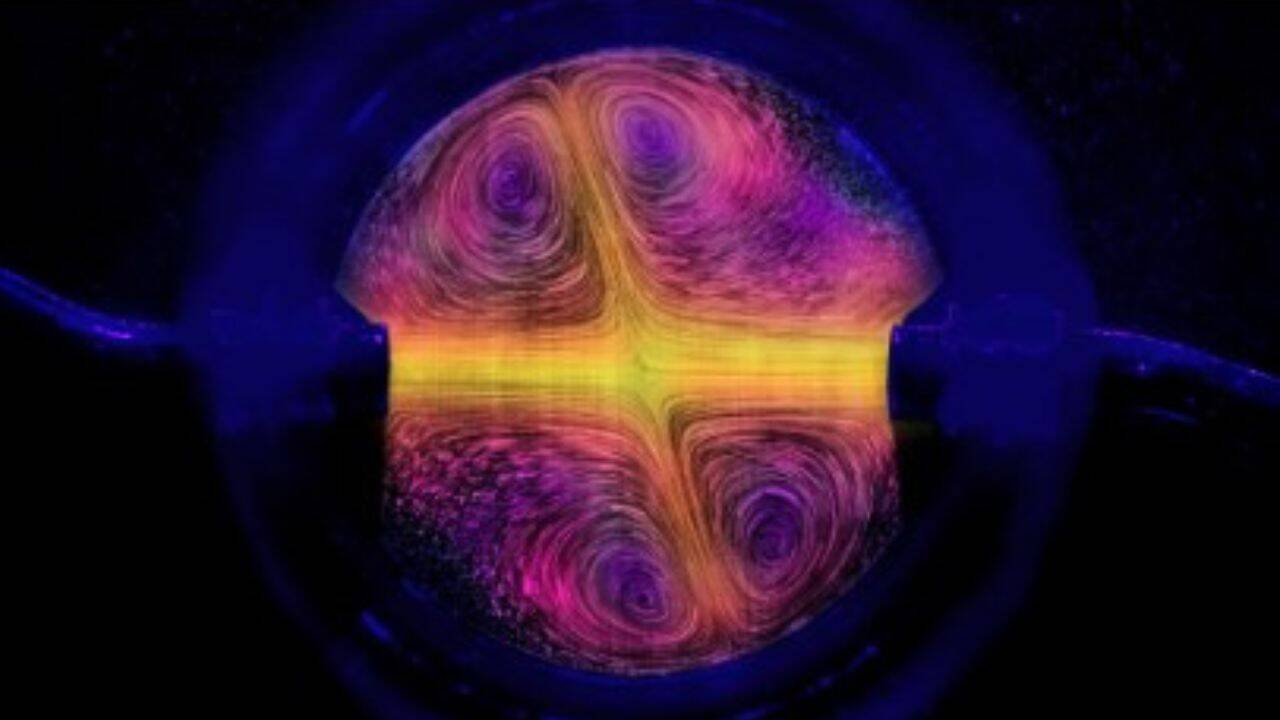
Mathematicians have made a breakthrough in solving a physics problem that had puzzled experts, including the renowned physicist Richard Feynman. The solution came from an unexpected source: children's backyard sprinklers.
The researchers conducted experiments using these sprinklers to understand the rotation of reverse sprinklers. They discovered that the key to this rotation lies in the collision of water momentum inside the central chamber of the sprinkler.
The team found that this principle applies to various sprinkler arm shapes and designs, providing a deeper understanding of the underlying physics. By studying the motion of water in the sprinklers, the mathematicians were able to clarify how the reverse sprinklers rotate.
The solution to this physics puzzle has significant implications for fluid dynamics in engineering applications. The findings could lead to improvements in the design of sprinkler systems and other devices that rely on fluid motion.
Richard Feynman, a Nobel Prize-winning physicist, had previously struggled with this problem. His work on the subject had sparked interest and debate among physicists, but a definitive solution had eluded them until now.
The use of backyard sprinklers in this research highlights the importance of creative thinking and experimentation in scientific inquiry. By exploring unconventional sources of inspiration, mathematicians and physicists can gain new insights into complex problems.
The study of fluid dynamics is crucial in various engineering fields, including aerospace, chemical, and civil engineering. The principles of fluid motion are used to design and optimize systems, such as pipelines, pumps, and turbines.
The researchers' findings have the potential to impact a wide range of applications, from irrigation systems to industrial processes. As scientists continue to explore and understand the complexities of fluid dynamics, they may uncover new and innovative solutions to real-world problems.
In conclusion, the solution to the physics puzzle using children's sprinklers demonstrates the power of creative thinking and experimentation in scientific research. The findings have significant implications for engineering applications and highlight the importance of continued exploration and discovery in the field of fluid dynamics.
The impact of this research will be felt across various industries and fields, as scientists and engineers apply the principles of fluid motion to design and optimize systems. As our understanding of fluid dynamics continues to evolve, we can expect to see new and innovative solutions to complex problems, leading to improvements in efficiency, productivity, and sustainability.
The story of how mathematicians used backyard sprinklers to solve a physics problem is a testament to the importance of curiosity and creativity in scientific inquiry. It shows that even the most complex problems can be solved with determination, innovative thinking, and a willingness to explore unconventional sources of inspiration.
In the end, the solution to this physics puzzle is a reminder that science is a continuous process of discovery and exploration. As we continue to push the boundaries of our knowledge and understanding, we may uncover new and unexpected solutions to complex problems, leading to a better understanding of the world around us and the development of new technologies and innovations.