Nepal Floods: 4 Survivors Rescued Alive From Tunnel, Damaged Home
Two more survivors rescued, offering hope. Rescue teams search through buried homes and tunnels.
'%3E%3Crect%20width%3D'96'%20height%3D'96'%20fill%3D'%23B3261E'%2F%3E%3Ccircle%20cx%3D'30'%20cy%3D'24'%20r%3D'44'%20fill%3D'%23fff'%20opacity%3D'.12'%2F%3E%3Ccircle%20cx%3D'60'%20cy%3D'74'%20r%3D'40'%20fill%3D'%23000'%20opacity%3D'.10'%2F%3E%3C%2Fg%3E%3Cg%20fill%3D'%23fff'%3E%3Crect%20x%3D'29'%20y%3D'49'%20width%3D'8'%20height%3D'19'%20rx%3D'1'%2F%3E%3Crect%20x%3D'39'%20y%3D'40'%20width%3D'9'%20height%3D'28'%20rx%3D'1'%2F%3E%3Crect%20x%3D'50'%20y%3D'45'%20width%3D'8'%20height%3D'23'%20rx%3D'1'%2F%3E%3Crect%20x%3D'60'%20y%3D'53'%20width%3D'7'%20height%3D'15'%20rx%3D'1'%2F%3E%3Crect%20x%3D'41'%20y%3D'34'%20width%3D'5'%20height%3D'6'%2F%3E%3C%2Fg%3E%3C%2Fsvg%3E)
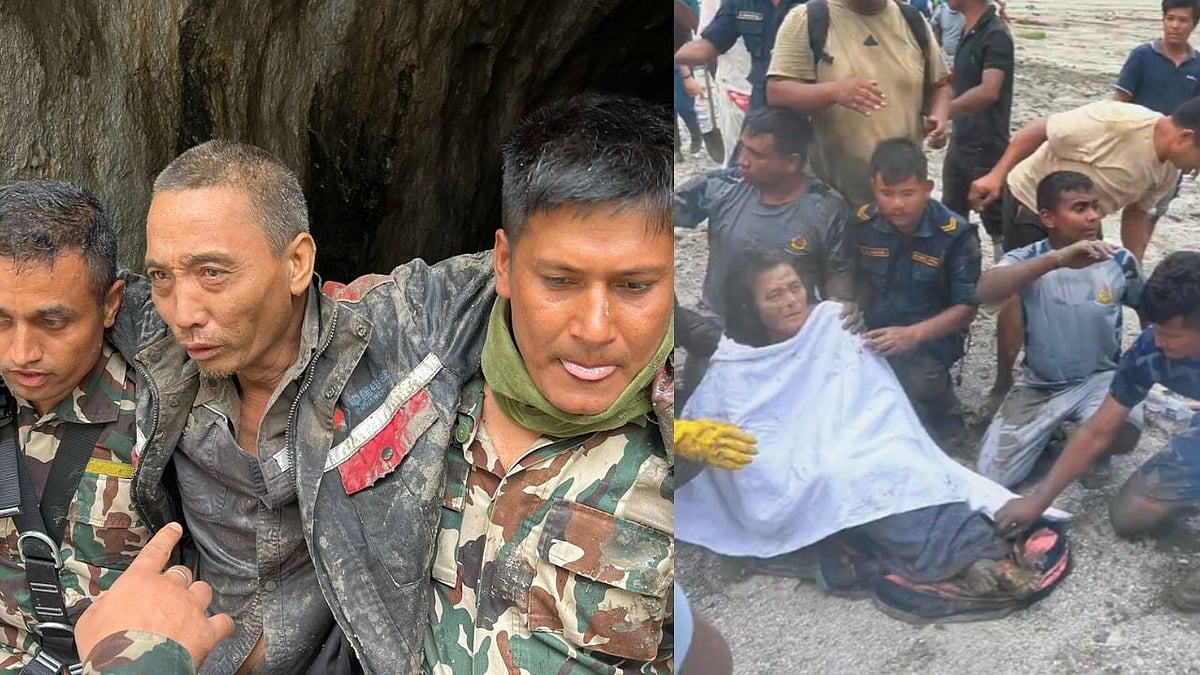
A Chinese national, Luhaitao, was rescued from a tunnel connected to a hydropower project in the Trishuli region of Nepal. The rescue operation was carried out by Nepalese military personnel, assisted by South Korean disaster-response specialists. Luhaitao was pulled to safety and airlifted by helicopter for medical treatment.
In another rescue, 64-year-old Chandika Shrestha was found alive inside a damaged house in Nuwakot. Emergency workers carried her out wrapped in a blanket before she was flown to Kathmandu for further treatment.
The latest rescues came a day after two Nepali hydropower workers, Sanjay Shah and Kabir Maharjan, were dramatically pulled from a mud-filled tunnel at the Upper Trishuli 3A hydropower project. The mechanical foreman and supervisor had reportedly been trapped for around nine days following the disaster.
Rescuers discovered signs of life after hearing voices underground. Using specialised digging techniques, satellite imagery and engineering assistance, teams gradually cleared the debris and reached the trapped workers. Both were airlifted to Kathmandu, with one reportedly in critical condition.
The devastating floods and debris flows struck Nepal on August 26 after a glacial collapse near the Nepal-Tibet border unleashed torrents of water, mud, rocks and ice through Himalayan valleys. The disaster devastated communities along the Trishuli River, destroying homes, roads, bridges and hydropower infrastructure.
With thousands still reported missing and rescue teams continuing to search collapsed structures and buried tunnels, the discovery of survivors has renewed hopes that others may still be found alive beneath the debris. The death toll from the floods has risen to 1,282, with many more feared trapped or dead.
The rescue efforts are being carried out by various teams, including the Nepali Army, Armed Police Force, and South Korean disaster-response specialists. The teams are using advanced technology, including satellite imagery and specialised digging equipment, to locate and rescue those trapped.
The floods have caused widespread destruction in Nepal, with many communities left without access to basic necessities like food, water, and shelter. The international community has pledged support to Nepal, with many countries providing aid and assistance to the affected areas.
As the rescue efforts continue, hopes are high that more survivors will be found. The discovery of the four survivors has brought new hope to the affected communities, and the rescue teams are working tirelessly to locate and rescue those still trapped.
The Nepali government has announced plans to provide relief and support to the affected communities, including food, shelter, and medical aid. The government has also announced an investigation into the cause of the floods and the damage caused by the disaster.
In conclusion, the rescue of the four survivors has brought new hope to the affected communities in Nepal. The rescue efforts are ongoing, and the international community is providing support to the affected areas. The Nepali government is working to provide relief and support to the affected communities, and an investigation has been announced into the cause of the floods and the damage caused by the disaster.
Frequently asked questions
What was the cause of the Nepal floods?
The floods were caused by a glacial collapse near the Nepal-Tibet border, which unleashed torrents of water, mud, rocks and ice through Himalayan valleys.
How many people are still missing after the floods?
Thousands of people are still reported missing, with many feared trapped or dead.