Airport UDF Fees Soar 300% in 10 Years
Flying out of Indian airports gets expensive, UDF fees rise sharply
'%3E%3Crect%20width%3D'96'%20height%3D'96'%20fill%3D'%23B3261E'%2F%3E%3Ccircle%20cx%3D'30'%20cy%3D'24'%20r%3D'44'%20fill%3D'%23fff'%20opacity%3D'.12'%2F%3E%3Ccircle%20cx%3D'60'%20cy%3D'74'%20r%3D'40'%20fill%3D'%23000'%20opacity%3D'.10'%2F%3E%3C%2Fg%3E%3Cg%20fill%3D'%23fff'%3E%3Crect%20x%3D'29'%20y%3D'49'%20width%3D'8'%20height%3D'19'%20rx%3D'1'%2F%3E%3Crect%20x%3D'39'%20y%3D'40'%20width%3D'9'%20height%3D'28'%20rx%3D'1'%2F%3E%3Crect%20x%3D'50'%20y%3D'45'%20width%3D'8'%20height%3D'23'%20rx%3D'1'%2F%3E%3Crect%20x%3D'60'%20y%3D'53'%20width%3D'7'%20height%3D'15'%20rx%3D'1'%2F%3E%3Crect%20x%3D'41'%20y%3D'34'%20width%3D'5'%20height%3D'6'%2F%3E%3C%2Fg%3E%3C%2Fsvg%3E)
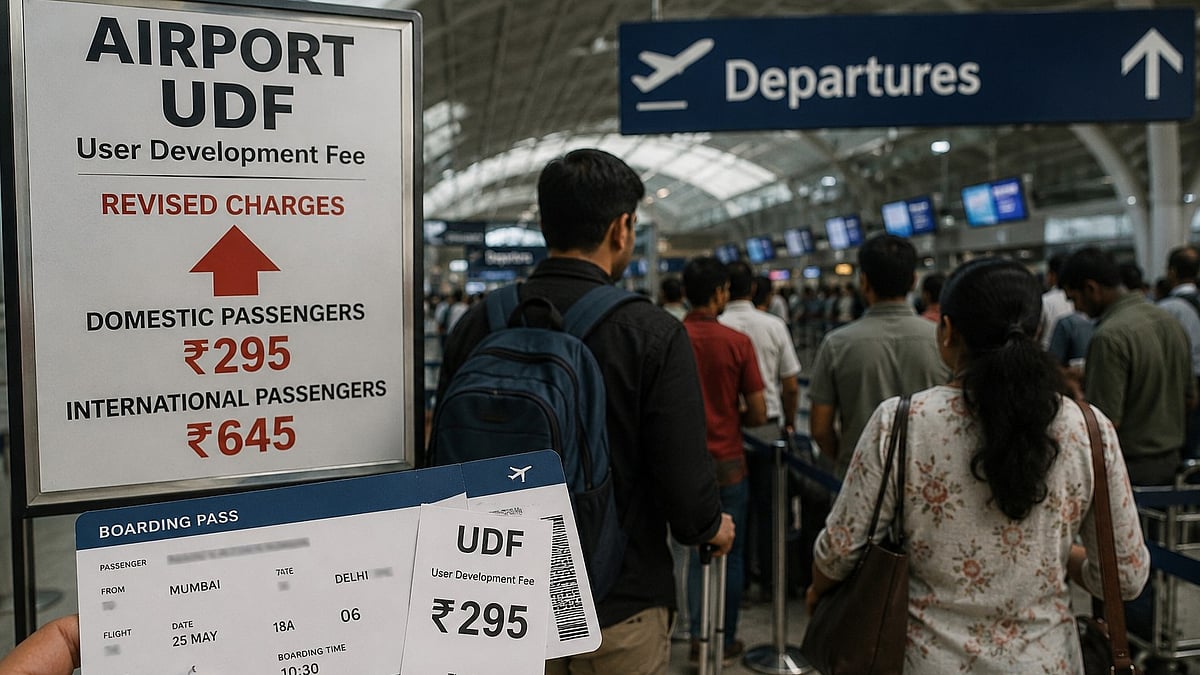
The cost of flying out of major Indian airports has increased significantly over the last four years, with User Development Fees (UDF) levied on outbound passengers seeing massive hikes across key hubs.
The UDF, determined by the Airports Economic Regulatory Authority of India (AERA), is collected directly from passengers by airport concessionaires to fund capital expenditure and operational costs.
According to figures provided in Lok Sabha regarding airport revenue operations, the domestic UDF across 10 major Indian airports has increased by 200% in the last four years, while UDF for international travellers has increased by 387%. The steepest hike was seen at Ahmedabad Airport, where international UDF increased by 1,300%, from Rs 85 to Rs 1,190.
Mumbai's Chhatrapati Shivaji Maharaj International Airport also saw a significant increase, with international UDF rising by 259% - from Rs 171 to Rs 615 for economy class and Rs 695 for business class. Other airports, such as Chennai, Bengaluru, and Hyderabad, also witnessed sharp spikes in UDF.
The Ministry of Civil Aviation defended the tariff determinations, stating that AERA follows a uniform regulatory framework across all major airports, regardless of whether they are operated by public or private joint ventures. The Ministry also responded to queries regarding potential cost escalations driven by concessionaire practices, asserting that AERA's regulatory framework is designed to prevent such practices.
The increase in UDF fees is likely to have a significant impact on air travel, making it more expensive for passengers to fly out of major Indian airports. The hike in fees is expected to generate additional revenue for airport operators, which will be used to fund capital expenditure and operational costs.
The Airports Economic Regulatory Authority of India (AERA) is responsible for determining the UDF fees, and the authority has stated that the fees are necessary to fund the development and maintenance of airport infrastructure. However, the sharp increase in UDF fees has raised concerns among passengers and airlines, who argue that the fees are too high and will have a negative impact on the aviation industry.
In contrast to the other airports, Kolkata's Netaji Subhash Chandra Bose International Airport was the sole major hub to post reductions across both domestic and international segments, with fees dropping by 6%.
The increase in UDF fees is a significant development in the Indian aviation industry, and it is likely to have far-reaching implications for air travel in the country. As the industry continues to grow and evolve, it will be important to monitor the impact of the UDF fee hike and to ensure that the fees are being used effectively to fund airport development and maintenance.
In conclusion, the hike in UDF fees at major Indian airports is a significant increase that will have a major impact on air travel. The fees are necessary to fund airport development and maintenance, but the sharp increase has raised concerns among passengers and airlines. As the industry continues to grow and evolve, it will be important to monitor the impact of the UDF fee hike and to ensure that the fees are being used effectively.
Frequently asked questions
What is User Development Fee (UDF)?
User Development Fee (UDF) is a fee levied on outbound passengers to fund capital expenditure and operational costs of airports.
Which airport saw the steepest hike in UDF fees?
Ahmedabad Airport saw the steepest hike in UDF fees, with a 1,300% increase.