Kharge Alleges RSS Dominance in Universities
Congress leader Mallikarjun Kharge sparks uproar in Rajya Sabha, accuses Centre of filling universities with RSS-affiliated individuals.
'%3E%3Crect%20width%3D'96'%20height%3D'96'%20fill%3D'%231A5276'%2F%3E%3Ccircle%20cx%3D'30'%20cy%3D'24'%20r%3D'44'%20fill%3D'%23fff'%20opacity%3D'.12'%2F%3E%3Ccircle%20cx%3D'60'%20cy%3D'74'%20r%3D'40'%20fill%3D'%23000'%20opacity%3D'.10'%2F%3E%3C%2Fg%3E%3Cg%20fill%3D'%23fff'%3E%3Cpath%20d%3D'M31%2041%20L48%2031%20L65%2041%20Z'%2F%3E%3Crect%20x%3D'33'%20y%3D'43'%20width%3D'4'%20height%3D'17'%2F%3E%3Crect%20x%3D'41'%20y%3D'43'%20width%3D'4'%20height%3D'17'%2F%3E%3Crect%20x%3D'51'%20y%3D'43'%20width%3D'4'%20height%3D'17'%2F%3E%3Crect%20x%3D'59'%20y%3D'43'%20width%3D'4'%20height%3D'17'%2F%3E%3Crect%20x%3D'30'%20y%3D'62'%20width%3D'36'%20height%3D'4'%20rx%3D'1'%2F%3E%3C%2Fg%3E%3C%2Fsvg%3E)
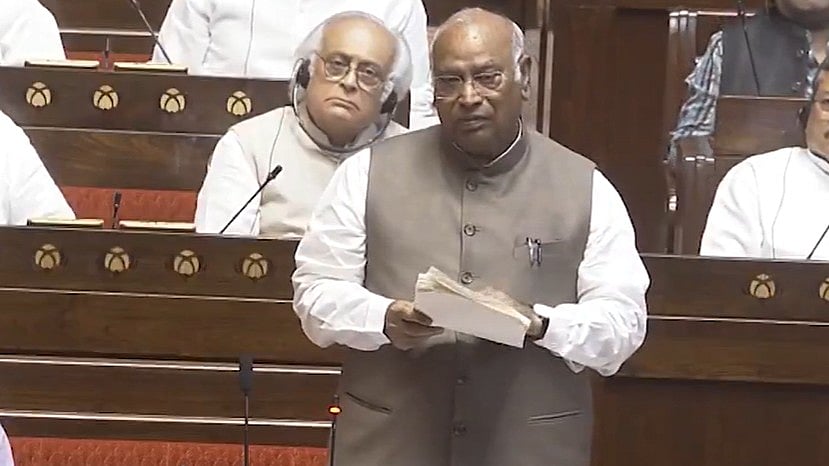
Mallikarjun Kharge, the Leader of Opposition in the Rajya Sabha and Congress president, triggered a heated debate in the House on Thursday. He alleged that the Centre was appointing RSS-affiliated individuals to key positions in educational institutions, compromising academic freedom and autonomy.
Kharge raised this issue during a debate on the Public Examinations (Prevention of Unfair Means) Amendment Bill, 2026. He accused the Centre of acting on examination reforms only after nationwide protests by students over repeated paper leaks.
The Congress leader stated that universities are not just places for granting degrees, but centres for new ideas, scientific temper, research, and healthy debate. He claimed that the academic freedom of the country's educational institutions is continuously weakening due to appointments driven by ideological affiliations rather than academic merit.
Kharge targeted the Centre, alleging that the Modi government was filling educational institutions with people affiliated to the Rashtriya Swayamsevak Sangh (RSS). He claimed that vice-chancellors are selected from the RSS, and professors are recruited after carefully screening whether they belong to the RSS.
The Congress leader emphasized that appointments should be based on a person's ability to teach and their expertise in their field, rather than their RSS affiliation. He alleged that there are no candidates from other communities or backgrounds, and only RSS-affiliated people are being recruited into universities.
Kharge's remarks triggered an uproar in the Rajya Sabha, with members of the Treasury benches objecting to the allegations. The Congress leader also turned to the issue of examination reforms, saying that the government was forced to respond only because of mounting public pressure from students.
He accused the government of prioritizing political survival over addressing the concerns of students. Kharge congratulated the country's students and youth, saying that their struggle has borne fruit, and the government has been forced to take action.
The debate highlights the ongoing concerns about the autonomy of educational institutions in India. The issue of RSS dominance in universities has been a topic of discussion in recent years, with many alleging that the Centre is attempting to exert control over educational institutions.
The Public Examinations (Prevention of Unfair Means) Amendment Bill, 2026, aims to address the issue of repeated paper leaks and promote transparency in examinations. However, the debate in the Rajya Sabha has brought attention to the broader issue of academic freedom and autonomy in educational institutions.
The Centre has been accused of compromising the autonomy of educational institutions by appointing individuals with RSS affiliations to key positions. This has raised concerns about the impact on academic freedom, research, and the overall quality of education in India.
As the debate continues, it remains to be seen how the government will respond to the allegations and address the concerns of students and educators. The issue of academic freedom and autonomy in educational institutions is a critical one, and its resolution will have a significant impact on the future of education in India.
In conclusion, the allegations made by Kharge have sparked a heated debate in the Rajya Sabha, highlighting the concerns about the autonomy of educational institutions in India. The issue of RSS dominance in universities is a complex one, and its resolution will require a nuanced approach that balances the need for academic freedom with the need for transparency and accountability in educational institutions.
Frequently asked questions
What is the issue of RSS dominance in universities?
The issue refers to the alleged appointment of RSS-affiliated individuals to key positions in educational institutions, compromising academic freedom and autonomy.
What is the Public Examinations (Prevention of Unfair Means) Amendment Bill, 2026?
The bill aims to address the issue of repeated paper leaks and promote transparency in examinations.