Mumbai Court Denies Bail To Ex-Lodha Director
Rajendra Lodha accused of ₹181-crore cheating case, bail denied due to ongoing investigation and potential witness influence.

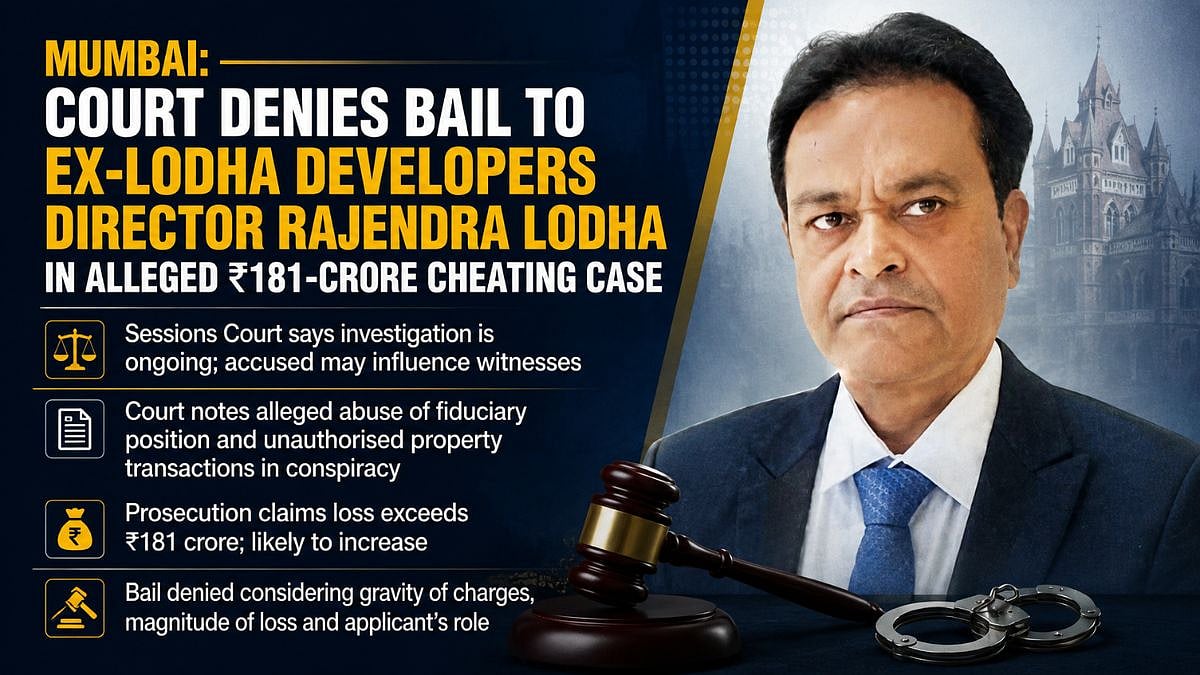
A Mumbai sessions court has refused to grant bail to Rajendra Lodha, the former director of Lodha Developers Ltd., who was arrested by the Mumbai Police for allegedly cheating the company. The court's decision was made on July 6, with the judge citing the gravity of the charges and the potential for Lodha to influence witnesses.
Lodha had sought bail, claiming that he is innocent and has been falsely implicated in the case. His lawyers argued that the prosecution's case is entirely documentary in nature and that no material establishes Lodha's criminal intent. They also contended that every act performed by Lodha was within the authority conferred by the Board of Directors and in accordance with the resolutions passed by the company.
However, the prosecution opposed the plea, with senior counsel Pranav Badheka arguing that Lodha is the principal architect of a well-planned conspiracy that resulted in the dishonest alienation of lands belonging to the complainant company. The prosecution also pointed out that the magnitude of the fraud is enormous, with the loss presently quantified exceeding ₹181 crore.
The court considered the objections and observed that the material collected during the investigation prima facie discloses that Lodha abused his authority as director of the company by entering into unauthorized transactions relating to valuable immovable properties. The court also noted that the pendency of further investigation and the likelihood of influencing material witnesses meant that Lodha's incarceration was justified at this stage.
The case has significant implications for the real estate industry in Mumbai, with the alleged fraud involving lands worth hundreds of crores. The court's decision to deny bail to Lodha is a setback for the former director, who will now have to remain in custody until the trial commences.
The trial is expected to be a lengthy one, with around 80 witnesses cited. Lodha's lawyers had argued that the trial is not likely to commence in the near future and that continued incarceration would amount to pre-trial punishment. However, the court was unmoved by this argument, citing the gravity of the charges and the potential for Lodha to influence witnesses.
Lodha's health was also a concern, with his lawyers raising medical grounds and contending that he is suffering from serious ailments, including diabetes, coronary artery disease, and hypertension. However, the court did not consider this sufficient reason to grant bail, given the seriousness of the charges against him.
The case will now proceed to trial, with the prosecution seeking to prove that Lodha was involved in a well-planned conspiracy to cheat the company. The outcome of the trial will have significant implications for the real estate industry in Mumbai and will be closely watched by industry observers.
In the meantime, Lodha will remain in custody, a decision that reflects the seriousness with which the court views the charges against him. The case is a reminder of the importance of corporate governance and the need for companies to ensure that their directors and officers are acting in the best interests of the company and its shareholders.
As the trial approaches, it is likely that more details will emerge about the alleged conspiracy and the role that Lodha played in it. The case has already generated significant interest and attention, and it is likely that it will continue to be closely watched in the coming months.
The Mumbai Police have been investigating the case for several months, and their efforts have resulted in the arrest of several individuals, including Lodha. The police have alleged that the conspiracy involved the dishonest alienation of lands belonging to the complainant company, resulting in a loss of over ₹181 crore.
The case is a significant one for the Mumbai Police, who have been working to crack down on corporate fraud and corruption in the city. The arrest of Lodha and the denial of his bail application are a testament to the police's commitment to bringing those responsible for corporate fraud to justice.
In conclusion, the Mumbai sessions court's decision to deny bail to Rajendra Lodha is a significant development in the ₹181-crore cheating case. The case has significant implications for the real estate industry in Mumbai and will be closely watched in the coming months. The court's decision reflects the seriousness with which it views the charges against Lodha and the potential for him to influence witnesses. As the trial approaches, it is likely that more details will emerge about the alleged conspiracy and the role that Lodha played in it.