ISKCON Defends Flexible Rath Yatra Dates
ISKCON defends its practice of conducting Rath Yatra on different dates, amid dispute with Puri temple. The organisation claims its celebrations are sanctioned by Hindu scriptures.
'%3E%3Crect%20width%3D'96'%20height%3D'96'%20fill%3D'%23B3261E'%2F%3E%3Ccircle%20cx%3D'30'%20cy%3D'24'%20r%3D'44'%20fill%3D'%23fff'%20opacity%3D'.12'%2F%3E%3Ccircle%20cx%3D'60'%20cy%3D'74'%20r%3D'40'%20fill%3D'%23000'%20opacity%3D'.10'%2F%3E%3C%2Fg%3E%3Cg%20fill%3D'%23fff'%3E%3Crect%20x%3D'29'%20y%3D'49'%20width%3D'8'%20height%3D'19'%20rx%3D'1'%2F%3E%3Crect%20x%3D'39'%20y%3D'40'%20width%3D'9'%20height%3D'28'%20rx%3D'1'%2F%3E%3Crect%20x%3D'50'%20y%3D'45'%20width%3D'8'%20height%3D'23'%20rx%3D'1'%2F%3E%3Crect%20x%3D'60'%20y%3D'53'%20width%3D'7'%20height%3D'15'%20rx%3D'1'%2F%3E%3Crect%20x%3D'41'%20y%3D'34'%20width%3D'5'%20height%3D'6'%2F%3E%3C%2Fg%3E%3C%2Fsvg%3E)
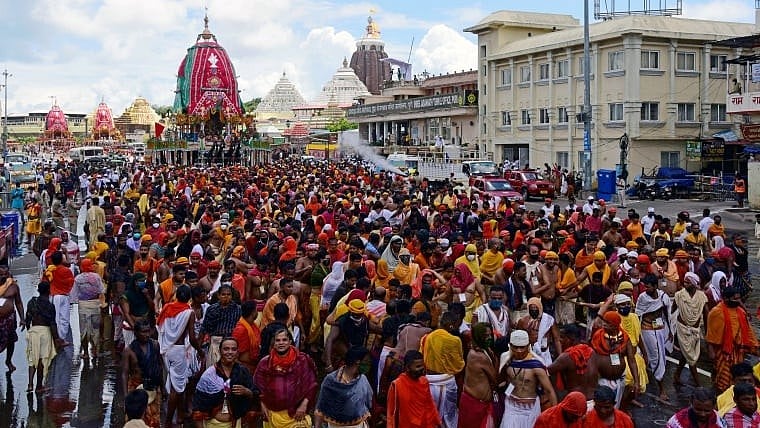
The International Society for Krishna Consciousness (ISKCON) has defended its practice of conducting Lord Jagannath's Rath Yatra on dates different from those observed at the Puri temple. This comes after Puri's Gajapati Maharaja Dibyasingha Deb urged ISKCON to align its overseas observances of Snana Yatra and Rath Yatra with the sacred tithis prescribed by the Jagannath temple tradition.
In a letter dated July 4, the Gajapati Maharaja requested ISKCON to review its decision to hold overseas Rath Yatras on dates determined by local practical considerations rather than the Puri temple calendar. However, ISKCON's Governing Body Commission (GBC) chairman Madhusevita Dasa declined to revisit the organisation's policy, stating that there is no more to add to the discussion.
ISKCON has cited scriptural approval for its celebrations, claiming that its scholars have held discussions with scholars of the Shree Jagannath Temple Administration (SJTA) and established that its Rath Yatra festivals are fully permitted and conducted in accordance with the shastras. The organisation has been conducting Rath Yatras on flexible dates abroad for nearly six decades, spreading Jagannath devotion across more than 100 countries.
The Gajapati Maharaja has maintained that the traditional dates of Snana Yatra and Rath Yatra, as prescribed by the Puri temple tradition, cannot be altered. He believes that conducting the festivals on different dates hurts the sentiments of millions of Jagannath devotees and undermines the sanctity of centuries-old rituals. However, ISKCON has argued that the essence of Rath Yatra is to enable Lord Jagannath to bestow His blessings on all devotees without discrimination.
While ISKCON follows the Puri temple calendar in India, the organisation claims that overseas celebrations face practical constraints, including administrative permissions, weather conditions, and local regulations, making flexibility in scheduling necessary. The dispute between ISKCON and the Puri temple highlights the challenges of balancing traditional practices with modern practicalities.
The Rath Yatra festival is an important event in the Hindu calendar, attracting millions of devotees worldwide. The festival commemorates the journey of Lord Jagannath, a form of Lord Krishna, through the streets of Puri. The traditional dates of the festival are determined by the lunar calendar and are considered sacred by devotees.
In recent years, ISKCON has expanded its reach globally, conducting Rath Yatras in over 100 countries. The organisation's flexible approach to scheduling has enabled it to reach a wider audience and spread Jagannath devotion to new regions. However, the dispute with the Puri temple has raised questions about the organisation's approach to traditional practices.
The issue has sparked a debate about the importance of adhering to traditional practices versus adapting to modern circumstances. While some argue that traditional practices should be preserved at all costs, others believe that flexibility is necessary to ensure the continued relevance and accessibility of religious festivals.
In conclusion, the dispute between ISKCON and the Puri temple over the scheduling of Rath Yatra highlights the complexities of balancing traditional practices with modern practicalities. As the organisation continues to expand its global reach, it will be important for ISKCON to navigate these challenges while remaining true to its spiritual purpose.
The significance of this issue extends beyond the realm of religious festivals, highlighting the importance of cultural sensitivity and adaptability in a rapidly changing world. As India becomes increasingly globalised, it will be important for organisations like ISKCON to find ways to balance traditional practices with modern circumstances, ensuring that cultural heritage is preserved while also remaining relevant to new generations of devotees.