India's Bullet Train Cost Doubles to Rs 2.1 Lakh Cr
India's bullet train project cost doubles, indigenous trains in development
'%3E%3Crect%20width%3D'96'%20height%3D'96'%20fill%3D'%230B6E4F'%2F%3E%3Ccircle%20cx%3D'30'%20cy%3D'24'%20r%3D'44'%20fill%3D'%23fff'%20opacity%3D'.12'%2F%3E%3Ccircle%20cx%3D'60'%20cy%3D'74'%20r%3D'40'%20fill%3D'%23000'%20opacity%3D'.10'%2F%3E%3C%2Fg%3E%3Cg%20fill%3D'none'%20stroke%3D'%23fff'%20stroke-width%3D'3.2'%20stroke-linecap%3D'round'%20stroke-linejoin%3D'round'%3E%3Cpolyline%20points%3D'31%2C59%2041%2C49%2049%2C54%2063%2C37'%2F%3E%3Cpolyline%20points%3D'55%2C37%2063%2C37%2063%2C45'%2F%3E%3C%2Fg%3E%3C%2Fsvg%3E)
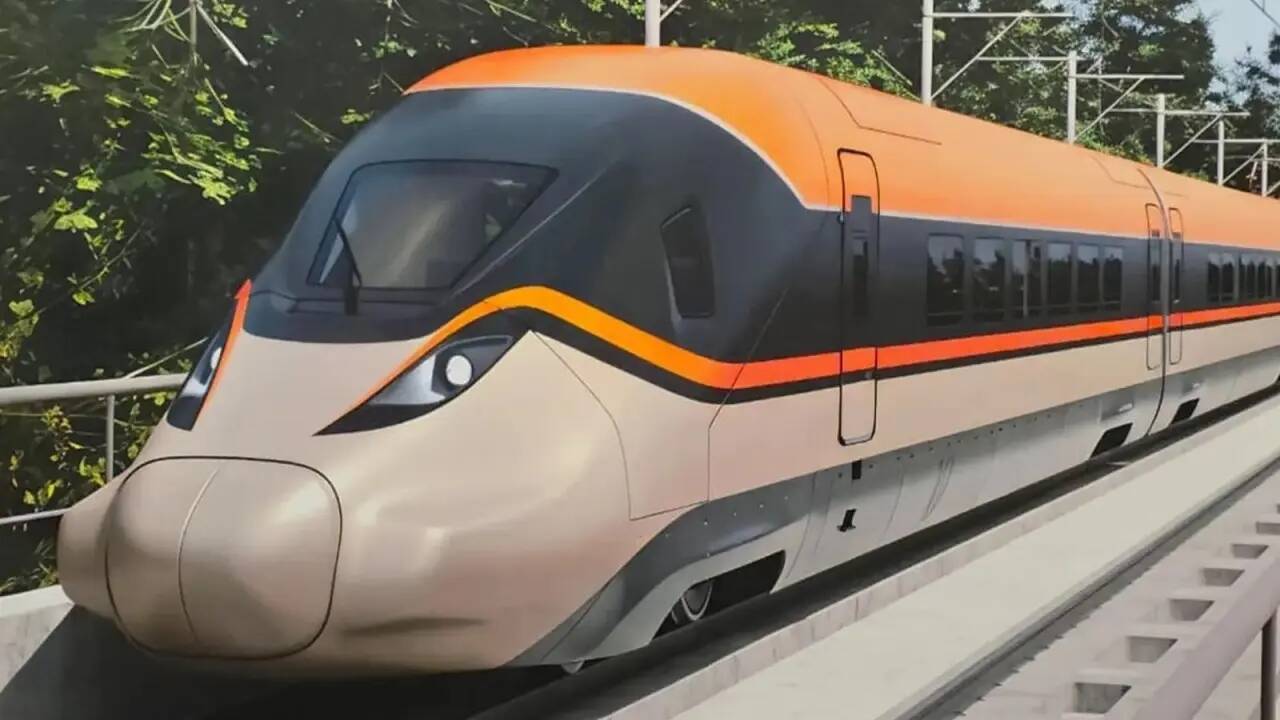
The cost of India's first bullet train project has increased significantly, from an initial estimate of Rs 1.1 lakh crore to a revised estimate of Rs 2.1 lakh crore. This project is not only aimed at introducing high-speed rail travel in India but also serves as a platform for the country's own high-speed rail ambitions.
The bullet train project, which aims to connect major cities in India with high-speed rail links, is being developed with the help of foreign technology and investment. However, India is also working on developing its own indigenous high-speed trains.
BEML and ICF, two Indian companies, are collaborating to develop India's first indigenous high-speed trainset. The first trainset is expected to be rolled out in 2027. These trains are being designed to operate at speeds of around 250 kmph, with a design speed of 280 kmph.
The development of indigenous high-speed trains is a significant step towards achieving India's goal of becoming self-sufficient in the production of high-speed rail technology. This will not only reduce the country's dependence on foreign technology but also create new opportunities for Indian companies in the rail sector.
The bullet train project has been in the works for several years, with the initial estimate of Rs 1.1 lakh crore being announced in 2015. However, the project has faced several delays and cost overruns, leading to the revised estimate of Rs 2.1 lakh crore.
Despite the increased cost, the project is expected to have a significant impact on India's transportation sector. The introduction of high-speed rail travel is expected to reduce travel times between major cities, making it easier and faster for people to travel across the country.
The project is also expected to create new job opportunities and stimulate economic growth in the regions where the high-speed rail links will be established. Overall, the bullet train project is an important step towards modernizing India's transportation sector and achieving the country's goal of becoming a major player in the global rail industry.
In the context of India's transportation sector, the bullet train project is a significant development. The country's rail network is one of the largest in the world, with a vast network of tracks and trains connecting major cities and towns. However, the network is still largely based on traditional rail technology, with most trains operating at speeds of around 100-150 kmph.
The introduction of high-speed rail travel is expected to revolutionize the way people travel in India, making it faster, easier, and more convenient. The project is also expected to have a significant impact on the country's economy, with the creation of new job opportunities and the stimulation of economic growth in the regions where the high-speed rail links will be established.
In conclusion, the bullet train project is an important development in India's transportation sector, with the potential to revolutionize the way people travel in the country. The project's increased cost is a significant concern, but the potential benefits of the project make it a worthwhile investment for the country's future.
The project's impact on Mumbai, as a major city in India, will be significant. The city is expected to be one of the major hubs for the high-speed rail network, with several trains operating from the city to other major cities in the country. The introduction of high-speed rail travel is expected to reduce travel times between Mumbai and other cities, making it easier and faster for people to travel to and from the city.
Overall, the bullet train project is an exciting development for India's transportation sector, with the potential to transform the way people travel in the country. The project's increased cost is a concern, but the potential benefits make it a worthwhile investment for the country's future.
Frequently asked questions
What is the revised cost of the bullet train project?
The revised cost of the bullet train project is Rs 2.1 lakh crore.
When is the first indigenous high-speed trainset expected to be rolled out?
The first indigenous high-speed trainset is expected to be rolled out in 2027.