India Drops Beggar Classification in Census
India's latest census removes beggar classification, reflecting progress towards Viksit Bharat. But unemployment persists.
'%3E%3Crect%20width%3D'96'%20height%3D'96'%20fill%3D'%231A5276'%2F%3E%3Ccircle%20cx%3D'30'%20cy%3D'24'%20r%3D'44'%20fill%3D'%23fff'%20opacity%3D'.12'%2F%3E%3Ccircle%20cx%3D'60'%20cy%3D'74'%20r%3D'40'%20fill%3D'%23000'%20opacity%3D'.10'%2F%3E%3C%2Fg%3E%3Cg%20fill%3D'%23fff'%3E%3Cpath%20d%3D'M31%2041%20L48%2031%20L65%2041%20Z'%2F%3E%3Crect%20x%3D'33'%20y%3D'43'%20width%3D'4'%20height%3D'17'%2F%3E%3Crect%20x%3D'41'%20y%3D'43'%20width%3D'4'%20height%3D'17'%2F%3E%3Crect%20x%3D'51'%20y%3D'43'%20width%3D'4'%20height%3D'17'%2F%3E%3Crect%20x%3D'59'%20y%3D'43'%20width%3D'4'%20height%3D'17'%2F%3E%3Crect%20x%3D'30'%20y%3D'62'%20width%3D'36'%20height%3D'4'%20rx%3D'1'%2F%3E%3C%2Fg%3E%3C%2Fsvg%3E)
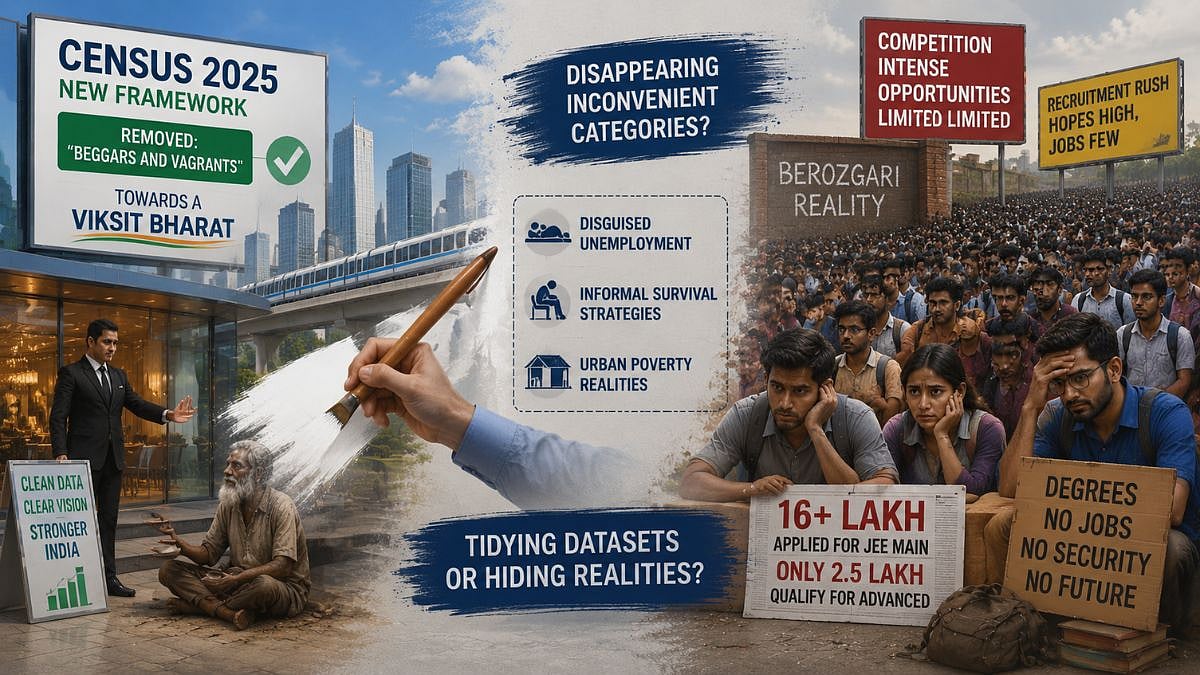
The latest census framework in India has decided to drop the separate classification of 'beggars and vagrants' from its questionnaire. This move is seen as a step towards a more progressive and developed India, where beggars have no place. According to the government, the number of beggars has decreased significantly, with less than five lakhs remaining.
However, despite this progress, the issue of unemployment remains a major concern. The phenomenon of disguised unemployment, where citizens are forced to adapt to harsh living conditions, is still prevalent. The employment landscape in India is marked by a hyper-competitive vacuum, where the drop from a graduate desk-job aspirant to destitution is steep and sudden.
The recurring spectacle of mass unemployment in states like Uttar Pradesh and Bihar, and the stampedes witnessed during Indian Railways recruitment drives, are a testament to the profound market imbalance. Lakhs of applicants, including those with advanced degrees, are competing for a handful of menial roles. This highlights the need for a more nuanced approach to addressing unemployment, rather than simply removing classifications from the census.
The government's decision to drop the beggar classification is seen as a creative bureaucratic logic, but it may not address the underlying issues of unemployment and poverty. The nation's employment landscape is complex, and requires a more comprehensive approach to solve. The issue of unemployment is not just a statistical aberration, but a harsh reality that affects millions of people.
As the country moves towards a more developed and progressive future, it is essential to confront the harsher backdrop of unemployment and poverty. The government's goal of achieving Viksit Bharat by 2047 is ambitious, but it requires a more nuanced approach to addressing the systemic frictions that exist in the employment landscape.
The removal of the beggar classification from the census is a welcome move, but it is only the first step towards addressing the issue of unemployment. The government needs to take a more comprehensive approach to solving this problem, rather than just relying on statistical adjustments. The future of India's employment landscape depends on it.
In conclusion, while the removal of the beggar classification from the census is a positive step, it is essential to address the underlying issues of unemployment and poverty. The government needs to take a more nuanced approach to solving this problem, and work towards creating a more inclusive and progressive employment landscape.
The issue of unemployment is a complex one, and requires a comprehensive approach to solve. The government's decision to drop the beggar classification is a step in the right direction, but it is only the beginning. As the country moves towards a more developed and progressive future, it is essential to confront the harsher backdrop of unemployment and poverty, and work towards creating a more inclusive and equitable society.
The future of India's employment landscape is uncertain, but one thing is clear: the government needs to take a more comprehensive approach to addressing the issue of unemployment. The removal of the beggar classification from the census is a welcome move, but it is only the first step towards creating a more progressive and developed India.
The country's goal of achieving Viksit Bharat by 2047 is ambitious, but it requires a more nuanced approach to addressing the systemic frictions that exist in the employment landscape. The government needs to work towards creating a more inclusive and equitable society, where everyone has access to opportunities and resources. Only then can India truly achieve its goal of becoming a developed and progressive nation.
In the end, the removal of the beggar classification from the census is a positive step, but it is only the beginning. The government needs to take a more comprehensive approach to addressing the issue of unemployment, and work towards creating a more inclusive and progressive employment landscape. The future of India depends on it.
Frequently asked questions
What is the significance of dropping beggar classification in the census?
The move reflects India's progress towards a more developed and progressive society, but it may not address the underlying issues of unemployment and poverty.
What is the current state of unemployment in India?
The issue of unemployment remains a major concern, with a hyper-competitive vacuum and a steep drop from graduate desk-job aspirants to destitution.