Supreme Court Rules Married Daughters Eligible for Compassionate Appointments
Married daughters can't be denied compassionate appointments, Supreme Court rules. Bihar policy excluding them is unconstitutional.
'%3E%3Crect%20width%3D'96'%20height%3D'96'%20fill%3D'%231A5276'%2F%3E%3Ccircle%20cx%3D'30'%20cy%3D'24'%20r%3D'44'%20fill%3D'%23fff'%20opacity%3D'.12'%2F%3E%3Ccircle%20cx%3D'60'%20cy%3D'74'%20r%3D'40'%20fill%3D'%23000'%20opacity%3D'.10'%2F%3E%3C%2Fg%3E%3Cg%20fill%3D'%23fff'%3E%3Cpath%20d%3D'M31%2041%20L48%2031%20L65%2041%20Z'%2F%3E%3Crect%20x%3D'33'%20y%3D'43'%20width%3D'4'%20height%3D'17'%2F%3E%3Crect%20x%3D'41'%20y%3D'43'%20width%3D'4'%20height%3D'17'%2F%3E%3Crect%20x%3D'51'%20y%3D'43'%20width%3D'4'%20height%3D'17'%2F%3E%3Crect%20x%3D'59'%20y%3D'43'%20width%3D'4'%20height%3D'17'%2F%3E%3Crect%20x%3D'30'%20y%3D'62'%20width%3D'36'%20height%3D'4'%20rx%3D'1'%2F%3E%3C%2Fg%3E%3C%2Fsvg%3E)
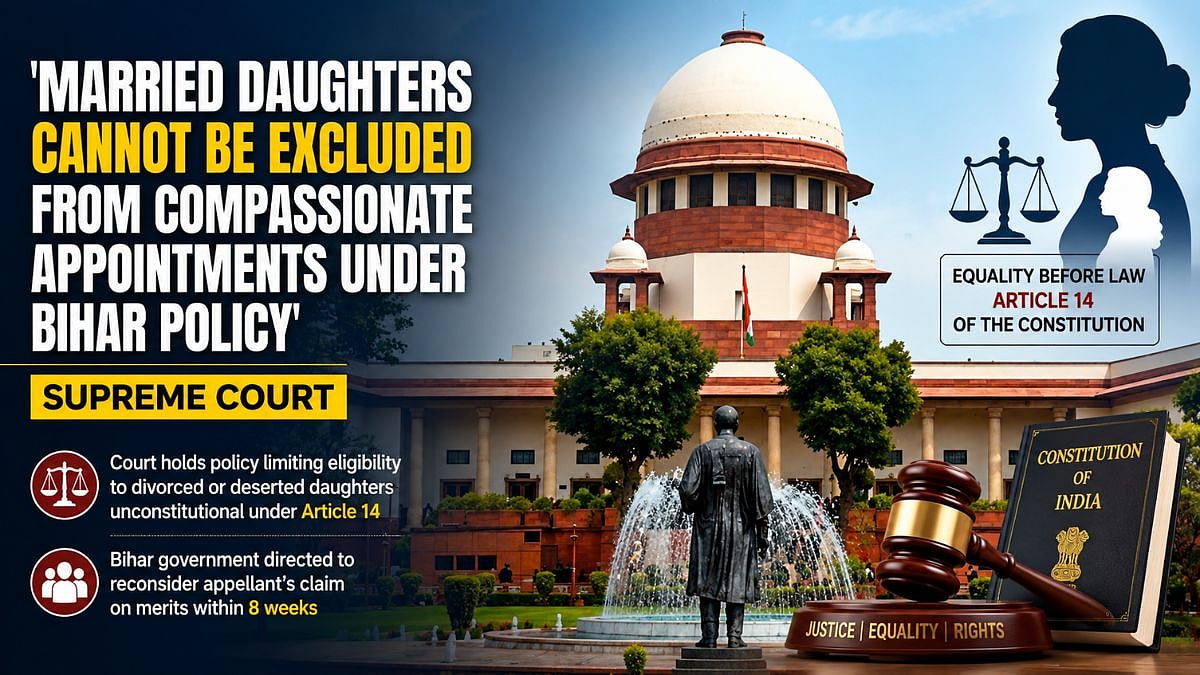
The Supreme Court has ruled that married daughters cannot be excluded from consideration for compassionate appointments under the Bihar government's policy.
The court's decision came in response to an appeal filed by Sayara Khatoon and her daughter, who were denied a compassionate appointment following the death of the daughter's father. The Bihar government's policy, introduced on December 10, 2014, allowed only divorced or deserted daughters to be eligible for such appointments.
The Supreme Court bench, comprising Justices M.M. Sundresh and Prasanna B. Varale, held that this policy was unconstitutional and violative of Article 14 of the Constitution. The court observed that any distinction between sons and daughters in such matters is constitutionally impermissible.
The state government had also rejected the claim on the ground that the deceased employee's brother had objected to the appointment. However, the Supreme Court noted that the brother had earlier furnished a no-objection certificate, rendering this ground for rejection invalid.
The court rejected the presumption underlying the Bihar government's policy, which assumed that a married daughter would sever her ties with her parental family and reside with her husband in her matrimonial home. The court observed that this presumption is not supported by law and that a married daughter's relationship with her parental family should not be a barrier to her eligibility for a compassionate appointment.
The Supreme Court directed the Bihar authorities to reconsider the appellant's case on merits within a period of eight weeks from the date of receipt of the court's order. This decision is expected to have significant implications for the eligibility of married daughters for compassionate appointments in Bihar.
The Bihar government's policy had been challenged on the grounds that it was discriminatory and unconstitutional. The Supreme Court's decision upholds the principle of equal treatment for all children, regardless of their marital status.
This ruling is a significant development in the context of compassionate appointments, which are made to provide financial support to the families of deceased government employees. The Supreme Court's decision ensures that married daughters are not unfairly excluded from consideration for such appointments.
In conclusion, the Supreme Court's ruling is a landmark decision that promotes gender equality and challenges discriminatory policies. It is expected to have far-reaching implications for the rights of married daughters in India.
The decision also highlights the importance of reconsidering outdated policies that perpetuate gender-based discrimination. The Bihar government's policy, which excluded married daughters from eligibility for compassionate appointments, has been deemed unconstitutional and violative of Article 14 of the Constitution.
Overall, the Supreme Court's ruling is a significant step forward in promoting gender equality and challenging discriminatory policies in India. It is expected to have a positive impact on the lives of married daughters and their families, who will now be eligible for compassionate appointments on an equal footing with their male siblings.
Frequently asked questions
Can married daughters be excluded from compassionate appointments in Bihar?
No, the Supreme Court has ruled that married daughters cannot be excluded from consideration for compassionate appointments in Bihar.
What was the basis for the Bihar government's policy excluding married daughters?
The policy assumed that a married daughter would sever her ties with her parental family and reside with her husband in her matrimonial home, which the Supreme Court deemed an unconstitutional presumption.