Parliamentary Panel Flags Curriculum Transition Issues
A parliamentary panel highlights gaps in curriculum implementation, academic stress among students.
'%3E%3Crect%20width%3D'96'%20height%3D'96'%20fill%3D'%231A5276'%2F%3E%3Ccircle%20cx%3D'30'%20cy%3D'24'%20r%3D'44'%20fill%3D'%23fff'%20opacity%3D'.12'%2F%3E%3Ccircle%20cx%3D'60'%20cy%3D'74'%20r%3D'40'%20fill%3D'%23000'%20opacity%3D'.10'%2F%3E%3C%2Fg%3E%3Cg%20fill%3D'%23fff'%3E%3Cpath%20d%3D'M31%2041%20L48%2031%20L65%2041%20Z'%2F%3E%3Crect%20x%3D'33'%20y%3D'43'%20width%3D'4'%20height%3D'17'%2F%3E%3Crect%20x%3D'41'%20y%3D'43'%20width%3D'4'%20height%3D'17'%2F%3E%3Crect%20x%3D'51'%20y%3D'43'%20width%3D'4'%20height%3D'17'%2F%3E%3Crect%20x%3D'59'%20y%3D'43'%20width%3D'4'%20height%3D'17'%2F%3E%3Crect%20x%3D'30'%20y%3D'62'%20width%3D'36'%20height%3D'4'%20rx%3D'1'%2F%3E%3C%2Fg%3E%3C%2Fsvg%3E)
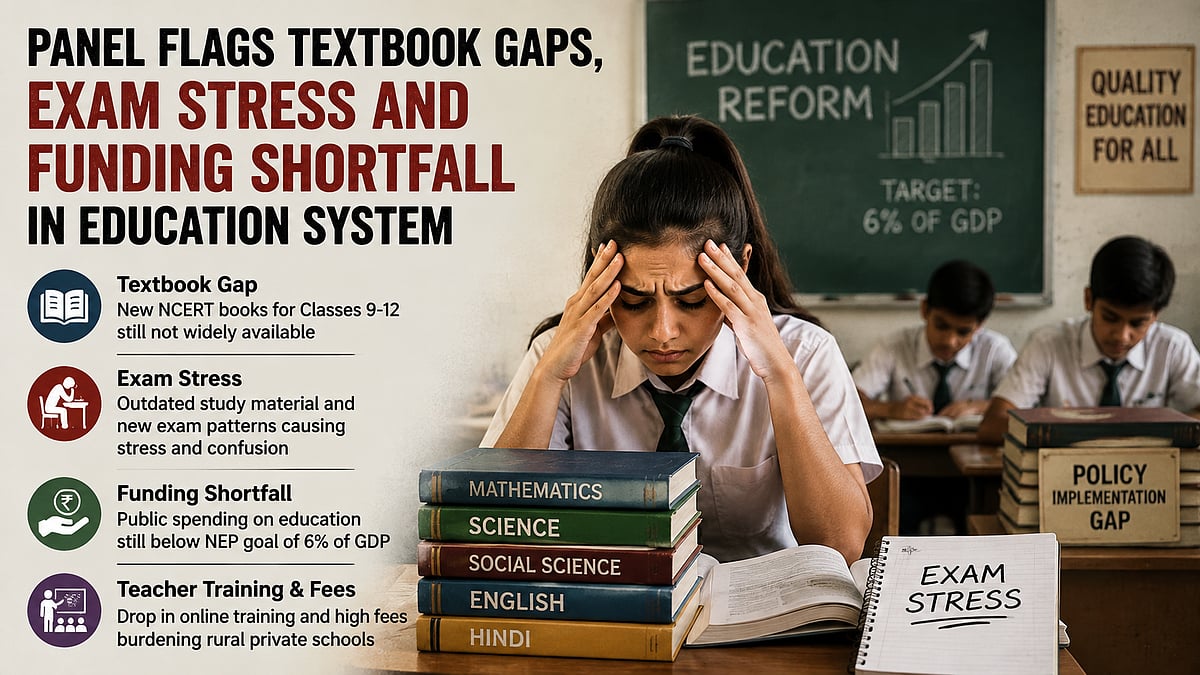
A parliamentary panel has identified significant gaps between curriculum designing and implementation for classes 9 to 12, leading to academic stress and confusion among students.
The panel's observations are part of the Tenth Report of the Committee on Estimates on 'Budget and Policy Aspects for Providing Affordable and Quality Education in the Country including Review of CBSE'.
The report notes that the Central Board of Secondary Education (CBSE) has onboarded the curriculum framework for Grades 9 to 12, aligned with the New Education Policy (NEP) 2020 and the National Curriculum Framework (NCF) 2023.
However, the non-availability of textbooks and new, application-based Board examination patterns are creating significant academic stress and confusion for students, especially those appearing for classes 10 and 12 examinations.
The committee has urged the Education Ministry to take immediate steps to resolve this transition gap and fast-track the development, printing, and nationwide distribution of new textbooks for all grades.
The panel has also recommended the launch of a nationwide teacher-capacity building programme to train educators on application-based pedagogy.
The CBSE conducts capacity building programmes nationwide to support teachers' development, with all teachers and principals required to complete a minimum of 50 hours training per year.
However, the committee has noted a drastic drop in online training of teachers from over 5.3 million in 2022 to just around 162,814 in 2025.
The panel has expressed concern that private affiliated schools in rural and difficult areas have to pay a general training fee plus an extra Rs 700 per teacher for single-day workshops.
The committee's report highlights the need for increased spending on higher education and addressing the curriculum transition challenges to provide affordable and quality education in the country.
The New Education Policy (NEP) 2020 aims to transform the education system in India, with a focus on accessibility, equity, and quality.
The National Curriculum Framework (NCF) 2023 provides a framework for curriculum development, with an emphasis on application-based learning and critical thinking.
The parliamentary panel's report emphasizes the need for effective implementation of these policies to ensure that students receive a high-quality education.
In conclusion, the parliamentary panel's report highlights the challenges in curriculum implementation and the need for increased spending on higher education to provide affordable and quality education in the country.
Frequently asked questions
What are the challenges in curriculum implementation?
The non-availability of textbooks and new, application-based Board examination patterns are creating significant academic stress and confusion for students.
What has the parliamentary panel recommended?
The panel has recommended the launch of a nationwide teacher-capacity building programme and fast-tracking the development, printing, and nationwide distribution of new textbooks for all grades.