Parijata Flowers Hold Special Significance in Hindu Traditions
Parijata flowers are offered to deities after falling, linked to Lord Krishna
'%3E%3Crect%20width%3D'96'%20height%3D'96'%20fill%3D'%23B3261E'%2F%3E%3Ccircle%20cx%3D'30'%20cy%3D'24'%20r%3D'44'%20fill%3D'%23fff'%20opacity%3D'.12'%2F%3E%3Ccircle%20cx%3D'60'%20cy%3D'74'%20r%3D'40'%20fill%3D'%23000'%20opacity%3D'.10'%2F%3E%3C%2Fg%3E%3Cg%20fill%3D'%23fff'%3E%3Crect%20x%3D'29'%20y%3D'49'%20width%3D'8'%20height%3D'19'%20rx%3D'1'%2F%3E%3Crect%20x%3D'39'%20y%3D'40'%20width%3D'9'%20height%3D'28'%20rx%3D'1'%2F%3E%3Crect%20x%3D'50'%20y%3D'45'%20width%3D'8'%20height%3D'23'%20rx%3D'1'%2F%3E%3Crect%20x%3D'60'%20y%3D'53'%20width%3D'7'%20height%3D'15'%20rx%3D'1'%2F%3E%3Crect%20x%3D'41'%20y%3D'34'%20width%3D'5'%20height%3D'6'%2F%3E%3C%2Fg%3E%3C%2Fsvg%3E)
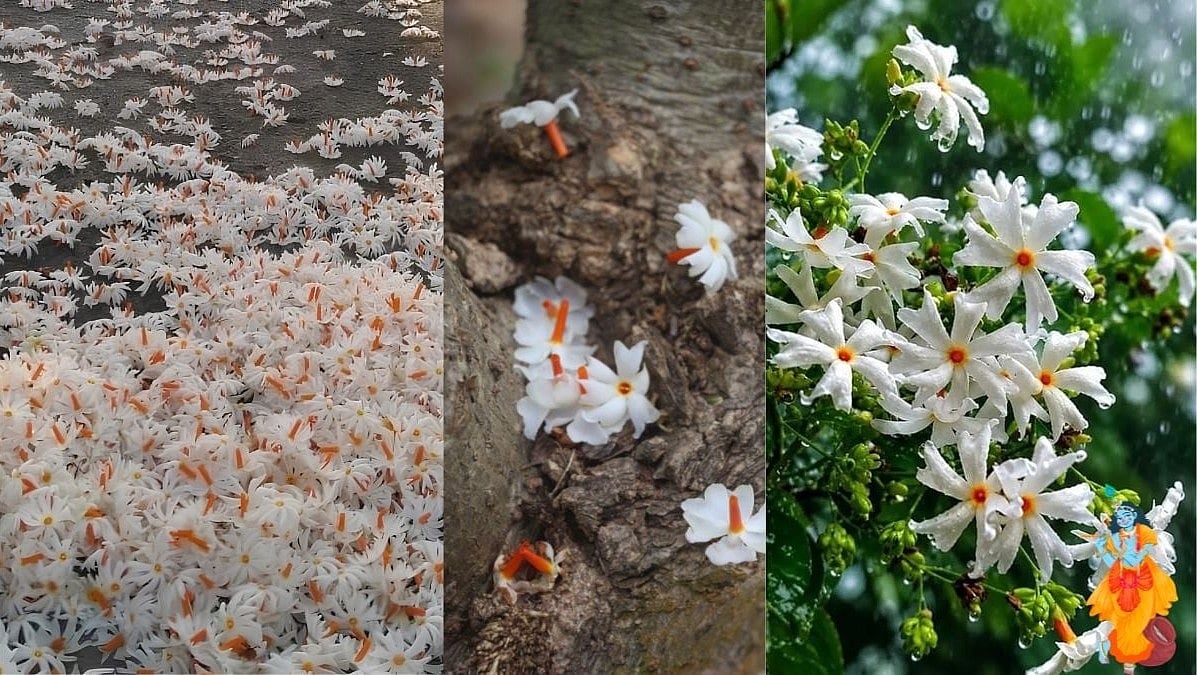
Parijata, also known as Harshringar or Night-flowering Jasmine, is a revered flowering shrub native to South Asia. It holds a special place in Indian mythology and Hindu traditions, with a unique practice of being offered to deities only after it has naturally fallen to the ground.
The Parijata flower blooms during the night and drops to the ground before sunrise, emitting a sweet fragrance. It is considered a sacred flower in Hinduism and is used in Ayurveda for its medicinal properties. The leaves and bark are used to help with fevers and joint pain.
In many households and temples, Parijata flowers are used in daily worship, particularly for offering to Lord Vishnu, Goddess Lakshmi, and other Hindu deities. The flower is closely associated with Lord Krishna, with legends stating that Sage Narada fetched a Parijata flower from the heavens to Earth and offered it to Lord Krishna.
According to Hindu mythology, Parijata is one of the divine treasures that emerged during the Samudra Manthan, or churning of the cosmic ocean. The celestial tree is said to have been brought to Earth by Lord Krishna, who battled Indra to obtain it. The tree was then positioned in Satyabhama's yard, allowing the flowers to cascade into Rukmini's adjacent courtyard.
The Parijata flower has a distinctive appearance, with small white petals surrounding an orange-red centre. Its fragrance is strongest during the night, and it is often associated with purity, devotion, and serenity.
The unique practice of offering Parijata flowers after they have fallen is a fascinating part of India's spiritual and cultural heritage. The flower's connection to Lord Krishna and its medicinal properties make it a significant part of Hindu traditions.
In conclusion, the Parijata flower holds a special significance in Hindu traditions, with its unique practice of being offered to deities after falling and its close association with Lord Krishna. Its medicinal properties and distinctive appearance make it a revered and sacred flower in Indian mythology.
The significance of the Parijata flower is a testament to the rich cultural heritage of India, with its unique traditions and legends. The flower's connection to Lord Krishna and its use in Ayurveda make it an important part of Hinduism, and its distinctive appearance and fragrance make it a beautiful and meaningful offering to deities.
Overall, the Parijata flower is a significant part of Indian mythology and Hindu traditions, with its unique practice, medicinal properties, and close association with Lord Krishna. Its beauty and fragrance make it a revered and sacred flower, and its significance is a testament to the rich cultural heritage of India.
The Parijata flower's significance extends beyond its religious importance, with its medicinal properties and distinctive appearance making it a valuable part of Indian culture. Its unique practice of being offered to deities after falling is a fascinating part of India's spiritual heritage, and its connection to Lord Krishna makes it a meaningful and beautiful offering.
In Hindu traditions, the Parijata flower is a symbol of purity, devotion, and serenity. Its fragrance and beauty make it a revered and sacred flower, and its significance is a testament to the rich cultural heritage of India. The flower's connection to Lord Krishna and its use in Ayurveda make it an important part of Hinduism, and its distinctive appearance and fragrance make it a beautiful and meaningful offering to deities.
The Parijata flower's significance is a reminder of the importance of preserving and respecting India's cultural heritage. Its unique practice, medicinal properties, and close association with Lord Krishna make it a valuable part of Hindu traditions, and its beauty and fragrance make it a revered and sacred flower.
In conclusion, the Parijata flower is a significant part of Indian mythology and Hindu traditions, with its unique practice, medicinal properties, and close association with Lord Krishna. Its beauty and fragrance make it a revered and sacred flower, and its significance is a testament to the rich cultural heritage of India.
Frequently asked questions
What is the significance of Parijata flowers in Hindu traditions?
Parijata flowers are offered to deities after falling and are closely associated with Lord Krishna.
What are the medicinal properties of Parijata flowers?
The leaves and bark of the Parijata tree are used to help with fevers and joint pain.