India To Trial Polymer ₹10 And ₹20 Notes
Government approves plan to introduce polymer banknotes, field trials to start soon.
'%3E%3Crect%20width%3D'96'%20height%3D'96'%20fill%3D'%231A5276'%2F%3E%3Ccircle%20cx%3D'30'%20cy%3D'24'%20r%3D'44'%20fill%3D'%23fff'%20opacity%3D'.12'%2F%3E%3Ccircle%20cx%3D'60'%20cy%3D'74'%20r%3D'40'%20fill%3D'%23000'%20opacity%3D'.10'%2F%3E%3C%2Fg%3E%3Cg%20fill%3D'%23fff'%3E%3Cpath%20d%3D'M31%2041%20L48%2031%20L65%2041%20Z'%2F%3E%3Crect%20x%3D'33'%20y%3D'43'%20width%3D'4'%20height%3D'17'%2F%3E%3Crect%20x%3D'41'%20y%3D'43'%20width%3D'4'%20height%3D'17'%2F%3E%3Crect%20x%3D'51'%20y%3D'43'%20width%3D'4'%20height%3D'17'%2F%3E%3Crect%20x%3D'59'%20y%3D'43'%20width%3D'4'%20height%3D'17'%2F%3E%3Crect%20x%3D'30'%20y%3D'62'%20width%3D'36'%20height%3D'4'%20rx%3D'1'%2F%3E%3C%2Fg%3E%3C%2Fsvg%3E)
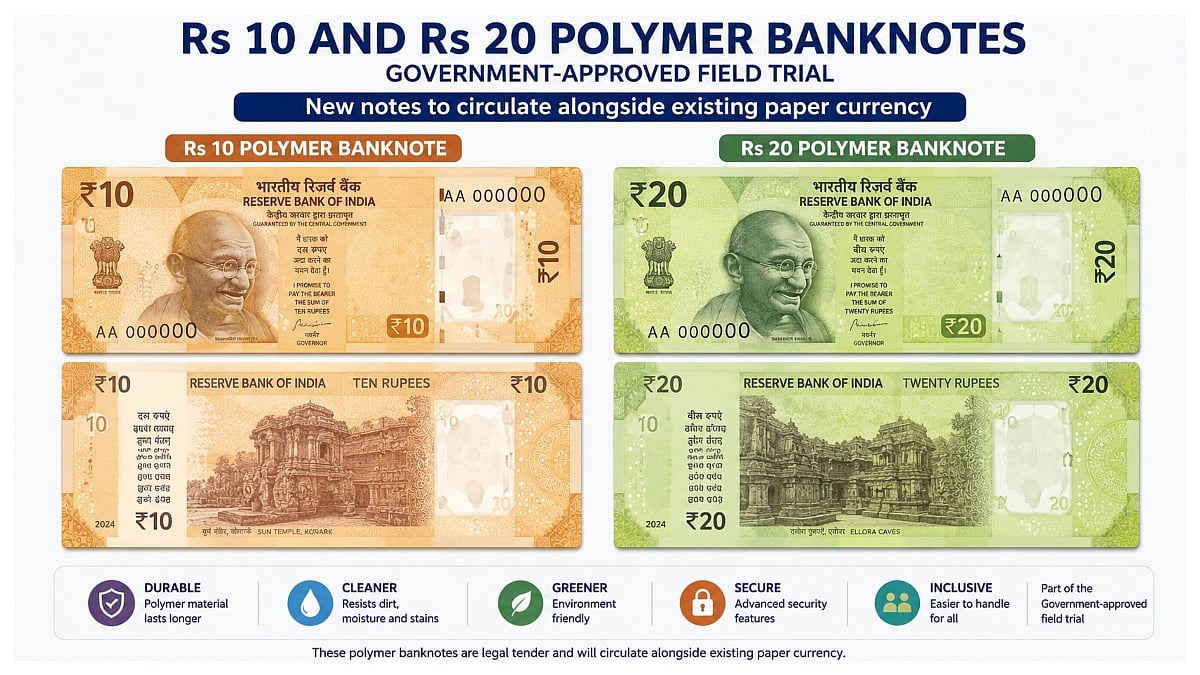
The Indian government has given the green light to a plan to introduce one billion polymer banknotes each in the ₹10 and ₹20 denominations for field trials.
Finance Minister Nirmala Sitharaman informed Parliament on Tuesday that the Reserve Bank of India had submitted the proposal after receiving a recommendation from its central board.
The proposal was sent under Section 25 of the Reserve Bank of India Act, 1934. If the field trials are successful, polymer notes may later be issued regularly in both denominations.
Polymer banknotes will circulate alongside existing paper notes. However, the procurement process is still at an early stage, and therefore, the launch date and expenditure cannot yet be estimated.
The introduction of polymer banknotes is a significant development in the country's currency management. Polymer notes are more durable and have a longer lifespan compared to paper notes.
In other economic news, the average retail inflation fell from 5.4 percent in 2023-24 to 4.6 percent in 2024-25 and 2.1 percent in 2025-26. However, it rose to 3.9 percent in the first quarter of 2026-27 due to higher global energy prices and other factors.
Despite the fluctuations, the retail inflation remained below the RBI's 4 percent target. The government has taken several measures to support household spending, including reducing tax rates on several goods and services.
The new GST structure includes rates of 5 percent and 18 percent, besides a special 40 percent rate for selected goods and services. The Union Budget 2026-27 also lowered Basic Customs Duty on several products to reduce input costs, support manufacturing, and improve export competitiveness.
Other steps included lower duties on crude edible oils and masur, besides a ₹10-a-litre cut in excise duty on petrol and diesel in March 2026. The government also exempted annual income up to ₹12 lakh from income tax.
For salaried people, the effective limit is ₹12.75 lakh after the standard deduction. These measures have supported household spending, with per capita private consumption expenditure growing 6.8 percent in 2025-26, compared with 4.8 percent in 2023-24.
The introduction of polymer banknotes and the various economic measures taken by the government are expected to have a positive impact on the country's economy.
The success of the field trials will determine the future of polymer banknotes in India, and the government's economic measures will continue to support household spending and drive economic growth.
Frequently asked questions
What are the denominations of the polymer banknotes to be introduced in India?
The polymer banknotes will be introduced in the ₹10 and ₹20 denominations.
Will the polymer banknotes replace the existing paper notes?
No, the polymer banknotes will circulate alongside the existing paper notes.