Sebi Revises InvIT Cash Flow Rules
Sebi allows InvITs to add back debt-funded road maintenance costs. InvITs to obtain unitholder approval before raising debt.
'%3E%3Crect%20width%3D'96'%20height%3D'96'%20fill%3D'%230B6E4F'%2F%3E%3Ccircle%20cx%3D'30'%20cy%3D'24'%20r%3D'44'%20fill%3D'%23fff'%20opacity%3D'.12'%2F%3E%3Ccircle%20cx%3D'60'%20cy%3D'74'%20r%3D'40'%20fill%3D'%23000'%20opacity%3D'.10'%2F%3E%3C%2Fg%3E%3Cg%20fill%3D'none'%20stroke%3D'%23fff'%20stroke-width%3D'3.2'%20stroke-linecap%3D'round'%20stroke-linejoin%3D'round'%3E%3Cpolyline%20points%3D'31%2C59%2041%2C49%2049%2C54%2063%2C37'%2F%3E%3Cpolyline%20points%3D'55%2C37%2063%2C37%2063%2C45'%2F%3E%3C%2Fg%3E%3C%2Fsvg%3E)
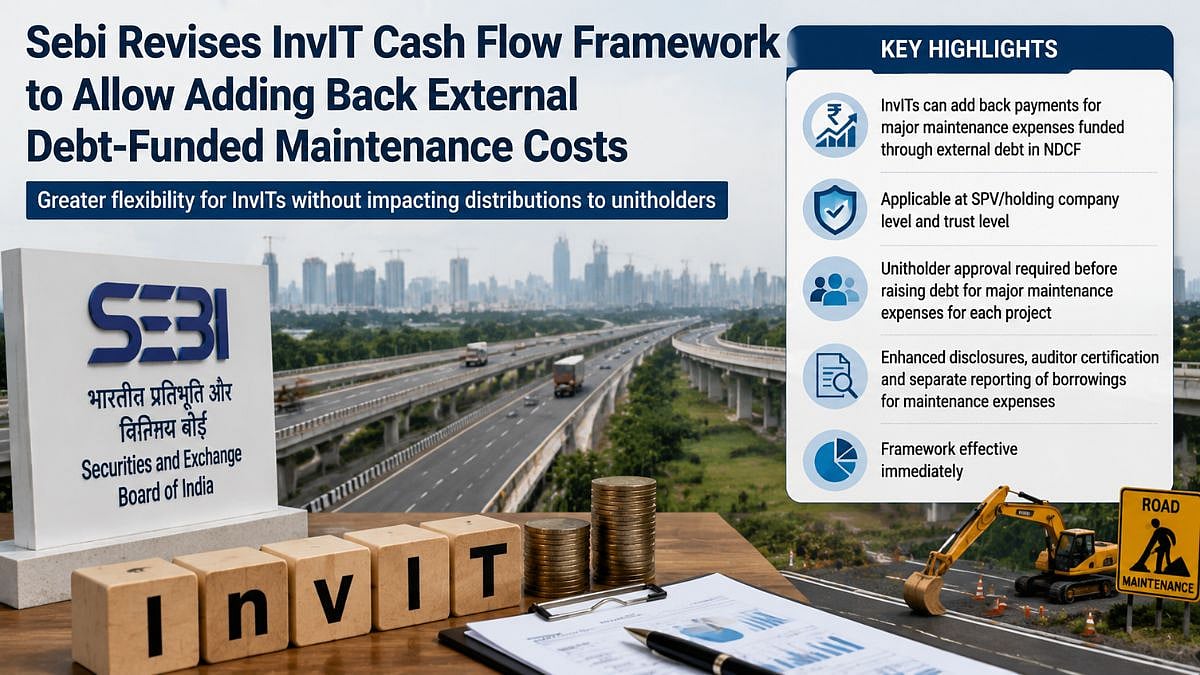
The Securities and Exchange Board of India (Sebi) has revised the rules for Infrastructure Investment Trusts (InvITs) to allow them to add back payments made towards major maintenance expenses for road projects funded through external debt while calculating net distributable cash flow (NDCF).
This move is aimed at providing greater flexibility to InvITs in managing major maintenance requirements of road projects without reducing the cash available for distribution to unitholders.
Under the revised framework, such expenses can be added back to NDCF at both the special purpose vehicle (SPV)/holding company level and the trust level.
However, InvITs will have to obtain approval from unitholders before raising debt for major maintenance expenses. The approval will be required for each project for which the investment manager proposes to raise such borrowing.
The regulator said the approval can be obtained on a one-time basis for debt already availed or proposed to be availed over the entire project life cycle, or for a specific major maintenance expense.
Any deviation requiring additional debt will need fresh unitholder approval, Sebi said.
In addition to the approval requirement, InvITs will also have to disclose details of the projects for which such debt is proposed, the categories of major maintenance expenses, estimated expenses and the possible impact on future growth and distributions.
A statutory auditor will have to certify that the maintenance expenses are in line with the concession agreement and have been funded through external borrowings.
InvITs will also have to separately disclose the borrowing raised and outstanding debt for major maintenance expenses in their financial and periodic reports.
Their debt maturity profiles will also have to separately highlight such borrowings.
Sebi clarified that no InvIT or SPV can distribute cash flows by raising external debt, except in specified cases.
Working capital or overdraft facilities used for treasury or working capital purposes will be excluded if squared off within the quarter.
The revised framework will come into force with immediate effect, Sebi said.
This change is expected to have a positive impact on the InvITs industry, as it will allow them to better manage their cash flows and maintain their road projects without reducing the cash available for distribution to unitholders.
The move is also expected to increase transparency and accountability in the industry, as InvITs will be required to disclose more information about their debt and maintenance expenses.
Overall, the revised framework is a step in the right direction for the InvITs industry, and it is expected to have a positive impact on the industry's growth and development.
The change is also expected to benefit unitholders, as it will allow them to have more visibility into the financials of the InvITs and make more informed investment decisions.
In the long run, the revised framework is expected to contribute to the growth and development of the infrastructure sector in India, as it will allow InvITs to play a more significant role in financing and maintaining infrastructure projects.
Frequently asked questions
What is the main change in Sebi's revised InvIT cash flow rules?
The main change is that InvITs are now allowed to add back payments made towards major maintenance expenses for road projects funded through external debt while calculating net distributable cash flow (NDCF).
What is the requirement for InvITs to raise debt for major maintenance expenses?
InvITs will have to obtain approval from unitholders before raising debt for major maintenance expenses.