Madhya Pradesh Hit By Heavy Rain, 75% Full Gandhi Sagar Dam
Heavy rain disrupts life, threatens soybean crop in Garoth, MP. Gandhi Sagar Dam nears capacity.
'%3E%3Crect%20width%3D'96'%20height%3D'96'%20fill%3D'%23B3261E'%2F%3E%3Ccircle%20cx%3D'30'%20cy%3D'24'%20r%3D'44'%20fill%3D'%23fff'%20opacity%3D'.12'%2F%3E%3Ccircle%20cx%3D'60'%20cy%3D'74'%20r%3D'40'%20fill%3D'%23000'%20opacity%3D'.10'%2F%3E%3C%2Fg%3E%3Cg%20fill%3D'%23fff'%3E%3Crect%20x%3D'29'%20y%3D'49'%20width%3D'8'%20height%3D'19'%20rx%3D'1'%2F%3E%3Crect%20x%3D'39'%20y%3D'40'%20width%3D'9'%20height%3D'28'%20rx%3D'1'%2F%3E%3Crect%20x%3D'50'%20y%3D'45'%20width%3D'8'%20height%3D'23'%20rx%3D'1'%2F%3E%3Crect%20x%3D'60'%20y%3D'53'%20width%3D'7'%20height%3D'15'%20rx%3D'1'%2F%3E%3Crect%20x%3D'41'%20y%3D'34'%20width%3D'5'%20height%3D'6'%2F%3E%3C%2Fg%3E%3C%2Fsvg%3E)
Heavy rainfall in Madhya Pradesh's Garoth has disrupted daily life, with overflowing rivers and streams causing traffic halts on several routes. The Gandhi Sagar Dam on the Chambal River has reached around 75% of its total capacity, prompting the water resources department to closely monitor the water level.
The region is expected to receive more rainfall over the next 24-48 hours, with temperatures ranging between 25°C and 31°C on Sunday. The humidity is forecast to exceed 75-80%, further exacerbating the situation.
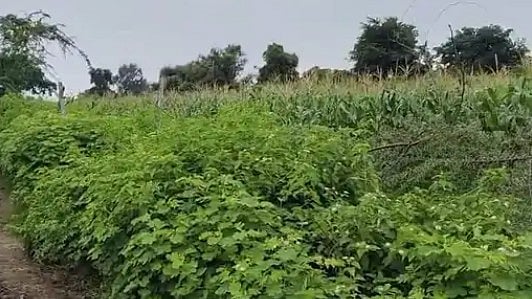
The continuous rain has put the region's main 'kharif' crop, soybean, at risk. The crop is currently at the pod-filling and ripening stage, making it vulnerable to waterlogging, root rot, wilting, discolouration of seeds, Yellow Mosaic disease, and fungal infections. Stalk rot is also being observed in maize, while ripened 'urad' and 'moong' seeds may germinate in pods due to persistent moisture, potentially affecting yield.
Agricultural expert Jitendra Kumar Ajna has advised farmers to take immediate action to mitigate the damage. He suggested creating deep channels along the field's slope to drain accumulated water and spraying fungicides like Tebuconazole + Azoxystrobin or Carbendazim + Mancozeb after the rain stops. Ajna also warned farmers not to leave ripened crops in fields during rain, instead harvesting and storing them at high, well-ventilated locations to minimize damage from moisture and rotting.
The situation in Garoth is a concern for farmers, who are already struggling with the challenges of the monsoon season. The heavy rainfall has not only disrupted their daily lives but also threatens their livelihoods. The authorities are closely monitoring the situation, and farmers are advised to take necessary precautions to protect their crops.
The Gandhi Sagar Dam's water level is being closely watched, as it nears its total capacity. The dam's water level has reached around 75% of its total capacity, and any further increase could lead to flooding in the surrounding areas.
In related news, an air ambulance reached Burhanpur, but unfortunately, it was too late to save a critically ill woman who died before she could be transferred to Indore.
The monsoon season has brought its share of challenges to Madhya Pradesh, and the situation in Garoth is a reminder of the importance of being prepared for natural disasters. The authorities and farmers must work together to mitigate the damage and ensure that the region's agricultural sector is protected.
The heavy rainfall and flooding in Garoth have significant implications for the region's economy and food security. The soybean crop is a crucial part of the region's agricultural output, and any damage to the crop could have far-reaching consequences. The situation is being closely monitored, and efforts are being made to support the affected farmers and minimize the damage to the crop.
In conclusion, the heavy rainfall in Madhya Pradesh's Garoth has disrupted daily life and threatens the region's soybean crop. The Gandhi Sagar Dam's water level is being closely watched, and farmers are advised to take necessary precautions to protect their crops. The situation is a reminder of the importance of being prepared for natural disasters and the need for authorities and farmers to work together to mitigate the damage.
Frequently asked questions
What is the current water level of the Gandhi Sagar Dam?
The Gandhi Sagar Dam is around 75% full.
What are the potential risks to the soybean crop due to heavy rainfall?
The soybean crop is at risk of waterlogging, root rot, wilting, discolouration of seeds, Yellow Mosaic disease, and fungal infections.