MP Teachers Risk Lives Crossing Flooded River For E-Attendance
Teachers in MP's Bhind cross river on inner tubes to mark attendance.
'%3E%3Crect%20width%3D'96'%20height%3D'96'%20fill%3D'%23B3261E'%2F%3E%3Ccircle%20cx%3D'30'%20cy%3D'24'%20r%3D'44'%20fill%3D'%23fff'%20opacity%3D'.12'%2F%3E%3Ccircle%20cx%3D'60'%20cy%3D'74'%20r%3D'40'%20fill%3D'%23000'%20opacity%3D'.10'%2F%3E%3C%2Fg%3E%3Cg%20fill%3D'%23fff'%3E%3Crect%20x%3D'29'%20y%3D'49'%20width%3D'8'%20height%3D'19'%20rx%3D'1'%2F%3E%3Crect%20x%3D'39'%20y%3D'40'%20width%3D'9'%20height%3D'28'%20rx%3D'1'%2F%3E%3Crect%20x%3D'50'%20y%3D'45'%20width%3D'8'%20height%3D'23'%20rx%3D'1'%2F%3E%3Crect%20x%3D'60'%20y%3D'53'%20width%3D'7'%20height%3D'15'%20rx%3D'1'%2F%3E%3Crect%20x%3D'41'%20y%3D'34'%20width%3D'5'%20height%3D'6'%2F%3E%3C%2Fg%3E%3C%2Fsvg%3E)
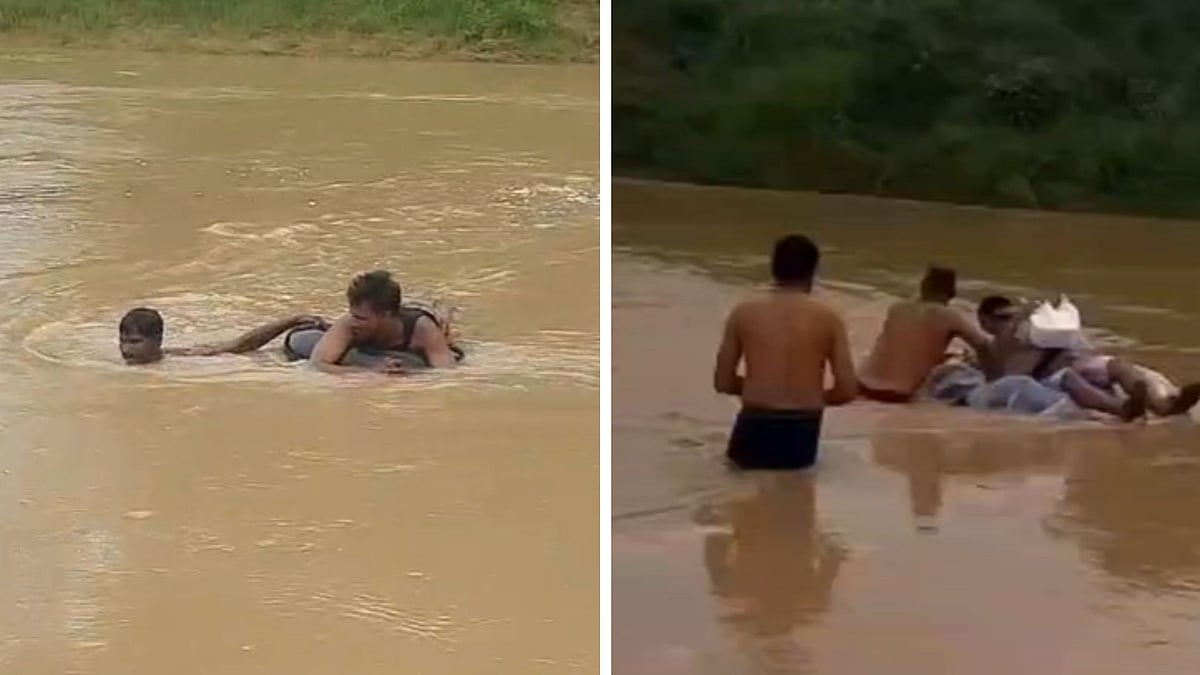
Teachers in a remote village in Madhya Pradesh's Bhind district are risking their lives to cross a rain-swollen stream on inner tubes to reach school and mark their mandatory e-attendance.
The incident took place in Gram Panchayat Babedi, Bhind, where the access route connecting Nadrauli and Sumer Singh Ka Pura gets completely cut off when monsoon rains fill the seasonal Khar.
With no culvert or safe passage available, teachers, students, and villagers are left with the dangerous option of crossing the strong current on inner tubes. A video has surfaced showing a teacher at Nadrauli Primary School balancing himself on an inner tube while crossing the flooded stream.
The waterlogged route reportedly remains disrupted for nearly four months every monsoon, making commuting on foot or by bike virtually impossible. The e-attendance system has added another layer to the hardship, as government school teachers are required to reach their institutions within a specified time and register attendance online.
In a similar case from Chhatarpur, teachers were reportedly forced to climb school rooftops to catch mobile network signals and mark their attendance through the 'Humare Shikshak' mobile application. Despite the absence of a safe route and a lack of network in rural areas, teachers are making life risky to avoid being marked absent.
Villagers said the problem is repeated every year, yet their demand for a permanent culvert or safe access road has remained unanswered. Residents questioned whether the realities of remote rural areas were considered before strict online attendance requirements were enforced.
They argued that digital systems cannot ensure smooth functioning when basic infrastructure is missing in rural areas. The incident highlights the disconnect between digital governance and ground reality, where teachers are forced to put their lives at risk to comply with mandatory e-attendance requirements.
The situation is a stark reminder of the challenges faced by rural communities in accessing basic amenities and services. The lack of infrastructure and connectivity in these areas exacerbates the problems, making it difficult for people to access essential services like education and healthcare.
The incident has sparked concerns about the safety and well-being of teachers and students in rural areas, who are forced to navigate treacherous terrain to access education. It also raises questions about the effectiveness of digital governance initiatives in addressing the needs of rural communities.
In conclusion, the incident in Bhind highlights the need for a more nuanced approach to digital governance, one that takes into account the ground realities and challenges faced by rural communities. It is essential to address the infrastructure and connectivity gaps in these areas to ensure that digital initiatives are effective and do not put people's lives at risk.
The incident is a wake-up call for the authorities to reassess their priorities and focus on providing basic amenities and services to rural communities. It is only by addressing these fundamental challenges that we can create a more equitable and just society, where everyone has access to opportunities and services regardless of their location or background.
Frequently asked questions
Why are teachers in MP's Bhind crossing a river on inner tubes?
They are crossing the river to reach school and mark their mandatory e-attendance, as the access route is cut off due to monsoon rains.
What is the e-attendance system and how does it affect teachers?
The e-attendance system requires government school teachers to reach their institutions within a specified time and register attendance online, which can be challenging in areas with poor connectivity and infrastructure.