Supreme Court Orders Closure Of NEET-UG Protest FIRs
Students facing criminal cases for NEET-UG protests get relief. SC directs closure of FIRs in Maharashtra and other states.
'%3E%3Crect%20width%3D'96'%20height%3D'96'%20fill%3D'%23B3261E'%2F%3E%3Ccircle%20cx%3D'30'%20cy%3D'24'%20r%3D'44'%20fill%3D'%23fff'%20opacity%3D'.12'%2F%3E%3Ccircle%20cx%3D'60'%20cy%3D'74'%20r%3D'40'%20fill%3D'%23000'%20opacity%3D'.10'%2F%3E%3C%2Fg%3E%3Cg%20fill%3D'%23fff'%3E%3Crect%20x%3D'29'%20y%3D'49'%20width%3D'8'%20height%3D'19'%20rx%3D'1'%2F%3E%3Crect%20x%3D'39'%20y%3D'40'%20width%3D'9'%20height%3D'28'%20rx%3D'1'%2F%3E%3Crect%20x%3D'50'%20y%3D'45'%20width%3D'8'%20height%3D'23'%20rx%3D'1'%2F%3E%3Crect%20x%3D'60'%20y%3D'53'%20width%3D'7'%20height%3D'15'%20rx%3D'1'%2F%3E%3Crect%20x%3D'41'%20y%3D'34'%20width%3D'5'%20height%3D'6'%2F%3E%3C%2Fg%3E%3C%2Fsvg%3E)
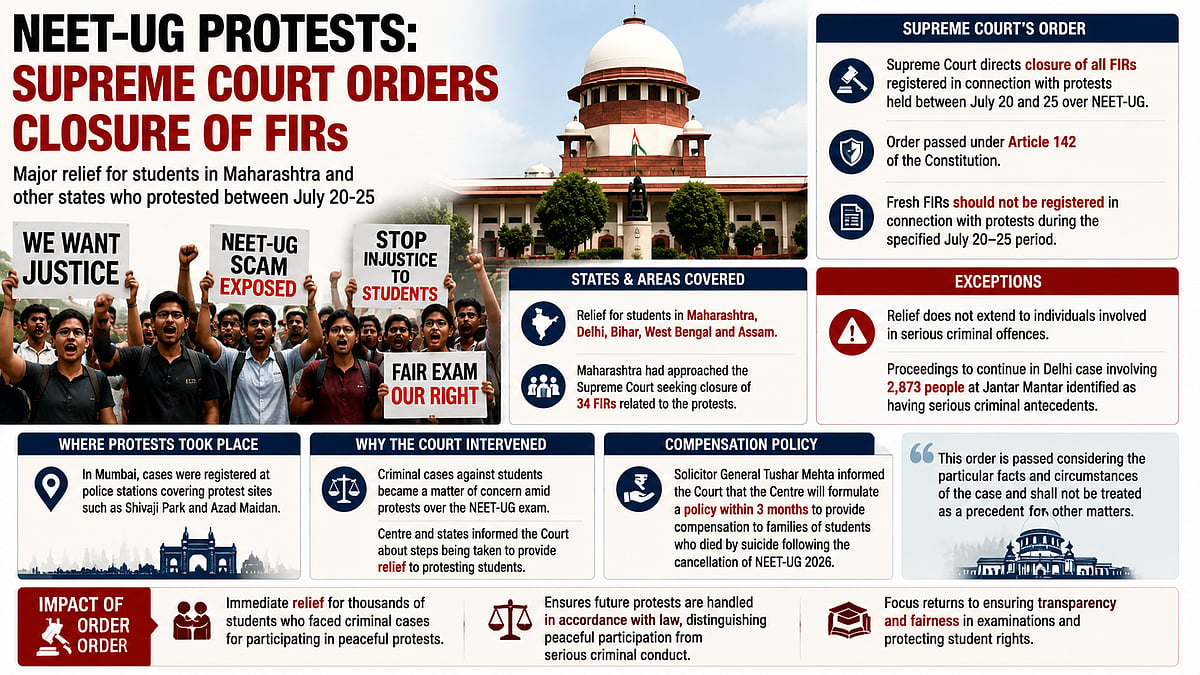
The Supreme Court has directed the closure of FIRs registered against students who participated in protests over the NEET-UG issue between July 20 and 25. A bench headed by Chief Justice of India Surya Kant passed the order, exercising the court's powers under Article 142 of the Constitution.
The order brings relief to students in Maharashtra, as well as those involved in similar protests in Delhi, Bihar, West Bengal, and Assam. Maharashtra had approached the Supreme Court seeking the closure of 34 FIRs registered in connection with the protests. In Mumbai, cases related to the demonstrations included FIRs registered at police stations covering protest sites such as Shivaji Park and Azad Maidan.
The Supreme Court has also directed that fresh FIRs should not be registered in connection with protests conducted during the specified July 20-25 period. However, the relief does not extend to individuals involved in serious criminal offences. The court has allowed proceedings to continue in a Delhi case involving 2,873 people who were present at the Jantar Mantar protest and were identified as having serious criminal antecedents.
The issue of criminal cases against students became a matter of concern amid protests over the NEET-UG examination. The Centre and states had placed before the court the steps being taken to provide relief to students who participated in the demonstrations. The Supreme Court has made it clear that its order has been passed considering the particular circumstances of the matter and should not be treated as a precedent for other cases.
During the proceedings, Solicitor General Tushar Mehta informed the court that the Centre would formulate a policy within three months to provide compensation to the families of students who died by suicide following the cancellation of NEET-UG 2026. For students in Maharashtra who had faced FIRs following the July protests, the order effectively removes the immediate criminal proceedings arising from their participation in the demonstrations.
The order puts the focus back on the authorities to ensure that future student protests are handled in accordance with law while distinguishing peaceful participation from serious criminal conduct. The Supreme Court's intervention is a significant development in the NEET-UG controversy, which has been a major issue in the country.
The NEET-UG examination has been a subject of controversy in recent years, with many students and parents expressing concerns over the exam's validity and fairness. The Supreme Court's order is likely to have a significant impact on the lives of students who participated in the protests, and it will be interesting to see how the authorities respond to the court's directives.
In conclusion, the Supreme Court's order directing the closure of FIRs registered against students who participated in NEET-UG protests is a major relief for the students involved. The order highlights the need for the authorities to handle student protests in a fair and lawful manner, and it sets an important precedent for the protection of students' rights in the country.
The Supreme Court's decision is also a reminder of the importance of the judiciary in protecting the rights of citizens and ensuring that the authorities act in accordance with the law. The order is a significant development in the NEET-UG controversy, and it will be closely watched by students, parents, and educators across the country.
The impact of the Supreme Court's order will be felt not only in Maharashtra but also in other states where students participated in the protests. The order is a major victory for the students who were facing criminal cases for participating in the demonstrations, and it will help to restore their faith in the justice system.
Overall, the Supreme Court's order is a significant development in the NEET-UG controversy, and it highlights the need for the authorities to handle student protests in a fair and lawful manner. The order is a major relief for the students involved, and it sets an important precedent for the protection of students' rights in the country.
Frequently asked questions
What is the Supreme Court's order on NEET-UG protest FIRs?
The Supreme Court has directed the closure of FIRs registered against students who participated in NEET-UG protests between July 20 and 25.
Which states are affected by the Supreme Court's order?
The order brings relief to students in Maharashtra, as well as those involved in similar protests in Delhi, Bihar, West Bengal, and Assam.