
Mumbai Airport to the City: Every Option Explained
Get from Mumbai airport (CSMIA T1 and T2) to Colaba, Bandra or BKC: prepaid taxis, Ola and Uber, the Aqua Line Metro and buses, with real fares.
'%3E%3Crect%20width%3D'96'%20height%3D'96'%20fill%3D'%23E65100'%2F%3E%3Ccircle%20cx%3D'30'%20cy%3D'24'%20r%3D'44'%20fill%3D'%23fff'%20opacity%3D'.12'%2F%3E%3Ccircle%20cx%3D'60'%20cy%3D'74'%20r%3D'40'%20fill%3D'%23000'%20opacity%3D'.10'%2F%3E%3C%2Fg%3E%3Cg%3E%3Ccircle%20cx%3D'48'%20cy%3D'48'%20r%3D'15'%20fill%3D'none'%20stroke%3D'%23fff'%20stroke-width%3D'3'%2F%3E%3Cpath%20fill%3D'%23fff'%20d%3D'M48%2037%20l3.5%2011%20-3.5%2011%20-3.5%20-11%20z'%2F%3E%3Ccircle%20cx%3D'48'%20cy%3D'48'%20r%3D'2.2'%20fill%3D'%23fff'%2F%3E%3C%2Fg%3E%3C%2Fsvg%3E)
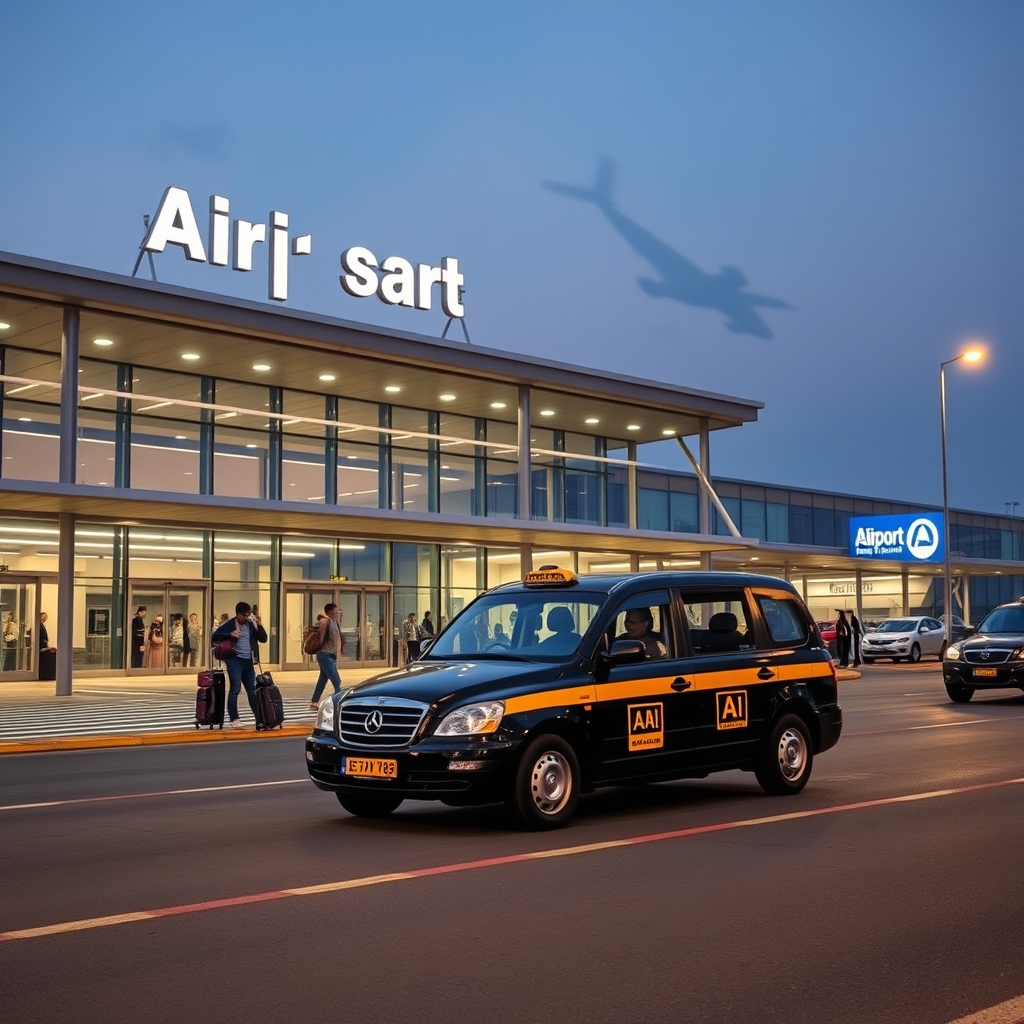
Photo: Ninara · CC BY 2.0 · via Wikimedia Commons
You have landed at Chhatrapati Shivaji Maharaj International Airport (CSMIA, airport code BOM), collected your bag, and walked out into that first wall of warm, salty Mumbai air. Now comes the part that quietly makes or breaks a first day here: the ride into town. Mumbai is long and thin, the traffic is theatrical, and the airport sits well to the north of where most visitors are heading. The good news is that you now have more sensible ways in than the city has ever offered, including a fully underground Metro that opened along its complete line in October 2025. This guide walks through each option in detail: how it actually works, what it honestly costs, and which one to pick depending on where you are staying and what time you touch down.
If you want the wider picture of how the city moves before you arrive, our overview of getting around Mumbai sets the scene. This guide zooms in on that first leg from the terminal to your door.
Quick reference: your options at a glance
| Option | Best for | Typical fare into town | Journey to Colaba | Watch out for |
|---|---|---|---|---|
| Aqua Line Metro (Line 3) | BKC, Worli, Fort in daylight, light luggage | ₹10–80 (about ₹60 end to end) | ~40–55 min incl. last-mile | No overnight service; crowded at peak |
| Prepaid taxi | Late arrivals, first-timers, zero surprises | ₹650–950 kaali-peeli; ₹900–1,400 AC sedan to South Mumbai | 45–70 min | Use the official counter only |
| App cab (Ola / Uber / Rapido) | Cheapest door-to-door in daylight | Colaba ₹620–920; Bandra ₹250–450; BKC ₹250–400 (off-peak) | 45–70 min | Surge of 2–2.7x at peak or in the monsoon |
| Auto-rickshaw | Bandra, Andheri, Vile Parle | Metered, cheap | Not permitted | Barred from South Mumbai |
| BEST bus (incl. AC S-104) | Budget travellers packing light | Under ₹100 | 80+ min | Slow and awkward with a trolley |
Treat those numbers as honest ranges rather than fixed quotes. Fares move with the time of day, the weather and the traffic, and Mumbai supplies all three in abundance.
First, know your terminal
T1, T2 and the free shuttle
CSMIA has two terminals a few kilometres apart, and confusing them is the classic first-timer’s stumble. Terminal 2 (T2) is the big glass-and-peacock international terminal at Sahar; it also handles a chunk of domestic flights, so do not assume “domestic” automatically means T1. Terminal 1 (T1) at Santacruz is domestic only. The two are not walkable from one another, and there is no pedestrian route worth attempting with luggage.
If you land at one and need the other, for example on a connecting flight booked as two separate tickets, use the free inter-terminal shuttle. It picks up at T1 near the Arrival exit (Gate 2) and at T2 on Level 1, Ground Transportation. Allow a good 20 to 30 minutes for the hop, and considerably more in traffic or during the evening peak. If your connection is tight, factor this in before you relax with a coffee; the shuttle runs to its own rhythm, not yours.
A rough map of distances
For everything that follows, keep a rough map in your head, because in Mumbai the distance decides the strategy. Bandra and Bandra Kurla Complex (BKC) sit close to the airport, roughly 7 km south. Colaba and the Gateway of India are far, around 22 km from T1 and 25 km from T2, near the very southern tip of the peninsula. Worli, Lower Parel, Dadar and Mahalaxmi fall in the busy middle.
That single geographic fact explains most of the pricing you will see. A cab to Bandra is pocket change and takes 20 to 35 minutes; a cab to Colaba is a proper journey of 45 to 70 minutes, sometimes longer if the Western Express Highway is having a bad evening. When someone quotes you a fare, the honest first question is not “is this cheap?” but “how far south am I going, and at what hour?”
Your options, one by one
The prepaid taxi counter
The Mumbai airport prepaid taxi counters sit inside the arrivals hall at both T1 and T2. You state your destination, pay a fixed fare at the desk, and walk out with a printed slip showing the driver’s name and vehicle number. You then board the assigned cab in the marshalled queue outside. The appeal is certainty: the price is locked before you move, there is no app to fumble with, no surge, and no roadside negotiation while you are jet-lagged.
Rough fares to South Mumbai (Colaba, Nariman Point, CST) run about ₹650 to ₹950 in a black-and-yellow “kaali-peeli”, or ₹900 to ₹1,400 in a Cool Cab air-conditioned sedan. Tolls and a small airport levy may be added to the slip, so glance at the breakdown before you pay. This is the option I steer nervous first-timers and late-night arrivals towards, precisely because the fare cannot balloon on you mid-journey.
One firm piece of advice: ignore the freelancers who drift up on the concourse murmuring “taxi, sir” and offering to “help”. Walk past them to the official, signposted, staffed counter. The touts almost always cost more, and starting your Mumbai trip in an unmetered car with a stranger who found you first is exactly the wrong note to open on.
App cabs: Ola, Uber and Rapido
Ola, Uber and Rapido all operate at CSMIA, and for most daytime trips they are the cheapest door-to-door choice in the city. The catch is the walk to the pickup point. At T2 you are directed to a dedicated cab zone outside arrivals, roughly a 3 to 5 minute walk, with app pickups clustered around the P6–P7 multi-level car park. Follow the physical “app-based cabs” signage rather than trusting the map pin in your app, which can be wildly optimistic inside a terminal this large.
Do yourself a favour and book while you are still inside on the airport Wi-Fi, in the cool, before you step out into the heat and the queue of hopeful drivers. Indicative off-peak sedan fares run about ₹620 to ₹920 for Colaba, ₹250 to ₹450 for Bandra West, and ₹250 to ₹400 for BKC. An auto booked through the app, where the route allows one, will undercut those figures further.
The honest caveat is surge. Late at night, throughout the monsoon, or during the weekday morning crush into BKC, multipliers of 2 to 2.7x are common, roughly between 7:30 and 8:45am. Under surge, a Colaba fare can climb to ₹1,400 to ₹2,200, at which point the prepaid counter suddenly looks like the sober choice. Tolls, including the Bandra–Worli Sea Link (about ₹100 for a car, one way), are added at the end of the trip, not quoted up front.
The Aqua Line Metro (Line 3)
This is the genuine game-changer, and the reason this guide reads differently from one written two years ago. The fully underground Aqua Line (Metro Line 3) runs the length of the city from Aarey in the north to Cuffe Parade in the south, and it opened along its complete route on 8 October 2025. Crucially, it has its own CSMIA T2 station, linked to the terminal by a short covered bridge of about 100 metres, plus a separate CSMIA T1 station. For the first time, you can step off a flight and be on a fast train heading downtown without ever touching the traffic.
Trains run roughly 6am to 10:30pm (from 8:30am on Sundays), every 5 to 7 minutes at peak and every 10 to 15 off-peak. Fares sit between ₹10 and ₹80, with an end-to-end ride costing about ₹60. Buy a QR token at the counter or a vending machine, or tap through with a stored-value card if you have one. For anyone heading to BKC, Worli, Dadar, Mahalaxmi or the Fort and Churchgate end, this is now the smart move: the line sails under the choked surface roads that used to swallow an hour of your evening.
The honest limits matter too. It does not run overnight. It can be genuinely busy at peak hour, when a rush-hour carriage is no place to be wrestling a suitcase. And while the T2 station bridge is walkable, the last-mile at the far end, from the Metro exit to your actual hotel door, still needs a short auto or taxi. If you are jet-lagged with three bags at midnight, this is not your ride; take a taxi and save the Metro for a fresh morning.
Auto-rickshaws and kaali-peeli taxis
Auto-rickshaws wait at both terminals, run on the meter, and are cheap and nippy for short hops to the nearby suburbs. But there is a rule that trips up newcomers constantly: autos are not allowed into South Mumbai. They cannot cross south of roughly the Bandra Fire Station on the western side or Sion on the central side. So an auto is perfect for Bandra, Andheri or Vile Parle, and useless for Colaba, Churchgate or Nariman Point, where the black-and-yellow metered taxi becomes your friend instead.
For both autos and kaali-peelis, insist on the meter, or agree the fare clearly before you set off. Most drivers are straight, but the airport is exactly the spot where an out-of-towner might be quoted a “special” flat rate. A polite, confident “meter, please” settles it. Carry small notes, because change for a ₹500 can mysteriously evaporate at the end of a ride.
BEST buses and the air-conditioned S-104
The city’s BEST buses are the most economical option of all, though never the fastest with luggage. From T1, route 312 links to Vile Parle and Andheri stations; from T2, routes 321 (Vile Parle) and 308 (Andheri) do the same, feeding you into the suburban rail network that most Mumbaikars actually live by. If you are up for that, our local train guide explains how to ride the lifeline without getting swept off your feet.
For a direct run south, the air-conditioned S-104 heads towards Colaba and Cuffe Parade via Bandra, Marine Drive, CSMT and the Gateway of India, but budget at least an hour and twenty minutes, longer in rush hour. Buses suit confident, light-travelling budget travellers who are not fazed by a bit of standing and a lot of stopping. With a full trolley on your first afternoon, they are more character-building than convenient.
Where are you actually going?
The right answer changes completely depending on your destination. Here is how the options stack up for the three areas visitors most often ask about.
Colaba, the Fort and the Gateway
This is the long haul, and where your arrival time matters most. For a stress-free first landing, the prepaid taxi counter is hard to beat: a fixed price, no surge, and a straight run to your hotel in 45 to 70 minutes. If you are comfortable, travelling light and it is not the dead of night, an app cab is usually a little cheaper.
The Metro is a fine daylight alternative. Ride the Aqua Line to Cuffe Parade for Nariman Point and lower Colaba, or to the CSMT and Hutatma Chowk stations for the Fort and Kala Ghoda quarter, then finish with a short kaali-peeli or a walk. This is also the neighbourhood of the Gateway of India and the great stone pile of CSMT, the former Victoria Terminus, so if sightseeing is on the first-day agenda, the southern Metro stops drop you close. For a fuller sense of the district, our Colaba neighbourhood guide is worth a look before you decide where to base yourself.
Bandra and the western suburbs
Bandra is close and easy, which makes it a forgiving first stop. An app cab is the natural choice at roughly ₹250 to ₹450 and 20 to 35 minutes, dropping you exactly where you want among Bandra West’s café-and-boutique lanes. An auto-rickshaw works well here too and is fully permitted, so if you enjoy the open-air, weave-through-traffic version of the arrival, flag one down.
The Aqua Line serves the BKC and eastern side of Bandra rather than the buzzy, seaside West, so for Bandra West specifically a road cab is simpler than the train. If you are staying north around Andheri instead, an auto or app cab is again your friend; the Andheri neighbourhood guide covers that end. And if you are still weighing where in the city to lay your head, our broader where to stay in Mumbai guide compares the areas. For a full portrait of the suburb itself, see the Bandra neighbourhood guide.
BKC, Worli and Lower Parel
For Bandra Kurla Complex, the Metro has quietly become the best option in the city. It is a direct, traffic-free ride of around 15 to 20 minutes from CSMIA T2 for roughly ₹20 to ₹30, versus a cab that costs several times more and can crawl to a standstill during the morning surge. If you are arriving for a weekday-morning meeting, the Aqua Line will very likely get you there faster, cheaper and a good deal calmer than any car.
The same logic extends down the line to Worli, Lower Parel and Mahalaxmi, the old mill district turned high-rise business and nightlife belt. If your cab route does take you across the water, you will meet the Bandra–Worli Sea Link, a genuinely handsome first view of the city and worth the modest toll. For what waits at that end of town, the Lower Parel and Worli guide fills in the detail.
Timing, money and the monsoon
Arriving late at night
After the Metro shuts around 10:30pm, your realistic choices narrow to the prepaid counter and app cabs, and at that hour the prepaid counter earns its keep. Fares are calm, the queue is marshalled, and you are not standing in a dim car park trying to match a number plate. If your flight lands very late and you simply want to sleep before dealing with the city, consider an airport hotel for the night and make the run into town fresh the next morning.
The weekday morning surge
Between roughly 7:30 and 8:45am, the whole city tries to move at once, and app fares into BKC in particular spike hard. This is the one window where the Metro is not just competitive but clearly superior for the central and eastern destinations it serves. If you can, either travel before the surge builds or lean on the Aqua Line and let the cars sit in the jam without you.
Paying: cash, cards and QR
Carry some cash. Prepaid counters, autos, buses and Metro token machines all deal happily in it, and small notes make metered rides smoother and change disputes rarer. Cards and UPI are widely accepted by app cabs and at Metro counters, but a purely cashless first hour in Mumbai can leave you briefly stuck. A modest wad of ₹100 and ₹500 notes is the simplest insurance.
Data before you drive off
Grab a local SIM or eSIM at the airport, or at the very least book your cab on the terminal Wi-Fi before you step outside, so you are never stranded without a connection at the kerb. Our guide to buying a SIM card in Mumbai covers where and how. And keep a little patience in reserve for the monsoon (June to September), when both journey times and fares swell and a downpour can turn a 40-minute run into a two-hour one; the Mumbai monsoon guide explains what the season does to the roads.
The bottom line
Match the option to the moment, and the airport run stops being a gamble. Heading to BKC, Worli, or the Fort end in daylight and travelling light? Take the Aqua Line Metro and skip the traffic entirely. Going to Bandra or the western suburbs? An app cab or an auto will have you there in half an hour. Making the long run to Colaba, arriving after dark, or simply wanting zero surprises on day one? Walk to the prepaid taxi counter, pay the fixed fare, and settle in for the ride. Whichever you choose, book or queue before you leave the terminal, keep some cash and mobile data handy, and give Mumbai’s traffic the respect it has thoroughly earned. Do that, and your first hour in the city will feel less like an ordeal and more like the start of the trip.
Frequently Asked Questions
How do I get from Mumbai airport to Colaba or South Mumbai?
For a fixed price and no surprises, use the prepaid taxi counter inside arrivals; expect roughly ₹650–950 in a black-and-yellow taxi or ₹900–1,400 in an AC sedan, and 45–70 minutes on the road. In daylight an app cab (Ola, Uber or Rapido) is usually a little cheaper. You can also ride the Aqua Line Metro to Cuffe Parade or CSMT and finish with a short taxi, which avoids the traffic entirely.
Does the Mumbai airport Metro go into the city, and how much does it cost?
Yes. The fully underground Aqua Line (Metro Line 3) has its own CSMIA T2 and T1 stations and runs from Aarey in the north to Cuffe Parade in the south. Fares are ₹10–80, with an end-to-end ride about ₹60, and a trip to BKC costs roughly ₹20–30. Trains run about 6am to 10:30pm (from 8:30am on Sundays), so it is ideal by day but not for overnight arrivals.
Can I take an auto-rickshaw from Mumbai airport to South Mumbai?
No. Auto-rickshaws are barred from South Mumbai and cannot cross south of roughly the Bandra Fire Station on the western side or Sion on the central side. Autos are fine for Bandra, Andheri and Vile Parle, but for Colaba, Churchgate or Nariman Point you need a black-and-yellow metered taxi, an app cab, or the Metro.
What is the cheapest way from Mumbai airport into town?
BEST buses are the most economical, especially routes 312, 321 and 308 that feed into the suburban rail network, and the AC S-104 which runs south towards Colaba. The Aqua Line Metro is the next cheapest and much faster. Of the door-to-door choices, an off-peak app cab usually beats the prepaid taxi on price.
Should I book a cab in advance or use the prepaid counter at Mumbai airport?
Prepay at the official counter for certainty, late-night arrivals and peace of mind, since the fare is locked and there is no surge. Use an app in daylight to save money, but book it while you are still inside on the airport Wi-Fi before walking to the pickup zone. Avoid the touts on the concourse who approach you offering a taxi.
How far is Mumbai airport from Bandra and BKC?
Both are close, around 7 km south of the terminals, so this is the easy direction. Bandra is a 20–35 minute app cab or auto ride for roughly ₹250–450. For BKC the Aqua Line Metro is the standout choice: a direct, traffic-free 15–20 minutes from T2 for about ₹20–30, often faster than a car during the weekday morning surge.