
Flamingo Watching in Mumbai: Where and When to See the Pink Flocks
A local's guide to flamingo season in Mumbai: best months, how the tide works, and where to see the flocks — Sewri Jetty, the Airoli boat safari and Bhandup.
'%3E%3Crect%20width%3D'96'%20height%3D'96'%20fill%3D'%23E65100'%2F%3E%3Ccircle%20cx%3D'30'%20cy%3D'24'%20r%3D'44'%20fill%3D'%23fff'%20opacity%3D'.12'%2F%3E%3Ccircle%20cx%3D'60'%20cy%3D'74'%20r%3D'40'%20fill%3D'%23000'%20opacity%3D'.10'%2F%3E%3C%2Fg%3E%3Cg%3E%3Ccircle%20cx%3D'48'%20cy%3D'48'%20r%3D'15'%20fill%3D'none'%20stroke%3D'%23fff'%20stroke-width%3D'3'%2F%3E%3Cpath%20fill%3D'%23fff'%20d%3D'M48%2037%20l3.5%2011%20-3.5%2011%20-3.5%20-11%20z'%2F%3E%3Ccircle%20cx%3D'48'%20cy%3D'48'%20r%3D'2.2'%20fill%3D'%23fff'%2F%3E%3C%2Fg%3E%3C%2Fsvg%3E)
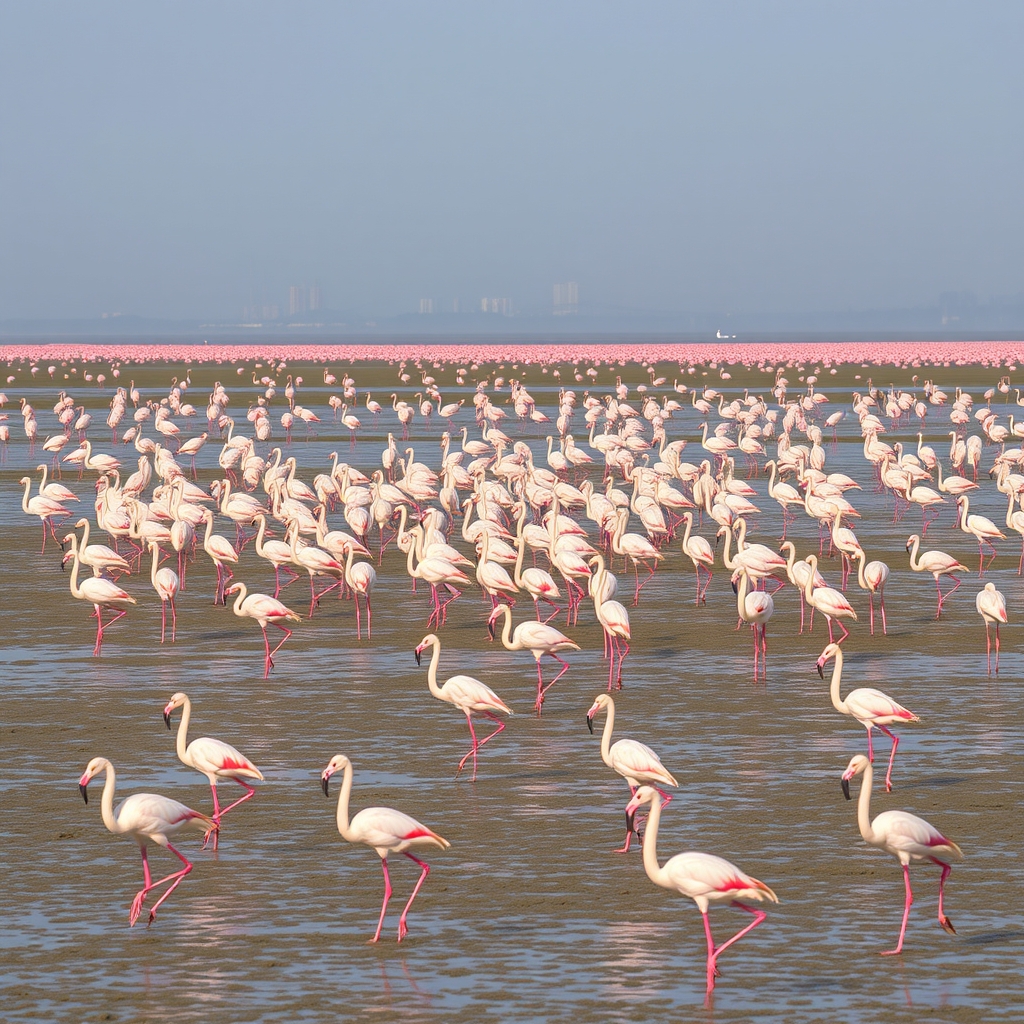
Photo: Sumita Roy Dutta · CC BY-SA 4.0 · via Wikimedia Commons
Some time around November, when the worst of the humidity has lifted and Mumbai starts sleeping under a sheet again, the mudflats along the eastern edge of the city begin to turn pink. Tens of thousands of flamingos, most of them flown in from the Rann of Kutch, settle into the tidal creeks between Sewri and Thane for the winter and stay well into the pre-monsoon heat. You do not need to leave the city to see them. Between roughly November and May you can watch flocks that run into the thousands from a public jetty, from a forest-department boat gliding through the mangroves, or from a quiet birding trail behind a pumping station. This guide covers the three places worth your time, when to go, how the tides govern everything, and what to carry so the trip is actually worth the early alarm.
The single most important thing to understand before you go is that flamingo watching in Mumbai is not like visiting a zoo, where the animals are always there and always close. These are wild birds feeding on the rhythm of the sea, and whether you see a distant pink haze or a wall of birds a hundred metres away comes down to two things you can control — the month and the tide — and one you cannot, which is luck. Get the first two right and the odds swing heavily in your favour.
| Spot | Area (nearest line) | Cost | Best months | Best for |
|---|---|---|---|---|
| Sewri Jetty (Flamingo Point) | Sewri, Harbour Line | Free | Dec–Apr | A free, spur-of-the-moment look; big distant flocks |
| Airoli boat safari (Thane Creek Sanctuary) | Airoli, Navi Mumbai (Trans-Harbour Line) | ~₹400–650 + small entry | Late Jan–May | Getting close; families and first-timers |
| Bhandup Pumping Station | Bhandup West / Mulund East, Central Line | Free (guided walks may charge) | Dec–Apr | Serious birders; the widest variety of species |
When to go: the season and the tide
Two clocks matter here, and you have to read both. The first is the calendar. The second is the tide, and it is the one most first-timers get wrong.
The calendar
Flamingos begin arriving from November, build through the winter, and are usually at their most numerous from December to April, with birds lingering into May before the monsoon scatters them and they head back towards Gujarat. If you can only make one trip, aim for February or March — the flocks are large and settled, the birds have fanned out across all three sites, and the light is still kind in the early hours before the summer haze thickens.
Early in the season, in November and early December, the numbers are still building and can be patchy from week to week. By the tail end, in late April and May, the heat is punishing and the birds thin out, though the boat safari at Airoli often holds good numbers latest of all. There is no need to chase a single perfect weekend; across the December-to-April window, any morning with the right tide is a reasonable bet.
The tide, and why it decides everything
Flamingos feed by sweeping their heads through shallow water and soft mud, filtering out the algae and tiny crustaceans that give their feathers that pink wash. That means they follow the water. At dead low tide the mudflats are fully exposed, the birds are scattered far out across acres of mud, and from the shore you will see distant pink smudges at best. As the tide turns and begins to climb, the rising water gently herds the flocks inwards — towards the mangrove edge, towards the jetty, towards you.
The sweet spot for shore-watching is a rising tide, roughly a couple of hours after low water, as it climbs towards high. The birds are being pushed closer but the mud has not yet drowned. At full high tide the feeding grounds disappear under water and the flocks lift off altogether, wheeling away in ribbons that are lovely to watch but hopeless to photograph. So before you fix a date, look up a Mumbai (Sewri) tide table — most weather apps and marine sites list one — and pick a morning where the tide is coming in during daylight hours, ideally between about 7am and 10am. Note the height too: a tide climbing to a healthy high of four metres or more will push the birds in far more convincingly than a weak one.
Mornings win on every count anyway. It is cooler, the light is soft and low, the birds are active and feeding, and you will beat both the heat and the day’s crowds. An afternoon rising tide can work in a pinch, but the light is harsher and the haze off the creek flattens everything. If you are the sort who likes to end a Mumbai day watching the sky change over the water instead, that is a job for the best sunset viewpoints in the city — the flamingo creeks are a morning affair.
The three places worth your time
Sewri Jetty (Flamingo Point) — the free classic
Area: Sewri, on the harbour (eastern) side of the city. This is the spot that put Mumbai’s flamingos on the map, and it is still the easiest: no ticket, no booking, just turn up. Walk out towards the jetty in Sewri, past the old salt pans and the working harbour, and on a good rising tide you will see flamingos strung across the mudflats in their hundreds, sometimes thousands, along with egrets, sandpipers, herons and the odd painted stork stalking the shallows.
A few honest caveats, because Sewri is not a manicured reserve and it helps to arrive knowing that. This is a functioning port and industrial zone — oil installations, container trucks, fishing boats, the smell of the working sea. There is almost no shade, so go early and be ready to leave before the sun turns brutal by mid-morning. The birds keep their distance here, often a few hundred metres out, so this is a place that rewards binoculars far more than a phone camera; a phone will give you a grey expanse of mud with a pink thread across it. And the flamingos now share their patch with the enormous Atal Setu sea bridge (the Mumbai Trans Harbour Link), which begins its span at Sewri. Noise barriers and mangrove replanting were built in as mitigation, and reassuringly the flocks have kept coming, but the vista is undeniably framed by the bridge these days.
If you want the fuller picture on this one site — exactly where to stand, how the salt-pan approach works, and what else turns up — we have a dedicated Sewri flamingo deep-dive that goes further than there is room for here.
Tip: the Bombay Natural History Society (BNHS) and a handful of other groups run guided flamingo walks at Sewri through the season, and going with one is the single best way to learn to tell the birds apart, borrow a spotting scope, and have someone who actually knows the tide standing next to you.
Thane Creek Flamingo Sanctuary and the Airoli boat safari
Area: Coastal & Marine Biodiversity Centre, Sector 10, Airoli, Navi Mumbai. If you want to get genuinely close — the kind of close where you can watch a single bird tip its head to feed — this is the trip to book. Run by the Maharashtra Mangrove Cell (the state Forest Department) with guides trained by the BNHS, the centre launches small boats that carry you roughly 10 km into the creek and its mangrove channels, right up to where the flamingos are feeding. The ride lasts around 45 minutes to an hour, life jackets are provided for everyone including small children, and it is comfortably the most family-friendly way to see the birds. If you are planning around little ones, it slots neatly into a wider list of family things to do in Mumbai.
Because the boats need water under the keel, safari timings track the high tide and therefore change every single day — there are usually a few departures clustered around the day’s high water, slots are limited, and they sell out. So book at least a week ahead. Bookings and the day’s timings are handled by the centre directly on +91 99876 73737; call rather than rely on anything you read online, because the schedule genuinely moves day to day. Expect to pay in the region of ₹400–650 per person depending on the day, with weekends at the top of that range, for the boat ride itself, plus a small entry fee (about ₹50 for adults and ₹25 for children). Be wary of third-party operators who bundle in transport and charge ₹1,000 or more per head — the safari is inexpensive if you book the centre directly, and the markup buys you very little.
The best months here run a little later than Sewri, from late January through to about May, so Airoli is your best option if you have left it late in the season. There is also a small marine-biodiversity museum on site, worth a wander while you wait for your slot, with displays on the mangroves and the creek’s ecosystem that add useful context to what you are about to see.
One naming knot that trips people up: “Thane Creek Flamingo Sanctuary,” “the Airoli boat safari” and “the Coastal & Marine Biodiversity Centre” all refer to the same operation on the Airoli side of the creek. Days and timings shift, and it is not open every day of the week, so confirm the operating day when you phone rather than assuming a weekend will be running.
Bhandup Pumping Station — for the keen birder
Area: Bhandup West / Mulund East, along the same Thane Creek wetland. This one is for people who genuinely like birds rather than a boat outing with a view. Behind Asia’s largest water-treatment plant lies a stretch of wetland and mangrove that is one of Mumbai’s richest birding patches — quieter, wilder, and far less visited than Sewri. Alongside both flamingo species you can reasonably expect painted storks, black-headed ibises, Eurasian spoonbills, kingfishers and a long list of waders and waterfowl; keen birders keep species tallies here that run well into the dozens on a good morning.
The trade-off is comfort. It is rough underfoot, there are no facilities to speak of, and access can be restricted, so most people come on an organised birdwalk — groups such as Nature Explorers India and the BNHS run them in season, and a knowledgeable leader is worth a great deal in a place with this much variety. Go at first light between December and April, wear shoes you do not mind ruining, and carry your own water and any snacks. If a morning here whets your appetite for the city’s wilder edges, Mumbai’s Sanjay Gandhi National Park is the obvious next outing for anyone who has caught the nature bug.
Telling the two flamingos apart
Part of the pleasure, once you have found the flocks, is realising you are looking at two different birds. Mumbai’s creeks host both the Lesser Flamingo and the Greater Flamingo, and once you know the trick you will not un-see it.
Lesser Flamingos are the smaller, more numerous, and noticeably pinker of the two — the ones responsible for the deep rose blush that photographs so well when the flock is dense. Greater Flamingos stand taller, look distinctly paler, almost white with a wash of pink, and carry a longer neck. The surest field mark is the bill: the Greater’s is pink with a clean black tip, while the Lesser’s looks darker, almost entirely deep red-black at a distance. Through binoculars, a mixed flock resolves into a satisfying jumble of the two, and picking out the taller, paler Greaters among the crowd is exactly the sort of small puzzle a guided walk teaches you to enjoy.
Getting there
All three sites sit on the eastern, creek-facing spine of the city, which is well served by the suburban rail network — usually the fastest and cheapest way in. If the local train is new to you, it is worth a quick read of our Mumbai local train guide before you set off, and our broader getting around Mumbai explainer covers the cabs, autos and app-taxis that cover the last stretch.
- Sewri sits on the Harbour Line; Sewri station is the nearest, and it is a short auto or walk from there towards the salt pans and jetty. Ask for “Flamingo Point” or the jetty and most locals will point you right.
- Airoli is reached via the Trans-Harbour Line to Airoli station, then a short cab ride to Sector 10 and the Coastal & Marine Biodiversity Centre. Give yourself buffer time — you do not want to miss a tide-locked boat slot to a traffic snarl on the way.
- Bhandup is on the Central Line; the pumping station wetland lies east of Bhandup station towards the creek, and because access is awkward, going with an organised group that arranges the meeting point saves a lot of confusion.
Because the birds vanish with the first rains, do not leave your trip until the monsoon is knocking — by June the flocks are gone and the creeks belong to the Mumbai monsoon instead.
Photography and binoculars: setting expectations
Be honest with yourself about kit before you go, because nothing sours a flamingo morning faster than expecting frame-filling photos and getting pink dots. At Sewri and Bhandup the birds are far, and a phone camera will disappoint — you will get a nice record of a wide muddy vista and not much of the birds themselves. A telephoto lens, ideally 300mm or longer, is what turns a distant flock into a photograph. On the Airoli boat you can get close enough for a phone to do something, but even there a proper zoom pays off, and you will be shooting from a moving boat, so keep your shutter speed high and brace against the hull.
For everyone else, binoculars are the great equaliser. A modest 8x42 pair transforms all three sites and costs a fraction of a long lens. If you own neither and are not sure this will become a habit, join a guided walk — the leaders almost always carry a spotting scope and are generous about letting first-timers take a look through it, which is genuinely the best view you will get anywhere.
Watching responsibly
These are wild birds on the fragile, working edge of a very big city, and they spook easily. Keep your voice down, do not clap, whistle or throw anything to make the flock take off “for a better photo” — a panicked lift-off costs the birds precious feeding energy and ruins the moment for everyone else on the shore. Stay on the paths and jetty at Sewri rather than wading out onto the mud, which is both dangerous underfoot and disturbing to the birds. Carry your litter back out with you; there are no bins worth the name at any of these sites. And if you are on the boat, follow the guide’s lead on how close is close enough. The reason Mumbai still has this spectacle at all is that these habitats have been, just about, protected — treat them accordingly and they will still be pink for the next person.
What to carry
- Binoculars. The one non-negotiable. At Sewri and Bhandup the birds are far; even on the boat they help.
- Sun protection and water. A hat, sunscreen and a full bottle. Shade is scarce to non-existent everywhere on this list.
- Closed shoes. Mudflats and mangrove edges are no place for good sandals — wear something you can hose down after.
- A telephoto lens if you are a photographer; phone cameras will disappoint at Sewri and Bhandup.
- The tide table, checked the night before, plus a fully charged phone and a little cash for the boat fee and autos.
The bottom line
Mumbai is one of the few big cities on earth where you can watch twenty-thousand-odd flamingos wade through a tidal creek and still be home for lunch. Pick a morning in the December-to-April window, check the tide so you arrive as the water is coming in, and choose your vantage to suit the company: Sewri for a free, spur-of-the-moment look, the Airoli boat safari for families and anyone who wants to get close, and Bhandup for the serious birder. Carry binoculars, keep your distance, respect that these are working, fragile habitats on the edge of a very big city, and let the tide do the rest. Do it once and the sight of the mudflats turning rose-pink at dawn tends to become an annual pilgrimage. For more ways to fill the day around it, our roundup of things to do in Mumbai has the rest of the city covered.
Frequently Asked Questions
When is the best time to see flamingos in Mumbai?
Flamingos arrive from around November and are usually most numerous from December to April, with some lingering into May before the monsoon scatters them. February and March are the safest bet for large, settled flocks. Just as important as the month is the time of day and tide: go in the early morning on a rising tide, roughly a couple of hours after low water as it climbs towards high.
Where can I see flamingos in Mumbai?
There are three main spots, all on the city's eastern creek edge. Sewri Jetty (Flamingo Point) is free and needs no booking, offering big but distant flocks. The Airoli boat safari, run by the Thane Creek Flamingo Sanctuary, takes you close to the birds by boat and is best for families. Bhandup Pumping Station is a rougher, quieter wetland that rewards keen birders with the widest variety of species.
How much does the Airoli flamingo boat safari cost and how do I book it?
The boat ride itself runs roughly ₹400–650 per person depending on the day, with weekends at the top of that range, plus a small entry fee of about ₹50 for adults and ₹25 for children. Rates are revised from season to season, so confirm the current price when you book. Book directly with the Coastal & Marine Biodiversity Centre in Airoli on +91 99876 73737, at least a week ahead, since timings track the daily high tide and slots sell out. Avoid third-party operators who bundle in transport and charge ₹1,000 or more per head.
Why does the tide matter for flamingo watching in Mumbai?
Flamingos feed on algae and tiny crustaceans in the exposed mudflats, so they move with the water. At dead low tide the birds are scattered far out and appear as distant pink smudges, while at full high tide the mud drowns and the flocks fly off. The best window is a rising tide, a couple of hours after low water, when the incoming water gently herds the birds closer to shore. Check a Mumbai (Sewri) tide table before fixing your date.
Do I need binoculars or a special camera to see the flamingos?
For Sewri and Bhandup, binoculars are essentially non-negotiable because the birds stay a few hundred metres out, and a phone camera will only capture pink dots on grey mud. A telephoto lens of 300mm or longer is what turns a distant flock into a real photograph. On the Airoli boat safari you get close enough for a phone to work, but even there binoculars or a zoom lens noticeably improve the experience.
Is the flamingo boat safari safe for children and families?
Yes. The Airoli boat safari provides life jackets for everyone, including small children, and the creek water is calm rather than open sea. The ride lasts about 45 minutes to an hour and gets you close to the birds without any rough terrain, making it the gentlest and most family-friendly of the three flamingo-watching options in Mumbai.