
Monsoon Treks Near Mumbai: Easy to Challenging Rain Trails
A Mumbai trekker's monsoon guide to Rajmachi, Andharban, Peb Fort and Kalsubai, graded easy to challenging, with fitness, gear, permits and rain-safety advice.
'%3E%3Crect%20width%3D'96'%20height%3D'96'%20fill%3D'%23E65100'%2F%3E%3Ccircle%20cx%3D'30'%20cy%3D'24'%20r%3D'44'%20fill%3D'%23fff'%20opacity%3D'.12'%2F%3E%3Ccircle%20cx%3D'60'%20cy%3D'74'%20r%3D'40'%20fill%3D'%23000'%20opacity%3D'.10'%2F%3E%3C%2Fg%3E%3Cg%3E%3Ccircle%20cx%3D'48'%20cy%3D'48'%20r%3D'15'%20fill%3D'none'%20stroke%3D'%23fff'%20stroke-width%3D'3'%2F%3E%3Cpath%20fill%3D'%23fff'%20d%3D'M48%2037%20l3.5%2011%20-3.5%2011%20-3.5%20-11%20z'%2F%3E%3Ccircle%20cx%3D'48'%20cy%3D'48'%20r%3D'2.2'%20fill%3D'%23fff'%2F%3E%3C%2Fg%3E%3C%2Fsvg%3E)
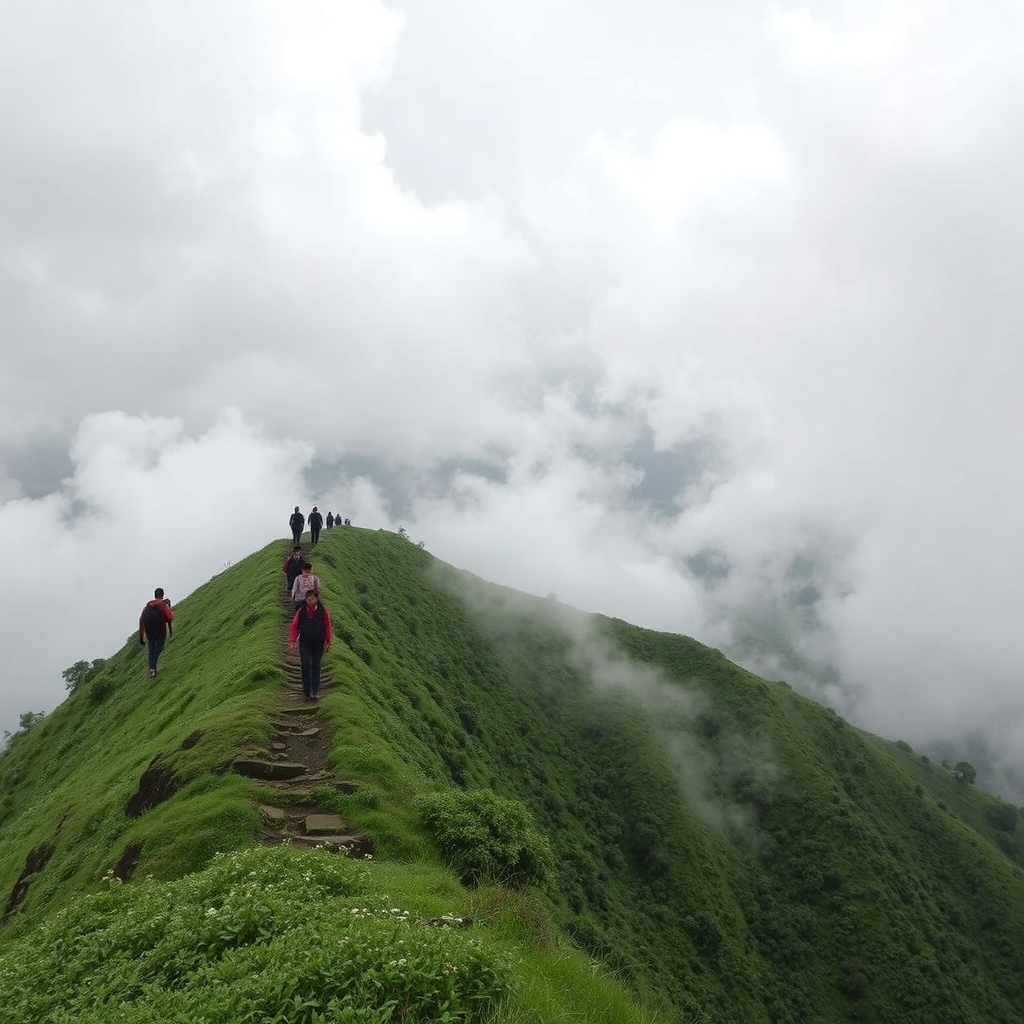
Every July, the same thing happens to Mumbai trekkers: one wet weekend on the Western Ghats and you are ruined for the season, checking rainfall totals like a farmer and hoarding leave for the next clear-ish Sunday. The Sahyadris an hour or three east of the city turn into moving cloud, streaming basalt and a green that looks slightly fake in photographs. But “monsoon trek” covers everything from a stroll a grandparent could manage to a slippery ladder-haul that has no business being attempted by a nervous beginner in heavy rain. The four trails below are arranged deliberately, easy to challenging, so you can match the walk to your legs rather than your Instagram feed. All four are real, well-trodden and run by organised groups out of Mumbai every weekend of the season.
The four trails compared
| Trek | Base / access | Grade | Distance | Signature challenge |
|---|---|---|---|---|
| Rajmachi Fort | Lonavala (Central line), ~80 km | Easy | ~15 km gentle track | Distance, mud in peak rain |
| Andharban | Tamhini/Mulshi, ~130 km, road only | Easy–moderate | 11–13 km descent | Slippery roots, permit needed |
| Peb Fort (Vikatgad) | Neral (Central line), ~4 km base | Moderate | Half-day climb | Four bolted iron ladders |
| Kalsubai | Bari, via Kasara, ~155 km | Challenging | ~6.6 km one way | Sustained ascent + wet ladders |
First, the monsoon rules that apply to all of them
The trekking window is roughly mid-June to late September. Counter-intuitively, late June and September are the kinder weeks for beginners: the trails are green but not yet fully flooded or churned to slush. Peak July–August gives you the drama and the danger in equal measure.
Three things are non-negotiable in the rain:
- Shoes with real grip. The commonest Sahyadri injury is a simple slip on wet rock or mud, not anything heroic.
- A local guide or a registered group, not because these trails are technical but because monsoon conditions change within hours, stream crossings swell, and someone who walked the route last weekend is your best safety tool.
- Respect for water in spate. Every year the Ghats kill visitors who wade into a stream or sit under a fall while rain they cannot see is falling upstream. Admire fast water from the bank.
The four trails, easiest first
Rajmachi Fort (Easy)
Area: near Lonavala, ~80 km from Mumbai via the Central line to Lonavala. This is the trek to start a monsoon season on, or to bring a mixed-fitness group to. Rajmachi is really twin forts — Shrivardhan (~2,710 ft) and Manaranjan (~2,510 ft) — sharing one base hamlet, Udhewadi. The classic monsoon approach from Lonavala is a long, gentle jeep track of roughly 15 km through the Shirota forest: almost flat, hard to get lost on, and lined the whole way with drifting cloud, tiny appearing-and-vanishing waterfalls and the roar of the Kataldhar fall in the valley. There is a steeper, shorter route up from the Karjat/Kondhane side that passes the 1st-century-BC Kondana Buddhist caves, but it involves river crossings and is best left to fitter walkers in full rain.
Why it is worth it: two forts, rock-cut water tanks on top, a genuine village to eat pithla-bhakri and drink chai in, and scenery that punches far above the effort required.
Practical tip: in peak monsoon vehicles cannot reach Udhewadi — the mud track gives out — so plan to walk the last stretch, or book an overnight camping package (roughly ₹1,200–1,600 per person with tent and meals) and do the forts unhurried the next morning.
Andharban (Easy to moderate)
Area: Tamhini Ghat / Mulshi belt, ~130 km from Mumbai; no train, so this is a road or organised-tour trek. The name means “dense forest,” and that is the entire pitch. Andharban is unusual for the Sahyadris in that it mostly goes down — an 11–13 km one-way descent from Pimpri village to the backwaters of the Bhira dam, taking five to six hours. In monsoon the canopy closes over you, temperatures sit around a cool 16–24°C, and the forest is so thick and misted that it earns its “dark forest” reputation. The gradient is forgiving, but slippery roots, high humidity and a few water crossings nudge it past “easy” on a wet day.
Why it is worth it: it feels like a Sahyadri from a film rather than a day trip from a city of twenty million.
Practical tip: Andharban is protected forest — a Forest Department permit (issued in limited numbers) and a department-appointed guide are compulsory, one guide per batch of up to 25. It is also the most frequently closed trek in Maharashtra: in heavy-rain spells the department shuts it for safety at the crossings and for wildlife breeding, so confirm it is open before you commit. Carry all your water; there is no reliable drinking source on the trail. Reputable operators run it from around ₹1,000–1,400 per person.
Peb Fort / Vikatgad (Moderate)
Area: near Neral and Matheran, ~4 km from Neral station on the Central line. This is where monsoon trekking gets properly exciting. From the base near Neral (Anandwadi/Fanaswadi side), the climb to the summit takes about two-and-a-half to three hours through dense forest and a ridge, finishing with a genuine little adrenaline course: a rock patch and four bolted iron ladders that are stable but feel a great deal more serious when they are wet and streaming. There are old caves near the top where sadhus once lived, and on a clear break in the cloud you look straight across at Matheran’s plateau.
Why it is worth it: it delivers the “on top of the clouds” moment with real exposure and ladder-work, without needing a multi-day commitment. You can even descend the other side into Matheran and take the road out.
Practical tip: the ladders and rock steps get glassy in July–August, so this is one to do with a group and grippy shoes, and to skip if you or anyone with you is uneasy with heights on wet metal. Neral is an easy Central-line ride, which keeps the whole day cheap.
Kalsubai (Challenging)
Area: Bari village, ~155 km from Mumbai; Central line to Kasara, then a shared jeep to base. Kalsubai is the highest point in Maharashtra at 1,646 m (about 5,400 ft), and topping it is a rite of passage. It is a moderate-graded trek on paper — roughly 6.6 km one way, three to four hours up — but four steep iron ladders bolted to near-vertical rock make it feel considerably harder in the rain, and you must negotiate every one of them again on the way down. A small Kalsubai Devi temple sits at the summit. Honesty demands two warnings: in peak monsoon the ladder section gets crowded with weekend crowds and slick with rain, and the “view” is very often a wall of white fog and hard wind rather than the famous panorama.
Why it is worth it: it is the roof of the state, and the cloud-and-fog atmosphere at the top is its own reward even without the vista.
Practical tip: most guides advise beginners to avoid Kalsubai in the wettest weeks precisely because of the slippery ladders — save it for late September or the post-monsoon clarity of October–November if you are new to this. Organised trips (often overnight, starting late to reach the summit by dawn) run from roughly ₹500 by train-based groups up to ₹1,500-plus for AC-bus packages from Mumbai.
Matching the trek to your fitness
Be plain with yourself. Rajmachi and Andharban ask mainly for stamina to keep walking for a few hours; a reasonably active person who climbs the odd flight of stairs will cope. Peb Fort adds ladder-work, mild exposure and a real climb, so you want to be comfortable pulling your own weight up wet metal. Kalsubai stacks sustained ascent, height and repeated ladders — attempt it in monsoon only if you already trek regularly and are steady with heights. If in doubt, go one rung easier than your ego suggests; wet rock is unforgiving of over-ambition.
Gear that actually earns its place
Skip the fashion, carry the essentials. Grippy, water-resistant trekking shoes with ankle support come first — everything else is secondary to not slipping. Then a rain cover for your pack, a fully separate dry set of clothes sealed in a plastic bag, a light rain jacket, quick-dry clothing, a spare pair of socks, basic first aid and enough water and snacks for the whole trail. From July onward, leeches are a certainty on forested trails like Andharban and Peb: wear long socks tucked over your trouser cuffs, and carry a little salt or a lime to make them let go. Keep your phone and documents in a zip-lock.
Permits, guides and the paperwork
Only Andharban has a formal permit-and-guide requirement, run through the Forest Department, and it is strictly enforced — going with a licensed operator handles it for you. The others need no personal permit, but Maharashtra authorities and forest offices routinely restrict or close routes during red and orange rainfall alerts, and Raigad and neighbouring districts issue monsoon prohibitory orders around dams, waterfalls and dangerous water. Check the IMD forecast the morning you leave, ring your operator to confirm the trail is open, and treat any official closure as final rather than a challenge.
Insider tips for monsoon trekking near Mumbai
- Book the early local. The best light and the emptiest trails belong to whoever catches the first Central-line train out.
- Start easy and build. Do Rajmachi in June, work up to Peb in August, and save Kalsubai for the post-monsoon clarity.
- Carry cash in small notes for jeeps, entry and village chai — UPI is patchy in the Ghats.
- Pack out everything. Leeches aside, the fastest way to get a trail closed is litter at the crossings.
- Confirm the trail is open the night before. Andharban especially can shut with no notice; a phone call saves a wasted trip.
The bottom line
The best thing about living near Mumbai in the monsoon is that a genuine cloud-forest is a train ride away, and these four trails let you dial the intensity up as your confidence grows: an easy fort walk at Rajmachi, a dim green descent at Andharban, a ladder-and-ridge scramble at Peb, and the full roof-of-Maharashtra effort at Kalsubai. Start easy, respect the water and the weather, wear shoes that grip, and let a guide who knows the current state of the route make the call on a bad-forecast day. Do that, and the Sahyadris give you the finest weekends of the year.
Frequently Asked Questions
Which monsoon trek near Mumbai is best for a complete beginner?
Rajmachi from the Lonavala side is the safest first monsoon trek — a long but gentle jeep track that is hard to lose. Andharban suits a fit beginner when it is open, but confirm first; leave Peb and especially Kalsubai until you have easier treks behind you.
Do I need my own transport for these treks?
Mostly no. Rajmachi (Lonavala), Peb (Neral) and Kalsubai (Kasara) are all reachable by Central-line train plus a short jeep or walk, which is why organised groups favour them. Andharban is the outlier — no convenient train, so it needs a road trip or a packaged tour.
Why is Andharban so often closed in July?
It runs through protected forest with water crossings that turn dangerous in heavy rain, and the Forest Department also closes it during wildlife breeding. It is genuinely known as the most-banned trek in Maharashtra, so a closure is normal, not a scam.
Are the iron ladders on Peb and Kalsubai safe when wet?
The ladders themselves are bolted and stable, but wet metal plus a queue of nervous trekkers is where accidents happen. Go with a group, keep three points of contact, and never rush the descent.
Roughly what does an organised day trek cost from Mumbai?
Expect somewhere between ₹500 and ₹1,600 per person depending on the trek and whether transport and meals are bundled, plus another ₹100–200 for village food like poha, pithla-bhakri and endless chai.