
Mount Mary Basilica & the Bandra Fair: Mumbai's Great Church Festival
A local's guide to Mount Mary Basilica and the September Bandra Fair — feast dates, wax offerings, mass timings, choris pao and how to dodge the crowds.
'%3E%3Crect%20width%3D'96'%20height%3D'96'%20fill%3D'%23E65100'%2F%3E%3Ccircle%20cx%3D'30'%20cy%3D'24'%20r%3D'44'%20fill%3D'%23fff'%20opacity%3D'.12'%2F%3E%3Ccircle%20cx%3D'60'%20cy%3D'74'%20r%3D'40'%20fill%3D'%23000'%20opacity%3D'.10'%2F%3E%3C%2Fg%3E%3Cg%3E%3Ccircle%20cx%3D'48'%20cy%3D'48'%20r%3D'15'%20fill%3D'none'%20stroke%3D'%23fff'%20stroke-width%3D'3'%2F%3E%3Cpath%20fill%3D'%23fff'%20d%3D'M48%2037%20l3.5%2011%20-3.5%2011%20-3.5%20-11%20z'%2F%3E%3Ccircle%20cx%3D'48'%20cy%3D'48'%20r%3D'2.2'%20fill%3D'%23fff'%2F%3E%3C%2Fg%3E%3C%2Fsvg%3E)
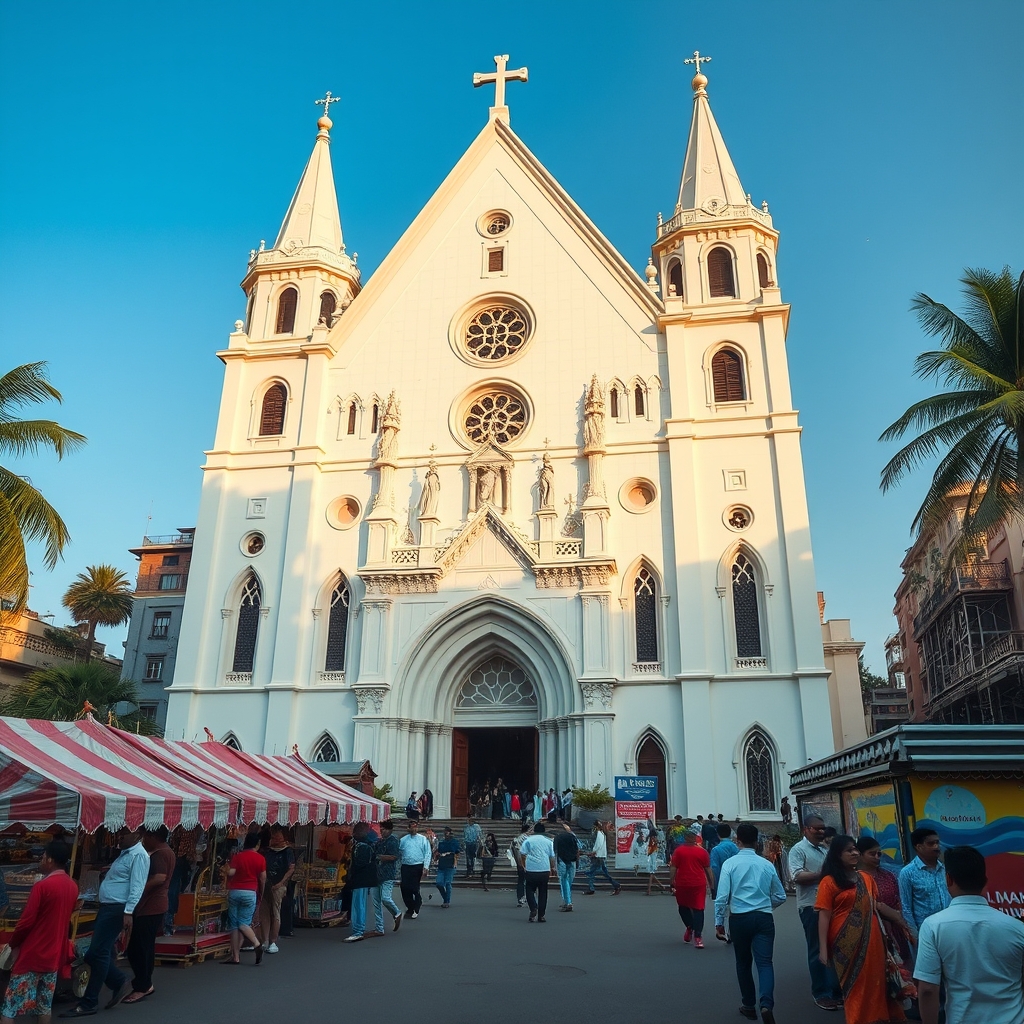
Photo: Rakesh Krishna Kumar · CC BY-SA 2.0 · via Wikimedia Commons
On a low hill above Bandra’s Bandstand, about 80 metres over the Arabian Sea, stands a butter-yellow church that half of Mumbai seems to have prayed at at least once. This is the Basilica of Our Lady of the Mount — Mount Mary to everyone who knows it — and for one week each September the quiet lanes below it become the Bandra Fair, the city’s oldest and largest Catholic festival. What makes it worth your time is not grandeur but the mix: Koli fisherfolk, East Indian families, Goans, Mangaloreans, and a great many Hindus and Muslims all climb the same steps to light a candle. This is a practical, first-hand guide to the shrine, the fair, the wax offerings that puzzle newcomers, and how to manage the famous September crowds.
Mount Mary and the Bandra Fair at a glance
| What | Detail | Approx cost (₹) | Best time |
|---|---|---|---|
| Basilica visit (non-fair) | Free entry, calm interior | Free | Weekday, not Wednesday |
| Devotional candle | Lit at the shrine | A few rupees | Any time |
| Wax offering figure | House, car or body part | From ~50 | During the fair |
| Choris pao / fair snacks | Goan sausage roll, sweets | Under 100 | Fair week, evenings |
| Bandra Fair | Feast + week-long fair | Free to enter | Weekday early/late |
A hilltop shrine with a 300-year story
The Jesuits raised a chapel on this hill in the seventeenth century, when Bandra was a Portuguese village of paddy fields and fishing hamlets. The church has been knocked down and rebuilt more than once. In 1700, Arab raiders are said to have damaged the statue of Mary, cutting off its right hand while looking for gold; the church itself was destroyed in 1738 during the Maratha campaign against the Portuguese at Bassein. It was rebuilt around 1760, and the present structure dates to 1904.
The statue at the heart of it all has its own legend, and it is a good one. A Koli Christian fisherman is said to have dreamed of a statue floating in the sea; the next morning it was found bobbing in the water off Bandra, and locals took it for a miracle. That is the origin story of both the shrine’s devotion and the fair. Bandra’s people affectionately call the image Moti Mauli, “Pearl Mother”. In 1954 the statue was granted a papal decree of canonical coronation, and the church is today a minor basilica — the “basilica” you see on the signboards.
You need not be Catholic, or religious at all, to appreciate it. The interior is cool and calm, with stained glass and a much-loved image of the Madonna and Child above the altar. Step to the front and you get a clean sweep of the sea. It costs nothing to enter.
The Bandra Fair: what actually happens
The feast marks the Nativity of Mary on 8 September. In practice the celebration is built around the Sunday on or after that date, preceded by a nine-day novena and followed by a week-long fair running to the “octave” Sunday — a stretch of roughly a fortnight in all. To picture it: in 2025 the novena ran 5–13 September, the feast fell on Sunday 14 September, and the octave closed the following Sunday, 21 September. Dates shift each year with the calendar, so check the basilica’s own site (mountmarybasilicabandra.in) for the current schedule before you plan.
During the fair the roads around the church — Mount Mary Road and the steps leading down towards Bandstand — fill with stalls, fairy lights and a slow river of people. Lakhs of pilgrims come over the week. It is loud, warm and generous-spirited: part pilgrimage, part street fair, part family day out.
What are the wax offerings and candles?
The stalls that stop every newcomer are the wax sellers. Alongside ordinary devotional candles you will find wax models of houses, cars, boats, and — most strikingly — human body parts: hands, feet, legs, hearts, even a whole tiny figure. The idea is simple and old. You offer a wax figure of the thing you are praying for. Hoping to buy a home, you offer a little wax house; praying over a bad knee or a sick child, you offer the matching wax limb, and light a candle for the intention. Whether or not you share the belief, it is a quietly moving thing to watch. A candle costs a few rupees; the moulded figures run from around ₹50 upward depending on size.
What should you eat at the Bandra Fair?
The food is a large part of why regulars come back. The stalls are a roll-call of Christian and coastal sweets and snacks: choris pao (spicy Goan-style sausage stuffed into a bread roll), kala channa (spiced black chickpeas), and the fair’s signature sugar-coated sweet sticks, kadyo-bodyo. Look too for guava cheese (perad) from Goa, Kerala and Calicut halwa, mawa peda, groundnut chikki and slabs of petha. A choris pao or a paper cone of sweets rarely tops ₹100. It is street food, so eat where the queue is longest and the turnover quick.
The fair is also the easiest window into East Indian cooking — the cuisine of Bombay’s original Catholic community, distinct from Goan food in that it leans far less on coconut and pivots instead on the community’s fiercely guarded “bottle masala”, a blend of dozens of roasted spices. Dishes to know are pork sorpotel (dark, semi-dry, tangy), vindaloo, potato chops, the fried sweet-savoury dumplings called fugias, and the festive wedding rice. You will find these more reliably in Bandra’s East Indian homes and a few local kitchens than at the stalls, but the fair is the moment the community is most visible.
Mass timings and visiting the basilica
On ordinary days the basilica keeps a gentle rhythm: weekday masses in the early morning (around 6:30 and 7:30am), with several more on Sunday mornings from about 6:30 to 9:30am. The church is generally open for quiet visits from roughly 8am to 8:30pm, with a short midday break on weekdays; Sundays it opens later, around 10:30am. Wednesday is the traditional novena day and draws the biggest weekly crowds all year, so a weekday other than Wednesday is calmest for a peaceful look.
During the feast the schedule expands enormously — masses run through the day from about 5:30am, including evening services, said in a rotation of languages (Konkani, Marathi, Tamil, Malayalam, Kannada, Hindi and Gujarati among them) to serve the mix of communities. Those timings change each year, so confirm them on the notice board or the official site.
Etiquette is simple. Dress modestly — this is a working church, and during mass especially, keep shoulders covered. Switch phones to silent inside, keep photography discreet during services, and join the candle queue rather than jumping it.
Getting there and handling the crowds
The basilica sits above Bandstand, Bandra West. The practical arrival point is Bandra station (Western and Harbour lines), about 3 km away — take an auto or taxi to “Mount Mary” (every driver knows it), or walk west through Hill Road and Chapel Road if you fancy the stroll. BEST buses run from outside Bandra station towards the church through the day.
During the fair, plan around the crush. Come on a weekday if you can, and early in the morning or after about 8pm rather than the Sunday-evening peak. Roads around the church are closed to most traffic, so expect to walk the last stretch regardless. Carry water, wear shoes you can stand in for a while, keep valuables zipped and close in the crowd, and settle a fare with the auto before you set off. If you only want a calm visit and not the fair, simply avoid the September feast fortnight — the rest of the year the shrine is serene.
Is Mount Mary worth visiting outside the fair?
Very much so, and for many that is the better trip. Strip away the September crowds and you are left with a calm, sea-lit basilica where you can actually sit, light a candle without queuing, and take in three centuries of story at your own pace. The best time for a peaceful visit is a weekday morning that is not a Wednesday — Wednesday is the traditional novena day and draws the biggest weekly crowds all year. Come mid-morning, spend twenty quiet minutes inside, then walk down to Bandstand for the sea. It is one of Bandra’s most restorative couple of hours, and it costs nothing.
The wider Bandra Catholic heritage
Mount Mary is the crown, but it sits inside a living Catholic landscape that predates almost everything else in the suburb. Bandra grew from a scatter of Portuguese-era fishing and farming hamlets — the gaothans and Koliwadas — and their descendants, the East Indians, are Bombay’s original Catholic community. Wander the older lanes of Ranwar, Sherly-Rajan and Chuim and you will find low tiled cottages, wayside crosses (the whitewashed khambas at street corners), and a village calm a few metres off Bandra’s busy roads.
These villages are the reason the Bandra Fair feels less like a tourist event and more like a community homecoming. The same families who farm the East Indian bottle-masala tradition, who cook sorpotel and fugias at Christmas and Easter, are the ones who fill the novena pews in September. Visiting Mount Mary with that context — that it is the shrine of a specific, centuries-old Bombay community, not just a photogenic yellow church — is what turns a quick stop into an actual encounter with the city’s oldest layer.
Make a half-day of it
The beauty of Mount Mary is how much sits within a short walk.
- Bandra Bandstand — the 1.2-km seafront promenade runs right below the hill: a jogging track, sunset spot and people-watching bench by turns, lined with the sea on one side and, famously, the homes of a few film stars on the other. Best in the hour before dusk.
- Bandra Fort and Land’s End — a little along is Castella de Aguada, the Bandra Fort, a Portuguese watchtower from 1640 perched at Land’s End. Free, open-air, and the cleanest view of the Bandra–Worli Sea Link arcing across the bay. Sunset here is one of the suburb’s small pleasures.
- Chapel Road and St Andrew’s — on the walk up from the station, Chapel Road is worth slowing for, its walls covered in Bandra’s well-known street murals. Nearby St Andrew’s Church, one of the area’s oldest, is the parish the replacement Mount Mary statue is said to have come from, rounding out a short circuit of the village’s Catholic heritage.
Plan your visit
Mount Mary rewards two very different trips. Come in September and you get the Bandra Fair in full cry — wax offerings, sausage rolls, sugar sticks and a good-natured crowd of every faith climbing the hill together, one of the most genuinely Mumbai things you can witness. Come on a quiet weekday and you get a calm, sea-lit church with three centuries of story behind its yellow walls, plus a promenade and a Portuguese fort a few minutes away. Either way, go modestly dressed, go light in the pocket, and give yourself time to sit a while and take it in.
Frequently Asked Questions
When is the Bandra Fair held?
It centres on the feast of the Nativity of Mary on 8 September, built around the Sunday on or near that date, with a nine-day novena before and a week-long fair after — roughly the first three weeks of September. Dates shift each year, so check the basilica's site before you go.
What are the wax offerings at Mount Mary about?
Devotees offer a wax model of what they are praying for — a house, a car, or a body part matching an ailment — and light a candle with that intention. Candles cost a few rupees; moulded wax figures start around ₹50 and rise with size.
Do you have to be Christian to visit Mount Mary?
Not at all. The shrine is famous for drawing Koli, East Indian, Goan, Hindu and Muslim devotees alike, and visitors of every background are welcome year-round. Entry is free; dress modestly, as it is a working church.
How do you reach Mount Mary Basilica in Bandra?
From Bandra station (Western and Harbour lines), about 3 km away, take an auto or taxi to "Mount Mary" — every driver knows it — or walk up via Hill Road and Chapel Road. During the fair, roads near the church close and you walk the final stretch.