
Sassoon Docks at Dawn: Mumbai's Oldest Fish Auction and the Colaba Murals
An early-morning guide to Sassoon Docks, Colaba — Mumbai's oldest fish dock: the Koli auction, St+Art murals, timings, access and photography etiquette.
'%3E%3Crect%20width%3D'96'%20height%3D'96'%20fill%3D'%23E65100'%2F%3E%3Ccircle%20cx%3D'30'%20cy%3D'24'%20r%3D'44'%20fill%3D'%23fff'%20opacity%3D'.12'%2F%3E%3Ccircle%20cx%3D'60'%20cy%3D'74'%20r%3D'40'%20fill%3D'%23000'%20opacity%3D'.10'%2F%3E%3C%2Fg%3E%3Cg%3E%3Ccircle%20cx%3D'48'%20cy%3D'48'%20r%3D'15'%20fill%3D'none'%20stroke%3D'%23fff'%20stroke-width%3D'3'%2F%3E%3Cpath%20fill%3D'%23fff'%20d%3D'M48%2037%20l3.5%2011%20-3.5%2011%20-3.5%20-11%20z'%2F%3E%3Ccircle%20cx%3D'48'%20cy%3D'48'%20r%3D'2.2'%20fill%3D'%23fff'%2F%3E%3C%2Fg%3E%3C%2Fsvg%3E)
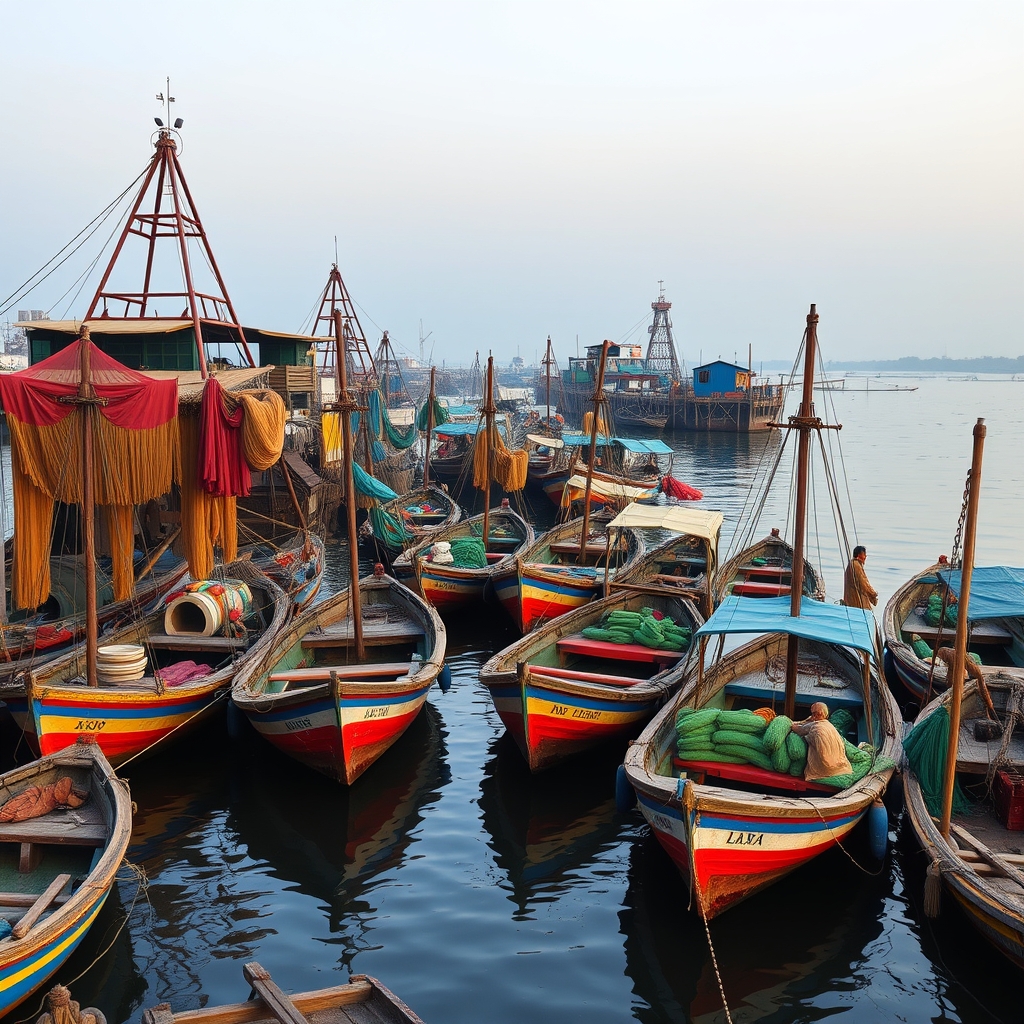
Photo: A. N. Appaiah · CC BY-SA 2.0 · via Wikimedia Commons
Set an alarm for 4:30am, because Sassoon Docks does its real work in the dark. By the time most of Colaba is stirring, the oldest working dock in the city has already landed a night’s catch, argued over the price of it, and started loading tempos bound for markets across Mumbai. This is not a manicured attraction. It is a loud, wet, fish-smelling harbour that happens to be open to anyone willing to turn up early, stand out of the way, and pay attention. For early risers and street photographers, there is nothing else in the city quite like it.
Sassoon Docks at a glance
| Detail | What to know |
|---|---|
| Area | Southern Colaba, off Shahid Bhagat Singh Marg (Colaba Causeway) |
| Best time | 5:30–7am for the auction; avoid the monsoon fishing ban |
| Entry | Free (except ticketed St+Art festival editions) |
| Nearest Metro | Cuffe Parade (Aqua Line 3) |
| Nearest suburban | Churchgate / CSMT, a taxi or bus north |
| Wear | Closed shoes you can ruin — the floor is slurry |
Why this particular dock
Sassoon Docks sits at the southern tip of Colaba, built in 1875 by Albert Abdullah David Sassoon, of the Baghdadi Jewish trading family who had settled in Bombay a generation earlier. It was among the first wet docks constructed in India, put up to handle the cotton trade, and over the decades it became the city’s great fish landing point instead. Unlike almost every other port facility in Mumbai, it is accessible to the general public and there is no entry fee. You simply walk in past the old clock-tower gate.
What keeps it worth the early start is that it is still a genuine place of work, not a heritage set. Boat owners auction their stock, wholesalers and export agents bid, and an army of headload carriers, ice-crushers and prawn-shellers keeps the whole thing moving. An estimated 1,50,000 people depend on the dock directly and indirectly, with a daily turnover that runs into crores. You are a guest in someone’s workplace, and the visit is better for remembering that.
Getting the timing right
The dock’s rhythm runs roughly from 3:30am to about 10am, with online auctions kicking off as early as 1am and boats drifting in from around 3am. The sweet spot for a visitor is 5:30 to 7am: there is enough light to see and shoot by, the boats are in, and the auction floor is at full tilt. Arrive at nine and you get the aftermath — hosepipes and empty crates — which has its own melancholy but misses the drama.
One important caveat: the annual monsoon fishing ban. Fishing along this coast pauses from around 1 June until Narali Purnima in August, when the Koli community makes its offering to the sea. During those weeks the dock is quiet and there is little auction to see, so plan for the drier months. The fishing seasons proper run roughly March to May and August to November.
The fish, and how the auction works
The variety on the floor is the first thing that hits you after the smell. Depending on the season you might see pomfret (increasingly scarce and pricey), surmai (kingfish), silvery bombil (Bombay duck) laid out in fans, mounds of prawns, tiny jawla and karandi shrimp, red snapper, tuna, cuttlefish, octopus, blue crabs and the occasional stingray or baby shark.
Mechanically, the dock splits into two. One side, under the tin sheds, handles the local wholesale trade; the other processes fish for export. Boat owners auction their catch to vendors, retail sellers and export companies in fast, shouted bursts. Once a lot is sold, the paati kamgars — the headload carriers — ferry it on their heads or by handcart to the tempos waiting to distribute it across the city. Prices at the source are a fraction of what you’d pay in a neighbourhood market, and while the auction itself is a wholesale business, persistent visitors can sometimes buy a small quantity directly. Look for clear, glossy eyes, red gills and firm flesh if you do.
The Koli women who run the floor
Do not mistake the shouting men for the whole picture. The retail and domestic side of Sassoon Docks is overwhelmingly a women’s world, run by the Koli community, the original inhabitants of the islands that became Mumbai. Koli women here own boats, work the auction, sort and shell, and carry the trade forward across four generations. Much of the labour is brutally hard: women working as paati kamgars and prawn-shellers earn in the region of Rs 300 to 400 for a full morning, a few rupees per trip.
Watching them shell prawns at speed, or haggle a wholesaler down without breaking stride, is the most memorable part of the dock for many visitors — more so than any single photograph. Their nine-yard saris, hitched for work, and their gold, are the living version of the Koli identity that the murals a few metres away celebrate.
The murals: the Sassoon Dock Art Project
In November 2017, St+Art India, the collective behind much of the country’s public-art movement, turned the dock into an open-air gallery for the Sassoon Dock Art Project, part of the St+art Mumbai Urban Art Festival. Some thirty Indian and international artists made site-specific murals and installations that spoke directly to the fishing community. The best-known survivor is Australian artist Guido van Helten’s enormous, weathered portrait of local faces on a warehouse wall, alongside work like Hanif Kureshi’s fishing nets printed with words gathered on walks around the dock.
The festival returned in December 2022 with a second edition, “Between the sea and the city,” part of the Mumbai Urban Art Festival, adding pieces such as the Vayeda Brothers’ Warli-style “Ways of Water.” Worth knowing: the big ticketed indoor installations appear only during festival editions, while the outdoor murals are what you’ll find on an ordinary morning. Salt air and time have faded some of them, so treat the art as a bonus to the working dock, not the main event, and check whether a festival edition is running if that is your reason for coming.
What a first visit actually looks like
Walk in through the clock-tower gate before six and the dark does most of the talking — headlamps bobbing, the crunch of crushed ice, the diesel of tempos idling. Follow the flow of headload carriers and you’ll find the auction sheds, where the real theatre is. Give it ten minutes before you do anything: watch a lot get called, sold and shouldered away, and you start to read the choreography — boat owner, bidder, carrier, tempo. From there, drift towards the retail edge where the Koli women sort and shell, then out to the warehouse walls for the murals as the light comes up. The whole visit is an easy 60 to 90 minutes; there’s no route to follow and no ticket to buy, just a working harbour to move through carefully. Keep to the sides, don’t block a lane, and let the place carry you rather than trying to see it all.
Photography etiquette (read this bit)
This is the part people get wrong. Technically, Sassoon Docks falls under Mumbai Port and its ISPS security rules, and organised or commercial shoots require permission; the official position is that general photography of the port is restricted. In practice, plenty of people photograph freely on the fish-market side and are left alone. The sensible way to navigate the gap:
- Keep your lens on the fish, the murals and the market bustle — not on ships, gates or anything that looks like security infrastructure.
- Ask before you take close portraits of people at work. A smile, a nod, and showing them the picture goes a long way; many will happily oblige, some won’t, and that is their call.
- Do not treat anyone as a prop or block a working lane for your shot. If a guard asks you to stop, stop.
- Leave the tripod and the drone at home; both invite trouble and neither is necessary in that light.
Getting there, and where to eat after
The dock is at the far southern end of Colaba, reached by taxi, bus or on foot from the Causeway. The nearest Metro is Cuffe Parade on the Aqua Line (Line 3), fully operational since October 2025, a short taxi ride away; the nearest suburban stations, Churchgate and CSMT, are a taxi or bus hop north. A black-and-yellow cab from anywhere in town will know Sassoon Dock without explanation.
Olympia Coffee House
- Area: Shahid Bhagat Singh Marg, Colaba Causeway — a few minutes’ walk or a very short ride from the dock.
- Why it’s worth it: A century-old Irani café (running since 1918) that opens at 7am, exactly when you’ll crawl off the dock hungry. The kheema pav and bun maska with cutting chai are the reward for the early alarm.
- Insider tip: Kheema is a breakfast-only affair, generally 7 to 11am, and the place is cash only. Two can eat very well for around Rs 300 to 400.
Insider tips for the dawn run
- Go with the light, not before it. Turning up before 5:30 leaves you fumbling in the dark; 5:30–7am is the visual sweet spot.
- Sacrifice a pair of shoes. The floor is melted ice, fish water and worse — sandals are a mistake you make once.
- Carry small notes and a zip pouch. Cash for Olympia after, and a dry pouch keeps your phone away from the slurry and spray.
- Lead with respect, then a camera. Watch the auction for ten minutes before you lift the lens; the pictures come easier once you’ve read the room.
- Check the festival calendar if the murals are your draw — the indoor installations only run during St+Art editions.
Sassoon Docks is not a place you tick off; it is a place you witness. Go for the fish and you’ll stay for the Koli women, the shouted arithmetic of the auction, the egrets stealing scraps and the faded giants painted on the warehouse walls. Come early, wear the wrong-shoes-you-can-lose, keep your camera respectful and your feet out of the way, and end the morning with kheema and chai a short walk away. Do that, and you’ll have seen a Mumbai that runs entirely before the rest of the city has had its first cup of tea.
Frequently Asked Questions
What time should I arrive at Sassoon Docks?
Between 5:30 and 7am for the auction in full swing. The dock works from about 3:30am to 10am, but earlier than 5:30 is too dark to shoot and later than 8 is winding down to hosepipes and empty crates.
Is there an entry fee for Sassoon Docks?
No. Unusually for a Mumbai port, Sassoon Docks is open to the public with no ticket — you walk in past the old clock-tower gate. The exception is ticketed St+Art festival editions, when the indoor art installations run.
Can I take photographs at Sassoon Docks?
On the fish-market side, generally yes and discreetly. But it is a working port under ISPS security rules, so avoid shooting ships, gates and security infrastructure, always ask before close portraits of people at work, and stop if a guard tells you to. Leave the tripod and drone at home.
When is Sassoon Docks closed or quiet?
The trade largely pauses during the monsoon fishing ban, roughly 1 June to Narali Purnima in August, when boats stay in and there is little auction to see. Come outside those weeks — the drier months — for a proper auction floor.
Is Sassoon Docks suitable for families and children?
It is safe but not gentle: slippery floors, strong smells, crowds and constant movement. Fine for older children who can watch their footing; not ideal for toddlers or anyone squeamish about blood and guts. Wear closed shoes you don't mind ruining.