
Starring

About the film
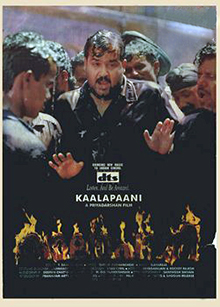
Kaalapaani (transl. Black Water) is a 1996 Indian Malayalam-language epic historical drama film written by T. Damodaran and directed by Priyadarshan. Set in 1915, the film focuses on the lives of Indian independence activists incarcerated in the Cellular Jail (or Kālāpānī) in Andaman and Nicobar Islands during the British Raj. The ensemble cast includes Mohanlal, Prabhu, Tabu, Amrish Puri, Tinnu Anand, Nedumudi Venu, Sreenivasan, Annu Kapoor, Alex Draper, Sankaradi, and Vineeth. The film was produced by Mohanlal for Pranavam Arts in association with R. Mohan's Shogun Films.
The film is about the lives of prisoners in British India who are brought to Kālā Pānī. The name Kalapani is derived from the mode of imprisonment in British India. Ilaiyaraaja composed the music, the cinematography was by Santosh Sivan, and the editing by N. Gopalakrishnan. The film introduced Dolby Stereo into Malayalam cinema. It was made on a budget of ₹2.50 crore, making it the costliest Malayalam film made until then.
Plot
In 1965, G. S. Sethu of the Indian Army went to Ross Island, Kaalapaani, to find the whereabouts of his aunt Parvathi's husband Govardhan Menon, who had been sent to jail in 1916 during the period of British rule. In an old room containing records of prisoners held at the jail, Sethu comes across Govardhan's records and learns his story.
In 1915, Govardhan, a doctor and Indian nationalist, is wrongly accused of bombing a train carrying 55 people, including British officials. On his wedding day with Parvathi, he is deported to the Cellular Jail at Port Blair, Andaman and Nicobar Islands, which is called Kaalapaani by the prisoners living there. There, hundreds of Indian prisoners are incarcerated in the Cellular Jail, including leading participants of the independence movement. David Berry is a sadistic jailor who is of Irish descent, while Len Hutton is a kindhearted English doctor. Savarkar is incarcerated and tries his best to keep the spirit of the prisoners going despite unbelievable torture.
The prisoners are often forced to perform harsh labour outside the jail, including quarrying and mining work where explosives are used to break rocks. During one such work assignment involving the transport of mining explosives, Mukundan, Govardhan's friend, seizes an opportunity to create a detonation to escape amid the confusion and flee from the guards. Govardhan chases Mukundan to stop his escape. They manage to steal a small boat and drift across the sea, eventually reaching North Sentinel Island. Unaware of the dangers posed by the isolated island inhabited by the Sentinelese tribe, they struggle to survive there for a brief period while hiding from British patrols. When British forces begin searching the surrounding waters, Govardhan decides to surrender, believing that continued resistance would lead to their deaths and harsher reprisals against other prisoners. Mukundan resists the idea of surrender and attempts to evade capture, but eventually both are taken into custody by the British authorities and brought back to the cellular jail, where they are subjected to even harsher punishment for their escape attempt.
Production
Director Priyadarshan co-wrote the screenplay with screenwriter T. Damodaran. The basis for the story was existing accounts of life in Cellular Jail, particularly excerpts from biographies of political leaders of the Indian Independence Movement. Most of these excerpts covered the ruthless routine of prisoners in jail, under the command of Jailer David Barry, Major James Pattinson Walker and Petty officer Mirza Khan.
While the Pre-World War I ports were recreated on the Andaman Islands, several huge sets were built on a 1.5-acre space in Murugalaya Studio, Chennai to replicate the Cellular Jail. In Madras, the sets of the Cellular Jail cost about Rs 12 lakh to build on 1.5 acres at the Murugalaya Studio. Apparently, director Priyadarshan was adamant and determined to be faithful to the details of the era. He said, "The Andamans had not seen a horse in 20 years. We had to carry four horses there at a cost of about Rs 3 lakh. When the filming was over, we presented them to the Andamans administration." Before the making of the film, Prabhu had injured his knee and, during his recovery phase, put on considerable weight. To accommodate his physique in the script, Priyadarshan altered the character by depicting him as a constant eater.
The budget of the film, ₹2.5 crore (equivalent to ₹14 crore or US$1.4 million in 2023), was much larger than the average ₹1 crore for a Malayalam film at the time. The shooting was completed in 72 days at Andaman and Nicobar Islands, several parts of Kerala and Chennai. Post-production took more than four months to complete. Composer Ilaiyaraaja completed his symphonic score in 16 days; audiographer Deepan Chatterji completed the sound design and mix in 90 days. This is the first Malayalam film to recorded in Dolby Stereo. The film is shot in the Malayalam language. However, numerous portions contain dialogues in Hindi, English, Tamil, Bengali, Telugu, and German.
Soundtrack
The music was composed and conducted by Ilaiyaraaja. K. S. Chithra was the only female singer in all the versions, while male singers kept changing from version to version.
Key details
| Release year | 1996 |
|---|---|
| Language | Hindi |
| Director | Priyadarshan. Set |
| Writer | T. Damodaran |
| Music | British India. Ilaiyaraaja |
| Starring | Tabu |
Frequently Asked Questions
When was Kaalapani released?
Kaalapani is a Hindi-language film released in 1996, directed by Priyadarshan. Set.
Who directed Kaalapani?
Kaalapani was directed by Priyadarshan. Set, with the screenplay by T. Damodaran.
Who stars in Kaalapani?
Kaalapani stars Tabu.
What is Kaalapani about?
Kaalapaani (transl. Black Water) is a 1996 Indian Malayalam-language epic historical drama film written by T.
Who composed the music for Kaalapani?
The music for Kaalapani was composed by British India. Ilaiyaraaja.
Where can I watch Kaalapani?
Kaalapani may be available on major streaming platforms or for digital rental — check current OTT listings for availability in your region.
Reference: Wikipedia
← Back to the Bollywood Hub