
Starring


About the film
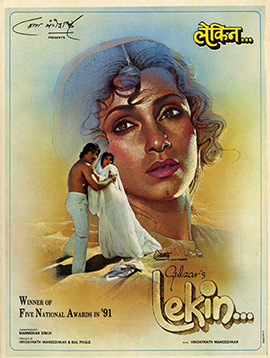
Lekin... (transl. But...) is a 1991 Hindi drama mystery film, loosely based on the 1895 short story Kshudhit Pashaan ("The Hungry Stones") by Rabindranath Tagore and directed by Gulzar. It stars Vinod Khanna, Dimple Kapadia, Amjad Khan, Alok Nath, and Beena Banerjee, and features a special appearance by Hema Malini. The film tells the story of Reva, a restless ghost who seeks liberation and haunts the ancient palace of Raja Param Singh in Rajasthan when she is discovered by Sameer, a museum curator sent by the government to salvage valuables in the region. As she recreates a visual representation of the history of the palace which reveals her tragic story, Sameer becomes determined to help set her free.
Produced by Indian singer Lata Mangeshkar (and co-produced by Hridaynath Mangeshkar and Bal Phule), the film took four years to release in theaters. It opened to positive reviews, with particular praise directed at Dimple Kapadia's performance. The soundtrack, composed by Hridaynath, was well-received, with Lata's rendition of "Yaara Seeli Seeli" becoming particularly popular. At the 38th National Film Awards, the film won five awards, a record for that year, including Best Music Direction for Hridaynath, Best Female Playback Singer for Lata, and Best Lyricist for Gulzar. At the 37th Filmfare Awards, the film won the Best Lyricist award, and Kapadia was nominated for Best Actress for her performance.
Plot
Government officer Sameer Niyogi is sent to Rajasthan to take inventory of items in the abandoned haveli (mansion) of the long-deceased Maharaja Param Singh. When he arrives in Rajasthan, he meets his old friend Shafi who is a tax collector in the area and lives with his wife Sharda.
En-route his journey to Jasor, Sameer begins seeing what he thinks could very well be visions of another time and place, visions that he is shown by a beautiful woman he encounters by the name of Reva. She keeps appearing and disappearing during his stay in Jasor. The mysterious appearance and disappearance initially shakes Sameer but reassurance that spirits exist from an expert on the field gives him an unknown inner motivation to find out the truth behind Reva and his own self, as well as find out the reason he is connected with this story.
The next time Sameer meets Reva, she trasports him into her past by presenting to him an apparitional display from ancient days in the palace. According to the story revealed through her recreation, Reva is a spirit stranded in a period of time, attempting to cross the desert to meet her long-lost sister Tara. The older sister, Tara, comes to Maharaja Param Veer's palace for a singing and dancing performance one night. The Maharaja eyes her malevolently and orders his men to not let her go out of the palace that night so he can rape her. Ustad Miraj Ali, the musical maestro in the king's court, who also happens to be Tara and Reva's music teacher, learns of the king's plan. He warns the father of Tara and Reva and advises them to run away from the town by crossing the desert. The King learns of this and imprisons Miraj Ali and Reva in the castle dungeons while Tara's camel runs ahead in the desert but is never heard of. The cruel Maharaja also orders Tara and Reva's father to be lashed till he bleeds to a near-death condition and then orders his men to put him on a camel's back and send him into the desert.
Production
Lata Mangeshkar's initiative to produce a film revolved solely around the idea of making a film with good music, as she was devastated by the quality of the songs that prevailed in the film industry and that she had to sing throughout the past decade. She approached Gulzar to direct the planned film. Having accepted her offer, he decided to adapt Rabindranath Tagore's 1895 spiritual short story Kshudhit Pashaan, also known as The Hungry Stones. Gulzar later explained his choice of Tagore: "I wanted to capture Tagore’s original voice, the voice that found expression only in Bangla and that was not replicated in the English translations." In their conversations, Lata and Gulzar would often discuss supernatural phenomena. Those were the days when cases of supposed reincarnation were being reported on in the press. Educated intellectuals would often accept them albeit with certain degrees of doubt and skepticism, and their arguments would often end with "Lekin..." (But...), hence the title of the film.
As soon as Kapadia learned about the project, she repeatedly called Gulzar and Mangeshkar insisting to be cast as Reva until she finally got the part. Vinod Khanna, who had been on a hiatus from acting and planned a comeback, approached Gulzar and asked if there was a role for him. Incidentally, the casting had almost completed by that time except for that of the male lead, and Khanna signed on to play Sameer. The film took four years to get made and released. The mahurat clap was given by cricketer Sunil Gavaskar in 1987. The film was shot during 1989. Gulzar had travelled extensively in Rajasthan (around 5,000 kilometers) looking for shooting locations. To make Kapadia's character more truthful to its ghost-like nature, Gulzar forbade Kapadia to blink during filming in order to capture an "endless, fixed gaze" that would give her "a feeling of being surreal".
Key details
| Release year | 1991 |
|---|---|
| Language | Hindi |
| Director | Gulzar. It |
| Starring | Hema Malini, Vinod Khanna, Dimple Kapadia, Amjad Khan, Alok Nath, Beena Banerjee |
Frequently Asked Questions
When was Lekin... released?
Lekin... is a Hindi-language film released in 1991, directed by Gulzar. It.
Who directed Lekin...?
Lekin... was directed by Gulzar. It.
Who stars in Lekin...?
Lekin... stars Hema Malini, Vinod Khanna, Dimple Kapadia, Amjad Khan, Alok Nath, Beena Banerjee.
What is Lekin... about?
Lekin... (transl.
Where can I watch Lekin...?
Lekin... may be available on major streaming platforms or for digital rental — check current OTT listings for availability in your region.
Reference: Wikipedia
← Back to the Bollywood Hub