
'%3E%3Crect%20width%3D'96'%20height%3D'96'%20fill%3D'%231B5E20'%2F%3E%3Ccircle%20cx%3D'30'%20cy%3D'24'%20r%3D'44'%20fill%3D'%23fff'%20opacity%3D'.12'%2F%3E%3Ccircle%20cx%3D'60'%20cy%3D'74'%20r%3D'40'%20fill%3D'%23000'%20opacity%3D'.10'%2F%3E%3C%2Fg%3E%3Cg%3E%3Ccircle%20cx%3D'48'%20cy%3D'48'%20r%3D'15'%20fill%3D'%23fff'%2F%3E%3Cpath%20d%3D'M43%2034%20Q50%2048%2043%2062'%20fill%3D'none'%20stroke%3D'%238a94a6'%20stroke-width%3D'2.4'%2F%3E%3Cpath%20d%3D'M47%2033%20Q54%2048%2047%2063'%20fill%3D'none'%20stroke%3D'%238a94a6'%20stroke-width%3D'1.8'%20stroke-dasharray%3D'1.5%203'%2F%3E%3C%2Fg%3E%3C%2Fsvg%3E)
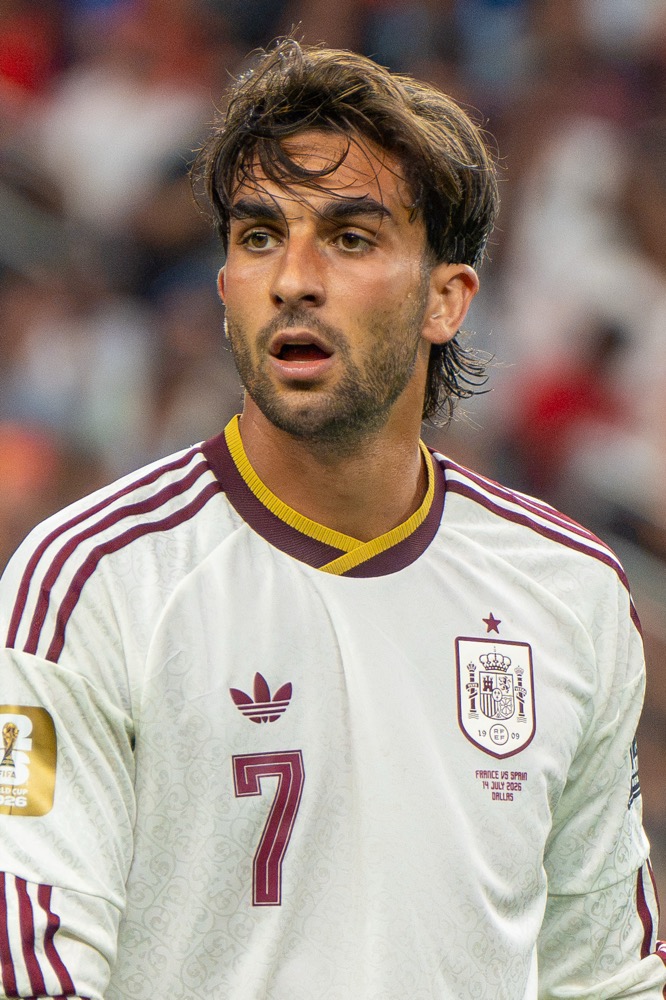
Ninety minutes were not enough. For the longest time it did not feel as though a hundred and twenty would be, either. The 2026 World Cup final asked both these sides to empty themselves onto the New York/New Jersey turf, and only when the tank ran dry did Spain find the goal that crowned them champions of the world a second time. This was tension stretched taut across two hours — a game of feints and fouls, of a sending-off and a flashpoint, settled at last by a substitute’s swing of the boot.
The long, locked hours
For much of normal time the final resembled a chess match played at a sprint. Argentina, the holders, sat deep and dared Spain to unpick them; Messi drifted between the lines, hunting the half-yard that had undone so many before. Spain answered with what they had done all tournament — keep the ball, keep the shape, keep the door bolted. Rodri treated possession as a birthright, while Pau Cubarsí, nineteen going on thirty-five, snuffed out every counter before it could catch fire. Chances were rationed; nerves were not. Goalless after ninety, the final tipped into extra time exactly as this Spanish machine liked it.
Red card, flashpoint, decisive blow
Then extra time cracked the game open. Enzo Fernández, stretched and desperate, caught Cubarsí with a late, reckless lunge and was sent off — Argentina down to ten and down to their last reserves of hope. The temperature spiked. Messi drew the referee towards Marc Cucurella after a heated exchange, the Spaniard covering his mouth as he spoke; Cucurella stayed on. Into the fracture stepped the bench. Ferran Torres, fresh legs among weary ones, met the decisive chance and buried it. Spain would not concede — they had done so only once all tournament. At the whistle Messi wept, Yamal reached out to hold him, and a young Spain stood as champions.