
'%3E%3Crect%20width%3D'96'%20height%3D'96'%20fill%3D'%231B5E20'%2F%3E%3Ccircle%20cx%3D'30'%20cy%3D'24'%20r%3D'44'%20fill%3D'%23fff'%20opacity%3D'.12'%2F%3E%3Ccircle%20cx%3D'60'%20cy%3D'74'%20r%3D'40'%20fill%3D'%23000'%20opacity%3D'.10'%2F%3E%3C%2Fg%3E%3Cg%3E%3Ccircle%20cx%3D'48'%20cy%3D'48'%20r%3D'15'%20fill%3D'%23fff'%2F%3E%3Cpath%20d%3D'M43%2034%20Q50%2048%2043%2062'%20fill%3D'none'%20stroke%3D'%238a94a6'%20stroke-width%3D'2.4'%2F%3E%3Cpath%20d%3D'M47%2033%20Q54%2048%2047%2063'%20fill%3D'none'%20stroke%3D'%238a94a6'%20stroke-width%3D'1.8'%20stroke-dasharray%3D'1.5%203'%2F%3E%3C%2Fg%3E%3C%2Fsvg%3E)
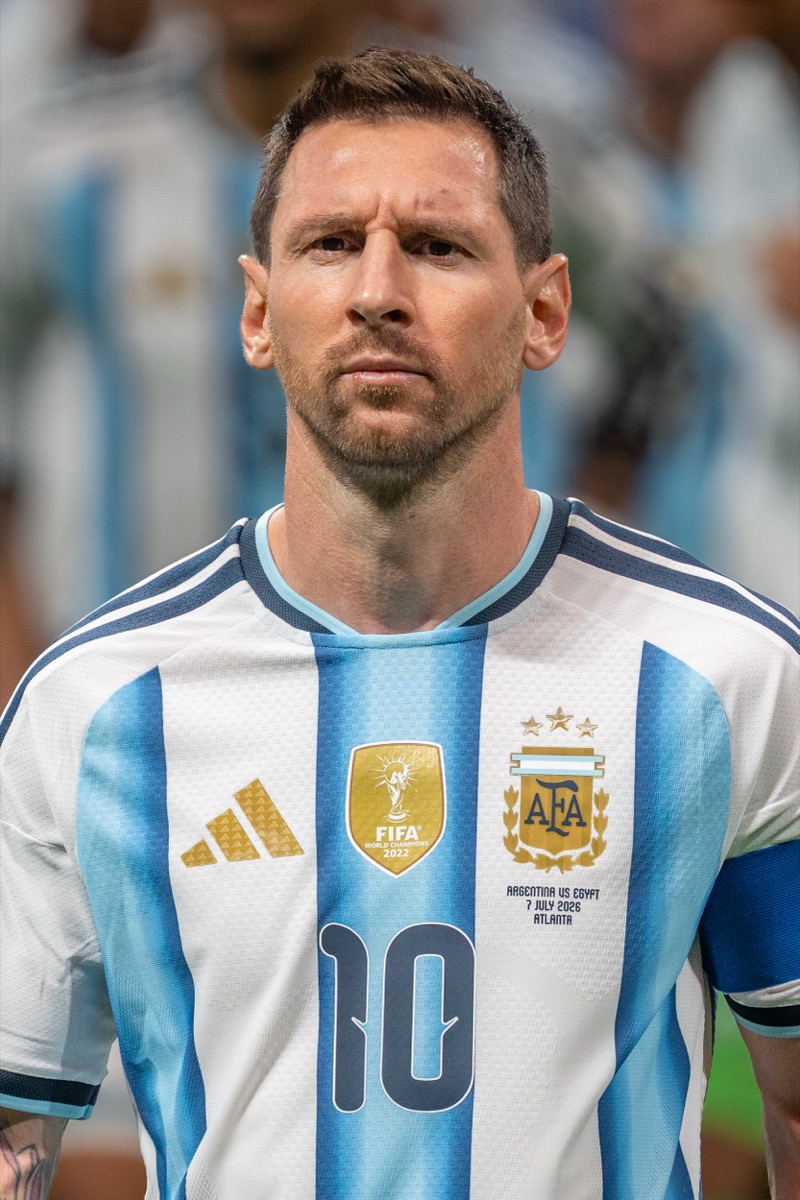
The camera found him before the confetti did. Under the New York night, as Spain’s players sprinted toward Luis de la Fuente, Lionel Messi stood alone near the centre circle, shoulders heaving, the tears coming freely. Spain 1, Argentina 0, after extra time. The dream of a second star to sit beside the one won in 2022 was gone, taken by a Ferran Torres finish in the additional half-hour.
A cruel, chaotic ending
The match turned ugly before it turned final. Enzo Fernández was sent off for a late challenge on the teenage Pau Cubarsí, and in the fury that followed, Messi tried to have Marc Cucurella dismissed too, drawing the referee’s eye after a heated exchange in which the Spaniard covered his mouth as he spoke. It was not the captain at his most serene, and some backlash followed. But grief rarely wears its best face.
For all Argentina’s fight, they met a Spain side that would not yield — unbeaten across the tournament, seven clean sheets in eight, a single goal conceded in the whole campaign. Rodri, imperious, took the Golden Ball after completing 101 of 105 passes. This was a wall Messi could not breach.
The torch, quietly passed
The lasting image was tender. Nineteen-year-old Lamine Yamal, Spain’s prodigy, found Messi in the chaos and embraced him — one era folding gently into the next. Scaloni, who hinted he too may step away, said any decision on Messi’s international future belongs to Messi alone.
Whatever he chooses, the ledger is already written: a World Cup, a Copa América, records that may never fall. Tonight he lost a final. He does not lose his place among the immortals. In Mumbai, where fans stayed up until dawn, the tears were shared.