
'%3E%3Crect%20width%3D'96'%20height%3D'96'%20fill%3D'%231B5E20'%2F%3E%3Ccircle%20cx%3D'30'%20cy%3D'24'%20r%3D'44'%20fill%3D'%23fff'%20opacity%3D'.12'%2F%3E%3Ccircle%20cx%3D'60'%20cy%3D'74'%20r%3D'40'%20fill%3D'%23000'%20opacity%3D'.10'%2F%3E%3C%2Fg%3E%3Cg%3E%3Ccircle%20cx%3D'48'%20cy%3D'48'%20r%3D'15'%20fill%3D'%23fff'%2F%3E%3Cpath%20d%3D'M43%2034%20Q50%2048%2043%2062'%20fill%3D'none'%20stroke%3D'%238a94a6'%20stroke-width%3D'2.4'%2F%3E%3Cpath%20d%3D'M47%2033%20Q54%2048%2047%2063'%20fill%3D'none'%20stroke%3D'%238a94a6'%20stroke-width%3D'1.8'%20stroke-dasharray%3D'1.5%203'%2F%3E%3C%2Fg%3E%3C%2Fsvg%3E)
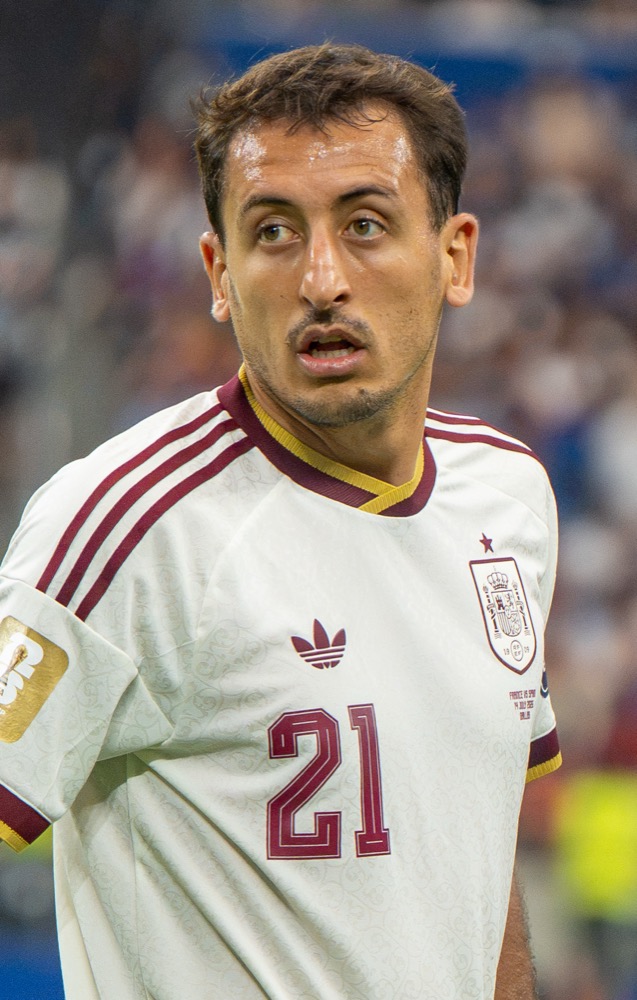
Sixteen years ago in Johannesburg, Andrés Iniesta’s extra-time strike gave Spain their first World Cup and crowned an age of tiki-taka. On a humid night at the New York / New Jersey Stadium, La Roja stitched a second star above the crest — and did it in a way that felt at once like an echo and a reinvention.
From Johannesburg to New Jersey
The parallels are irresistible. Once again Spain needed extra time; once again the decisive goal came from a forward sent on to change the picture, Ferran Torres rewarding Luis de la Fuente’s bold substitutions. The 1–0 over Argentina mirrors the grinding 1–0 over the Netherlands in 2010. Yet where the first crown was built on possession as suffocation, this one rested on something Spain rarely boasted before: a granite defence. Seven clean sheets in eight matches, a single goal conceded all tournament — that lone lapse arriving in the quarter-final against Belgium — and an unbeaten run that brooked no argument.
A new golden generation
The bridge across the eras runs through the middle. Rodri, imperious with 101 of 105 passes completed and roughly four-fifths of his duels won, took the Golden Ball as the natural heir to Xavi and Busquets. Behind him, 19-year-old Pau Cubarsí, alongside Aymeric Laporte, anchored those clean sheets and claimed the Young Player award. Add Lamine Yamal — whose embrace of a tearful Messi became the night’s defining image — and this reads less like a repeat than a dynasty renewing itself: Euro 2024 champions who have now conquered the world.
For India, where FIFA’s new partnership with Zee promises to deepen the game’s roots and where fervour spilled from Pune to every living room, Spain’s second star carries a simple lesson. Greatness, once earned, can be built anew.