DU Allocates UG Seats To 93,000 Students
DU announces first round of UG admissions, 93,033 students get seats. Female candidates outnumber males.
'%3E%3Crect%20width%3D'96'%20height%3D'96'%20fill%3D'%23B3261E'%2F%3E%3Ccircle%20cx%3D'30'%20cy%3D'24'%20r%3D'44'%20fill%3D'%23fff'%20opacity%3D'.12'%2F%3E%3Ccircle%20cx%3D'60'%20cy%3D'74'%20r%3D'40'%20fill%3D'%23000'%20opacity%3D'.10'%2F%3E%3C%2Fg%3E%3Cg%20fill%3D'%23fff'%3E%3Crect%20x%3D'29'%20y%3D'49'%20width%3D'8'%20height%3D'19'%20rx%3D'1'%2F%3E%3Crect%20x%3D'39'%20y%3D'40'%20width%3D'9'%20height%3D'28'%20rx%3D'1'%2F%3E%3Crect%20x%3D'50'%20y%3D'45'%20width%3D'8'%20height%3D'23'%20rx%3D'1'%2F%3E%3Crect%20x%3D'60'%20y%3D'53'%20width%3D'7'%20height%3D'15'%20rx%3D'1'%2F%3E%3Crect%20x%3D'41'%20y%3D'34'%20width%3D'5'%20height%3D'6'%2F%3E%3C%2Fg%3E%3C%2Fsvg%3E)
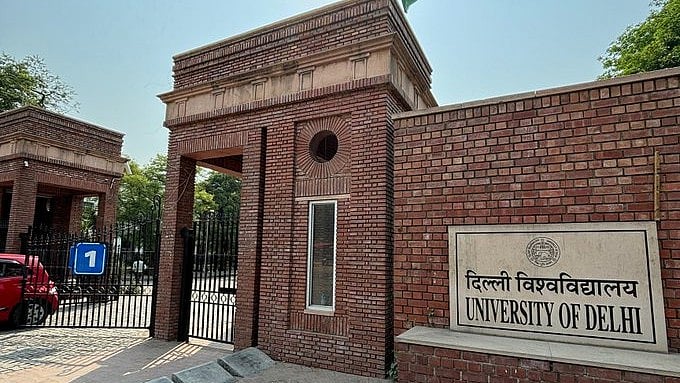
The University of Delhi (DU) announced the allocations of the first round of undergraduate admissions for the 2026-27 academic session on Thursday. A total of 93,033 candidates were allocated seats across 221 programmes in 67 colleges.
The allocations cover 1,393 programme-college combinations, with 42,019 male candidates and 51,014 female candidates getting seats. The overall allocation rate stands at around 86.1 per cent.
Out of the total candidates who completed successful registrations, 2,18,284 candidates went through the process, while 2,08,043 candidates completed Phase II of the admission process. A total of 1,59,42,385 programme-college preferences were considered during the allocation process.
The university also allotted seats to 1,243 single girl child candidates and 242 orphan candidates. Female candidates outnumbered male candidates in the allocation process.
Shortlisted candidates must accept their allotted seats by 11:59 pm on July 18, while candidates opting for an upgrade or wishing to reorder their preferences can do so until 11:59 pm on July 21.
Admissions to two-year postgraduate programmes have concluded their third allocation round, with 10,240 candidates admitted. Of these, 6,240 candidates froze their allotted seats, while 2,153 opted for an upgrade.
For one-year postgraduate programmes introduced under the National Education Policy (NEP) 2020, the university said 12,639 candidates have registered. The second spot round for the five-year integrated law programme will begin on July 17, while the third round of B.Tech admissions is scheduled to commence on July 19.
According to the university, classes for the 2026-27 academic session will begin on July 28. The university's admission process is a significant event for students seeking higher education in India.
The University of Delhi is one of the most prestigious institutions in the country, and its admission process is highly competitive. The allocation of seats to over 93,000 students is a notable achievement, and the university's efforts to promote diversity and inclusion are commendable.
The fact that female candidates outnumbered male candidates in the allocation process is a positive trend, and the university's initiatives to support single girl child candidates and orphan candidates are worthy of appreciation.
The admission process at DU is a complex and challenging task, involving multiple stakeholders and requiring careful planning and execution. The university's ability to allocate seats to such a large number of candidates is a testament to its efficiency and effectiveness.
In conclusion, the allocation of seats to over 93,000 students at the University of Delhi is a significant event that marks an important milestone in the academic calendar. The university's commitment to promoting diversity, inclusion, and accessibility is evident in its admission process, and its efforts to support students from diverse backgrounds are commendable.
The university's admission process has a significant impact on the lives of thousands of students, and its outcomes have far-reaching consequences for the country's education system. As the academic session begins, students, teachers, and staff at DU are likely to be filled with a sense of excitement and anticipation, and the university's admission process will continue to be a topic of interest and discussion in the days to come.