SpaceX Falcon 9 Upper Stage Crashes Into Moon
A SpaceX rocket stage has likely crashed into the Moon, scientists confirm. The impact occurred near the Einstein Crater.
'%3E%3Crect%20width%3D'96'%20height%3D'96'%20fill%3D'%23B3261E'%2F%3E%3Ccircle%20cx%3D'30'%20cy%3D'24'%20r%3D'44'%20fill%3D'%23fff'%20opacity%3D'.12'%2F%3E%3Ccircle%20cx%3D'60'%20cy%3D'74'%20r%3D'40'%20fill%3D'%23000'%20opacity%3D'.10'%2F%3E%3C%2Fg%3E%3Cg%20fill%3D'%23fff'%3E%3Crect%20x%3D'29'%20y%3D'49'%20width%3D'8'%20height%3D'19'%20rx%3D'1'%2F%3E%3Crect%20x%3D'39'%20y%3D'40'%20width%3D'9'%20height%3D'28'%20rx%3D'1'%2F%3E%3Crect%20x%3D'50'%20y%3D'45'%20width%3D'8'%20height%3D'23'%20rx%3D'1'%2F%3E%3Crect%20x%3D'60'%20y%3D'53'%20width%3D'7'%20height%3D'15'%20rx%3D'1'%2F%3E%3Crect%20x%3D'41'%20y%3D'34'%20width%3D'5'%20height%3D'6'%2F%3E%3C%2Fg%3E%3C%2Fsvg%3E)
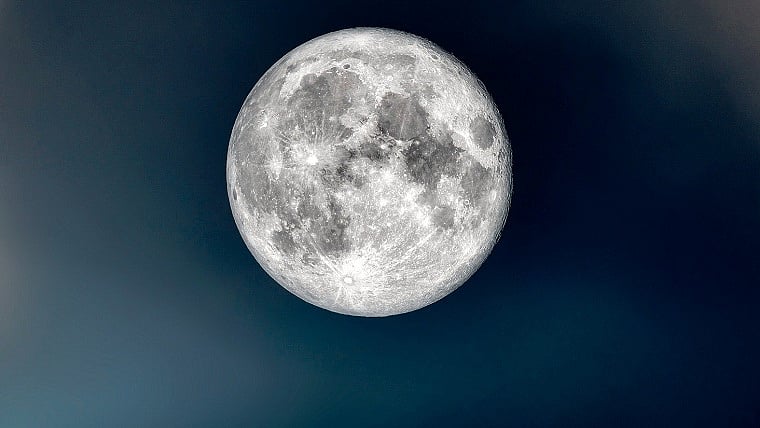
A discarded upper stage of SpaceX’s Falcon 9 rocket has likely impacted the Moon’s surface, with scientists tracking the collision near the Einstein Crater on the lunar far side. The event is estimated to have occurred at approximately 12:05 pm IST, though official confirmation is still pending as space agencies analyse fresh orbital imagery.
According to preliminary tracking data, the object’s trajectory had been predicted with remarkable precision, narrowing the impact window to within seconds and a few hundred metres. Observations from lunar orbiters in the coming days are expected to confirm the exact impact site.
The object that hit the Moon was not an intact rocket but the Falcon 9’s upper stage, the second segment responsible for carrying payloads into higher orbits after the first stage separates and returns to Earth. This particular stage, measuring about 12 metres in length and weighing roughly 4,500 kilograms, was launched on January 15, 2025.
It carried payloads including Firefly Aerospace’s Blue Ghost-1 and ispace’s Hakuto-R Mission 2 lunar landers. Once its mission was complete, the stage was left in a high-energy orbit between Earth and the Moon, eventually becoming space debris.
The crash took nearly 19 months to occur due to the stage remaining in an unstable orbit. Gravitational forces from the Earth, Moon, and Sun, combined with subtle effects like solar radiation pressure, gradually altered its trajectory. These cumulative perturbations eventually pushed the stage onto a collision course with the Moon.
SpaceX confirmed that the stage had been 'passivated', meaning residual fuel was vented to reduce explosion risk, but a controlled disposal burn was not feasible due to its trajectory. Scientists estimate the stage struck the lunar surface at nearly 8,700 kilometres per hour, releasing energy equivalent to around three tonnes of TNT.
The impact would have carved out a fresh crater estimated to be between 20 and 30 metres wide. The collision is also expected to have ejected large amounts of lunar regolith, potentially displacing over a million kilograms of dust and debris.
This event is a rare scientific opportunity for researchers, as the characteristics of the object were well documented in advance. Unlike natural meteorite impacts, the mass, velocity, and trajectory of the rocket stage were known, making it possible to study the effects of the impact in detail.
The crash matters to scientists because it provides a unique chance to learn more about the Moon’s surface and the effects of space debris. The data collected from this event will help researchers better understand the risks and consequences of space debris and how to mitigate them in the future.
In conclusion, the SpaceX Falcon 9 upper stage crash into the Moon is a significant event that provides a rare scientific opportunity for researchers. The data collected from this event will help us better understand the effects of space debris and how to mitigate them in the future.
Frequently asked questions
What was the object that crashed into the Moon?
The object was the upper stage of SpaceX’s Falcon 9 rocket, measuring 12 metres in length and weighing 4,500 kilograms.
Why did the crash take so long to occur?
The crash took nearly 19 months to occur due to the stage remaining in an unstable orbit, with gravitational forces and solar radiation pressure gradually altering its trajectory.