RBI Keeps Repo Rate At 5.25%, Sees 6.7% GDP Growth
RBI holds repo rate, raises GDP forecast, lowers inflation estimate. Experts see growth support but warn of global risks.
'%3E%3Crect%20width%3D'96'%20height%3D'96'%20fill%3D'%230B6E4F'%2F%3E%3Ccircle%20cx%3D'30'%20cy%3D'24'%20r%3D'44'%20fill%3D'%23fff'%20opacity%3D'.12'%2F%3E%3Ccircle%20cx%3D'60'%20cy%3D'74'%20r%3D'40'%20fill%3D'%23000'%20opacity%3D'.10'%2F%3E%3C%2Fg%3E%3Cg%20fill%3D'none'%20stroke%3D'%23fff'%20stroke-width%3D'3.2'%20stroke-linecap%3D'round'%20stroke-linejoin%3D'round'%3E%3Cpolyline%20points%3D'31%2C59%2041%2C49%2049%2C54%2063%2C37'%2F%3E%3Cpolyline%20points%3D'55%2C37%2063%2C37%2063%2C45'%2F%3E%3C%2Fg%3E%3C%2Fsvg%3E)
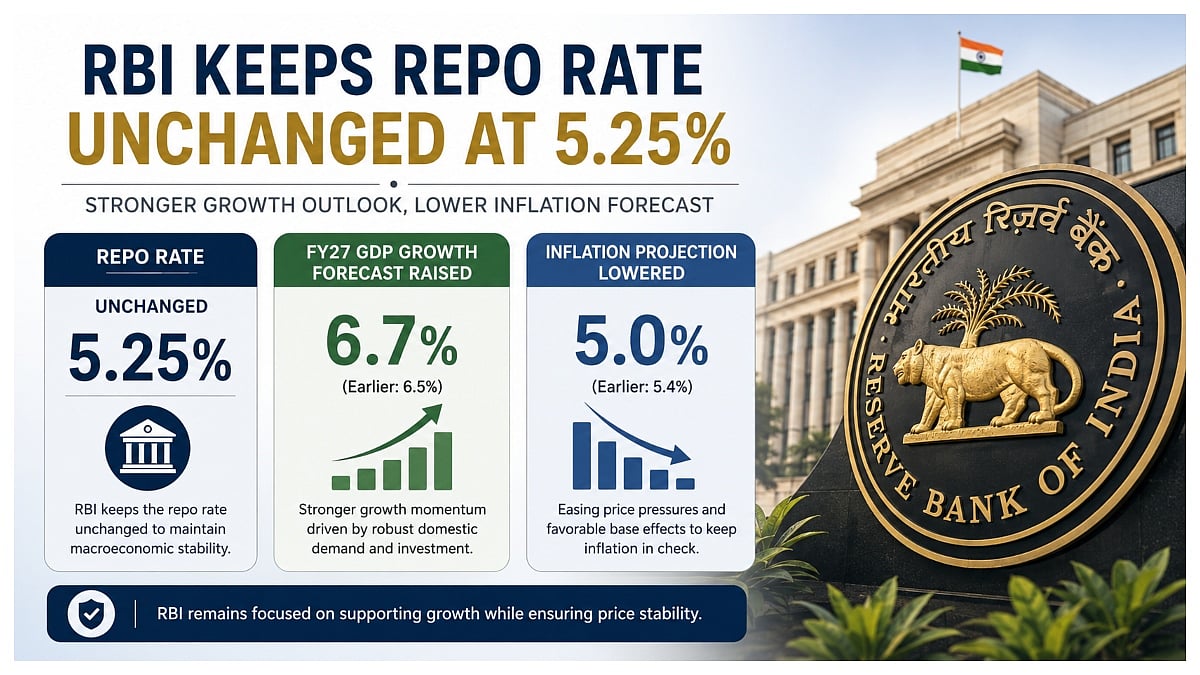
The Reserve Bank of India (RBI) has decided to keep the repo rate unchanged at 5.25 percent and retained its neutral policy stance. This decision was made in light of the current economic situation, with the RBI also raising India's FY27 GDP growth forecast to 6.7 percent and lowering its inflation estimate to 5.0 percent from 5.1 percent.
According to Prof. Mahendra K Chouhan, President of the IMC Chamber of Commerce and Industry, the decision balances economic growth with price stability. He believes that the higher growth forecast reflects strong domestic demand, investment, and services activity. Chouhan also noted that lower inflation expectations and better banking system liquidity could improve the flow of loans to businesses.
However, experts also warn of potential global risks that could impact the Indian economy. Shubhada Patil, Founder and Managing Director of Quantace Research, said that while the current repo rate of 5.25 percent is the main scenario, it is not guaranteed and could be raised to 5.50 percent if crude oil prices rise, the rupee weakens, or core and services inflation becomes more widespread.
The RBI's decision is seen as a cautious but constructive approach, balancing risks from the Middle East conflict, tighter global financial conditions, and El Niño against resilient domestic growth and foreign currency inflows. Madhavi Arora, Chief Economist at Emkay Global Financial Services, noted that near-term price pressure may remain supply-driven unless it spreads widely.
The rate pause is expected to benefit deposit-rich banks, capital goods, and infrastructure companies, while a defensive rate increase could hurt NBFCs, real estate, automobiles, and consumption linked to loan instalments. The real estate sector, in particular, is expected to benefit from the stable borrowing costs, with Knight Frank welcoming the rate pause and expecting it to improve confidence among homebuyers, businesses, and investors.
The RBI's decision to keep the repo rate unchanged is seen as a positive move for the economy, with experts believing that it will support growth and stability. However, they also caution that the RBI must continue to watch geopolitical tensions, volatile energy prices, and uncertainty over US tariffs, which could impact the Indian economy.
In terms of the impact on the economy, the RBI's decision is expected to have a positive effect on growth, with the higher GDP forecast reflecting strong domestic demand and investment. The lower inflation estimate is also seen as a positive move, with experts believing that it will improve the flow of loans to businesses and support economic activity.
Overall, the RBI's decision to keep the repo rate unchanged is seen as a cautious but constructive approach, balancing risks and supporting growth. While there are potential global risks that could impact the Indian economy, experts believe that the RBI's decision will help to support stability and growth in the short term.
The RBI's decision is also expected to have a positive impact on the real estate sector, with stable borrowing costs expected to improve confidence among homebuyers, businesses, and investors. The rate pause is seen as a positive move for the economy, with experts believing that it will support growth and stability.
In conclusion, the RBI's decision to keep the repo rate unchanged is a positive move for the economy, with experts believing that it will support growth and stability. While there are potential global risks that could impact the Indian economy, the RBI's decision is seen as a cautious but constructive approach, balancing risks and supporting growth.
Frequently asked questions
What is the current repo rate in India?
The current repo rate in India is 5.25 percent.
What is the RBI's GDP growth forecast for FY27?
The RBI's GDP growth forecast for FY27 is 6.7 percent.