Farmers Protest 400 kV Transmission Line in Sanwer
Farmers demand compensation, protest transmission line project in Madhya Pradesh
'%3E%3Crect%20width%3D'96'%20height%3D'96'%20fill%3D'%23B3261E'%2F%3E%3Ccircle%20cx%3D'30'%20cy%3D'24'%20r%3D'44'%20fill%3D'%23fff'%20opacity%3D'.12'%2F%3E%3Ccircle%20cx%3D'60'%20cy%3D'74'%20r%3D'40'%20fill%3D'%23000'%20opacity%3D'.10'%2F%3E%3C%2Fg%3E%3Cg%20fill%3D'%23fff'%3E%3Crect%20x%3D'29'%20y%3D'49'%20width%3D'8'%20height%3D'19'%20rx%3D'1'%2F%3E%3Crect%20x%3D'39'%20y%3D'40'%20width%3D'9'%20height%3D'28'%20rx%3D'1'%2F%3E%3Crect%20x%3D'50'%20y%3D'45'%20width%3D'8'%20height%3D'23'%20rx%3D'1'%2F%3E%3Crect%20x%3D'60'%20y%3D'53'%20width%3D'7'%20height%3D'15'%20rx%3D'1'%2F%3E%3Crect%20x%3D'41'%20y%3D'34'%20width%3D'5'%20height%3D'6'%2F%3E%3C%2Fg%3E%3C%2Fsvg%3E)
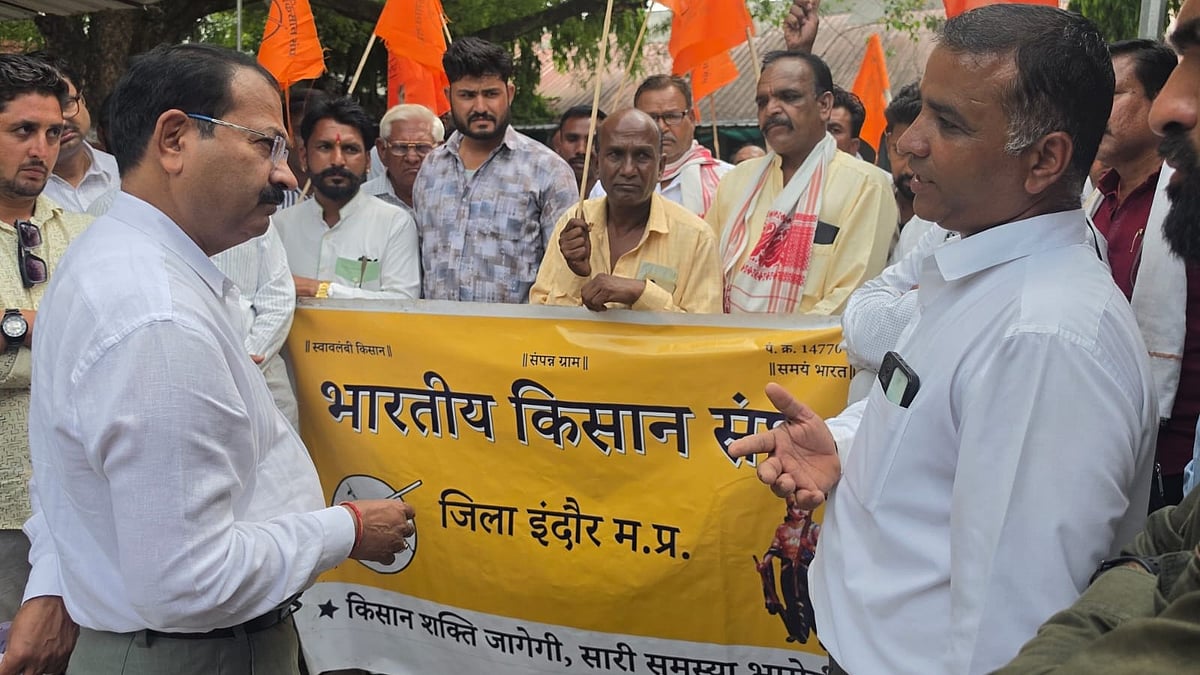
A large group of farmers in Sanwer, Madhya Pradesh, protested against the under-construction 400 kV single-circuit Runija-Indore transmission line project on Wednesday. Led by the Bharatiya Kisan Sangh, the farmers submitted a memorandum to the newly appointed SDM Harishankar Vishwakarma, demanding that work on their land should only proceed after all affected landowners receive compensation as per the prescribed rules.
The farmers alleged that Renew Energy Communications Private Limited, the company executing the project, has not distributed compensation uniformly. They claimed that while tower foundations, excavation, and other construction work have already been carried out on several farmers' agricultural land, only a few have received compensation. Many affected farmers are yet to be paid, they said.
The transmission line passes through several villages in Sanwer tehsil, including Kachaliya, Ajnod, Tarana, Darjikaradia, Shahana, Malikhedi, Hatunia, and Patwakhedi. The project is being constructed under the provisions of the Electricity Act, 2003, and the Indian Telegraph Act, 1885.
The farmers cited an order issued by the then collector and district magistrate of Indore on May 5, 2026, which provides for both construction permission and payment of compensation. However, they alleged that company officials are pressuring them to cooperate with the project by only citing the permission granted for construction.
The protest highlights the long-standing issue of compensation for farmers whose land is acquired for infrastructure projects. The farmers are seeking fair compensation for their land, which is a critical issue in the development of the region.
The Bharatiya Kisan Sangh, which is leading the protest, has been advocating for the rights of farmers in the region. The organization has been demanding that the government ensure fair compensation for farmers whose land is acquired for development projects.
The protest in Sanwer is not an isolated incident. There have been several instances of farmers protesting against infrastructure projects in the region, citing concerns over compensation and the impact on their livelihoods.
The government has been trying to balance the need for development with the concerns of farmers. However, the issue of compensation remains a contentious one, with many farmers feeling that they are not being fairly compensated for their land.
In this context, the protest in Sanwer highlights the need for a more nuanced approach to development, one that takes into account the concerns of all stakeholders, including farmers. The government must ensure that farmers are fairly compensated for their land and that their livelihoods are protected.
The outcome of the protest is still uncertain, but it has brought attention to the critical issue of compensation for farmers. The government must now respond to the demands of the farmers and ensure that their concerns are addressed.
The incident also raises questions about the implementation of infrastructure projects in the region. While the projects are critical for development, they must be implemented in a way that is fair and equitable for all stakeholders.
In conclusion, the protest by farmers in Sanwer against the 400 kV transmission line project highlights the critical issue of compensation for farmers whose land is acquired for infrastructure projects. The government must ensure that farmers are fairly compensated and that their livelihoods are protected. The incident also raises questions about the implementation of infrastructure projects in the region and the need for a more nuanced approach to development.