Supreme Court Demands Reforms in NTA
NEET controversy sparks calls for change, SC warns against 'committee-hopping'
'%3E%3Crect%20width%3D'96'%20height%3D'96'%20fill%3D'%231A5276'%2F%3E%3Ccircle%20cx%3D'30'%20cy%3D'24'%20r%3D'44'%20fill%3D'%23fff'%20opacity%3D'.12'%2F%3E%3Ccircle%20cx%3D'60'%20cy%3D'74'%20r%3D'40'%20fill%3D'%23000'%20opacity%3D'.10'%2F%3E%3C%2Fg%3E%3Cg%20fill%3D'%23fff'%3E%3Cpath%20d%3D'M31%2041%20L48%2031%20L65%2041%20Z'%2F%3E%3Crect%20x%3D'33'%20y%3D'43'%20width%3D'4'%20height%3D'17'%2F%3E%3Crect%20x%3D'41'%20y%3D'43'%20width%3D'4'%20height%3D'17'%2F%3E%3Crect%20x%3D'51'%20y%3D'43'%20width%3D'4'%20height%3D'17'%2F%3E%3Crect%20x%3D'59'%20y%3D'43'%20width%3D'4'%20height%3D'17'%2F%3E%3Crect%20x%3D'30'%20y%3D'62'%20width%3D'36'%20height%3D'4'%20rx%3D'1'%2F%3E%3C%2Fg%3E%3C%2Fsvg%3E)
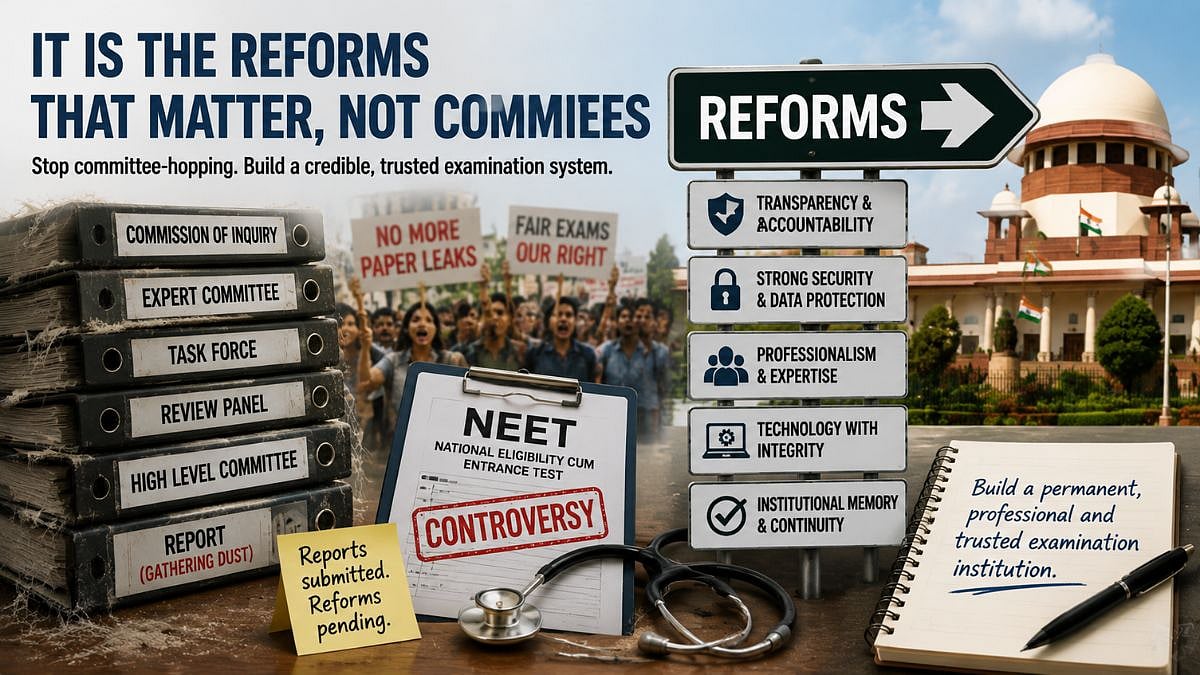
The National Eligibility-cum-Entrance Test (NEET) controversy has led to widespread criticism and calls for reform. Following the leakage of the NEET question paper and cancellation of the examination, the government faced backlash. The protests and eventual resignation of the Education Minister highlighted the need for change.
The National Testing Agency (NTA) was tasked with conducting the examination, but its failure exposed serious questions about its competence and credibility. A series of incidents had already raised concerns about the agency's ability to manage the examination process.
In response to the criticism, a committee headed by Nandan Nilekani was appointed to suggest measures to revamp the NTA. However, the composition of the committee did not inspire confidence, leading to suspicions that it was a face-saving device rather than a genuine attempt at reform.
The Supreme Court has now intervened, warning the government against 'committee-hopping' and asking for a concrete timeline for implementing reforms. The court has directed the Nilekani task force to incorporate and refine the 101 recommendations of the earlier committee headed by former ISRO chief K. Radhakrishnan.
This move is significant, as it recognizes the need for institutional memory and reform. The court's reference to the UPSC as a model is particularly relevant, highlighting the importance of professional and trustworthy institutions.
The government has announced several measures to address the issues, including removing 600 subject experts from the examination process and introducing a four-tier scrutiny mechanism for question papers. Technology, including AI and blockchain, is also being explored.
However, the Supreme Court's warning suggests that technology alone cannot compensate for institutional weakness. The real test is whether the NTA can become a permanent, professional, and trustworthy institution.
The NEET controversy has sparked a wider debate about the need for reforms in the examination system. The Supreme Court's intervention is a significant step towards addressing these concerns and ensuring that the NTA is held accountable for its actions.
In the end, it is the reforms that matter, not the committees. The government must take concrete steps to address the issues and ensure that the NTA is a trustworthy and professional institution.
The Supreme Court's decision is a positive step towards reform, but it remains to be seen whether the government will take the necessary steps to implement the changes. The NEET controversy has highlighted the need for accountability and transparency in the examination system, and it is up to the government to ensure that these values are upheld.
Frequently asked questions
What is the NEET controversy about?
The NEET controversy refers to the leakage of the NEET question paper and cancellation of the examination, which led to widespread criticism and calls for reform.
What has the Supreme Court ordered in response to the NEET controversy?
The Supreme Court has ordered the government to provide a concrete timeline for implementing reforms and has directed the Nilekani task force to incorporate and refine the 101 recommendations of the earlier committee headed by former ISRO chief K. Radhakrishnan.