India To Try 26/11 Accused In Absentia
India may try 26/11 accused in absentia, experts question impact.
'%3E%3Crect%20width%3D'96'%20height%3D'96'%20fill%3D'%23B3261E'%2F%3E%3Ccircle%20cx%3D'30'%20cy%3D'24'%20r%3D'44'%20fill%3D'%23fff'%20opacity%3D'.12'%2F%3E%3Ccircle%20cx%3D'60'%20cy%3D'74'%20r%3D'40'%20fill%3D'%23000'%20opacity%3D'.10'%2F%3E%3C%2Fg%3E%3Cg%20fill%3D'%23fff'%3E%3Crect%20x%3D'29'%20y%3D'49'%20width%3D'8'%20height%3D'19'%20rx%3D'1'%2F%3E%3Crect%20x%3D'39'%20y%3D'40'%20width%3D'9'%20height%3D'28'%20rx%3D'1'%2F%3E%3Crect%20x%3D'50'%20y%3D'45'%20width%3D'8'%20height%3D'23'%20rx%3D'1'%2F%3E%3Crect%20x%3D'60'%20y%3D'53'%20width%3D'7'%20height%3D'15'%20rx%3D'1'%2F%3E%3Crect%20x%3D'41'%20y%3D'34'%20width%3D'5'%20height%3D'6'%2F%3E%3C%2Fg%3E%3C%2Fsvg%3E)
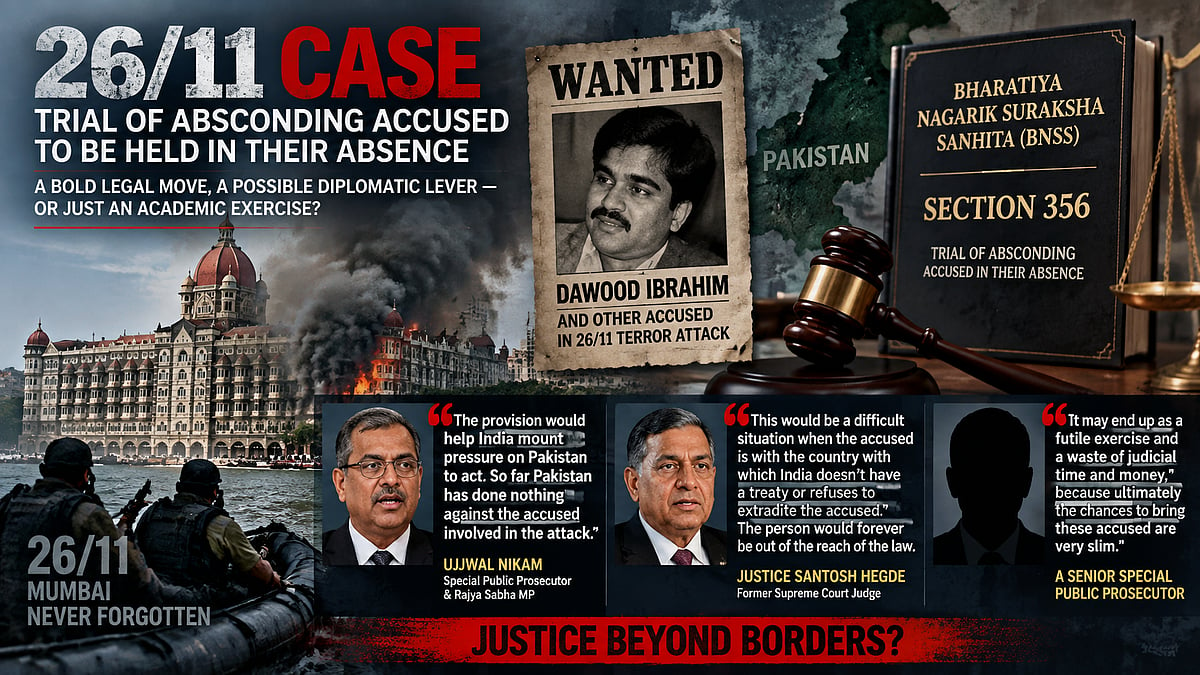
The prosecution in the 26/11 terror attack case is preparing to conduct a trial against wanted absconding accused in their absence. This move is seen as a way to pressure Pakistan to take action against the accused.
The Bharatiya Nagarik Suraksha Sanhita (BNSS) has a provision, Section 356, that allows investigating agencies to approach the court to conduct a trial of an absconding accused in their absence. If the court permits the trial, the accused is deemed to have waived their right to be present and face the proceedings.
The court then appoints a lawyer from the legal aid panel to represent the accused. This provision could be used to try wanted accused linked to several terror attacks, including Dawood Ibrahim.
Special Public Prosecutor Ujwal Nikam believes that this provision will help India mount pressure on Pakistan to act. Nikam stated that Pakistan has done nothing against the accused involved in the attack so far.
However, former Supreme Court judge Santosh Hegde said that this would be a difficult situation when the accused is in a country with which India doesn't have a treaty or refuses to extradite the accused.
A senior special public prosecutor also opined that this may end up as a futile exercise and a waste of judicial time and money, because ultimately the chances of bringing these accused to justice are very slim.
The 26/11 terror attack was a major attack on Indian soil, and the trial of the accused has been ongoing for several years. The attack resulted in the loss of many lives and caused significant damage to property.
The Indian government has been trying to bring the accused to justice, but the lack of cooperation from Pakistan has been a major hurdle. The use of the BNSS provision to try the accused in absentia is seen as a way to move the case forward.
However, experts believe that the practical impact of this move may be limited. The accused may still be out of reach of the law, and the trial may not result in any significant consequences for them.
The Indian government will have to wait and see how the court proceedings unfold and whether the use of the BNSS provision will have any significant impact on the case.
In the end, the trial of the 26/11 accused in absentia may be a symbolic move, but it shows that the Indian government is committed to bringing the accused to justice, no matter how long it takes.
The case has significant implications for India's relations with Pakistan and its efforts to combat terrorism. The use of the BNSS provision is a new approach, and its effectiveness will be closely watched by experts and the public alike.
As the case moves forward, it is likely to generate significant interest and attention, both in India and internationally. The outcome of the trial will have significant implications for the accused, the victims, and the wider community.
The 26/11 terror attack was a tragic event that resulted in the loss of many lives. The trial of the accused is an important step towards bringing closure to the victims and their families.
It is also an important step towards ensuring that those responsible for the attack are held accountable. The use of the BNSS provision to try the accused in absentia is a significant development in the case, and its outcome will be closely watched by all parties involved.
Frequently asked questions
What is the BNSS provision?
The BNSS provision, Section 356, allows investigating agencies to approach the court to conduct a trial of an absconding accused in their absence.
Why is India trying the 26/11 accused in absentia?
India is trying the 26/11 accused in absentia to mount pressure on Pakistan to act against the accused and to bring them to justice.