Bombay HC Denies Early Release To Murder Convict
Murder convict's plea rejected, Bombay HC upholds 26-year imprisonment. Convict committed crime with exceptional violence.
'%3E%3Crect%20width%3D'96'%20height%3D'96'%20fill%3D'%23B3261E'%2F%3E%3Ccircle%20cx%3D'30'%20cy%3D'24'%20r%3D'44'%20fill%3D'%23fff'%20opacity%3D'.12'%2F%3E%3Ccircle%20cx%3D'60'%20cy%3D'74'%20r%3D'40'%20fill%3D'%23000'%20opacity%3D'.10'%2F%3E%3C%2Fg%3E%3Cg%20fill%3D'%23fff'%3E%3Crect%20x%3D'29'%20y%3D'49'%20width%3D'8'%20height%3D'19'%20rx%3D'1'%2F%3E%3Crect%20x%3D'39'%20y%3D'40'%20width%3D'9'%20height%3D'28'%20rx%3D'1'%2F%3E%3Crect%20x%3D'50'%20y%3D'45'%20width%3D'8'%20height%3D'23'%20rx%3D'1'%2F%3E%3Crect%20x%3D'60'%20y%3D'53'%20width%3D'7'%20height%3D'15'%20rx%3D'1'%2F%3E%3Crect%20x%3D'41'%20y%3D'34'%20width%3D'5'%20height%3D'6'%2F%3E%3C%2Fg%3E%3C%2Fsvg%3E)
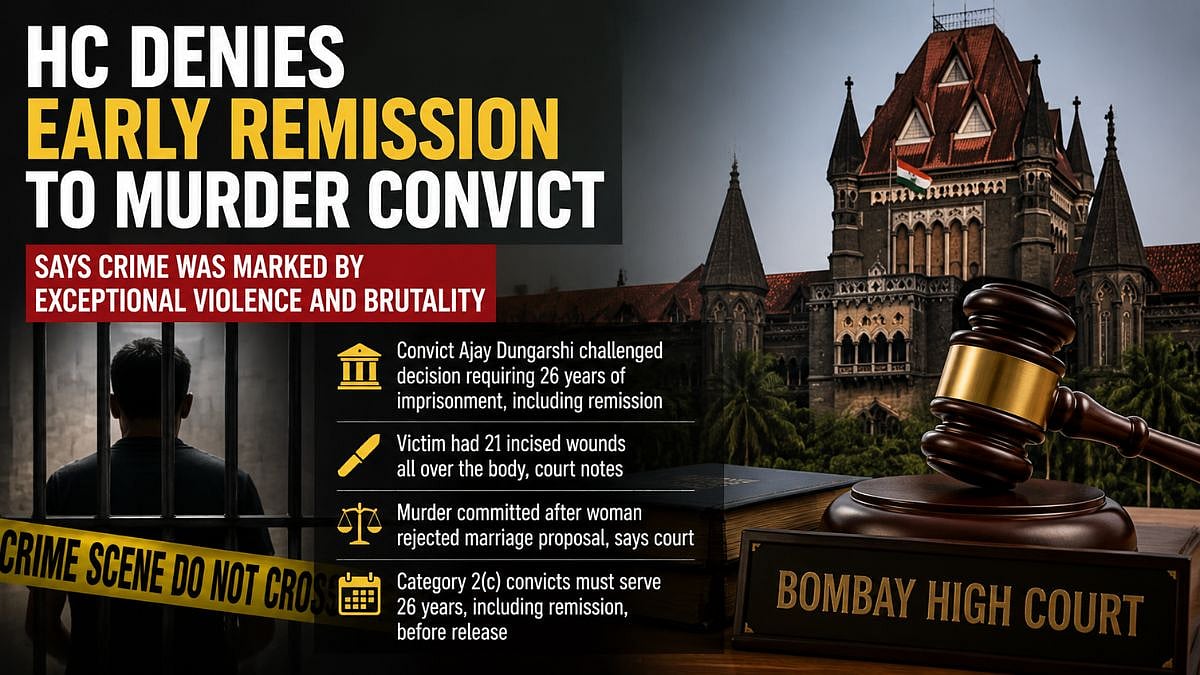
The Bombay High Court has upheld the Maharashtra government's decision to deny early remission and release to a man convicted of murdering a woman after she rejected his marriage proposal.
The court observed that the crime was marked by exceptional violence and brutality. A Bench headed by Justice Sarang Kotwal dismissed the plea filed by convict Ajay Dungarshi on July 20.
Dungarshi had challenged the state government's September 2025 decision classifying his case under a category that requires 26 years of imprisonment, including remission, before release. He argued that his case should be placed under another category, which allows release after 22 years of imprisonment.
The court referred to the trial court's findings and the nature of the injuries suffered by the victim. The judges noted that the prosecution had established that the murder was committed because the woman had refused Dungarshi's marriage proposal.
The court cited the brutality of the crime, which involved 21 incised wounds all over the victim's body. The state government had argued that Dungarshi's case clearly fell within the category of exceptional violence and brutality.
The High Court agreed, noting that the victim had suffered multiple deep stab injuries. The court's decision means that Dungarshi will have to serve 26 years of imprisonment, including remission, before becoming eligible for release.
The Maharashtra government's resolution of March 15, 2010, categorizes crimes based on their severity. Category 2(c) of the resolution requires convicts whose crimes involve exceptional violence, brutality, or death due to burns to undergo 26 years of imprisonment before release.
The court's decision is significant, as it upholds the state government's decision to deny early remission to convicts who have committed heinous crimes. The decision also highlights the importance of considering the severity of the crime when determining the sentence.
In recent years, there have been several cases of violent crimes in Mumbai, which have raised concerns about public safety. The Bombay High Court's decision in this case sends a strong message that such crimes will not be tolerated and that perpetrators will be held accountable.
The decision is also a reminder that the justice system is in place to protect the rights of victims and their families. The court's ruling is a testament to the commitment of the judiciary to upholding the law and ensuring that justice is served.
Frequently asked questions
What was the Bombay HC's decision in the murder convict's case?
The Bombay HC denied early release to the murder convict and upheld 26-year imprisonment.
What was the reason for the murder?
The murder was committed because the woman had refused the convict's marriage proposal.