Madras HC Issues Notice To Tamil Nadu CM, Minister
Notices issued over election petitions, Court grants one week to rectify defects

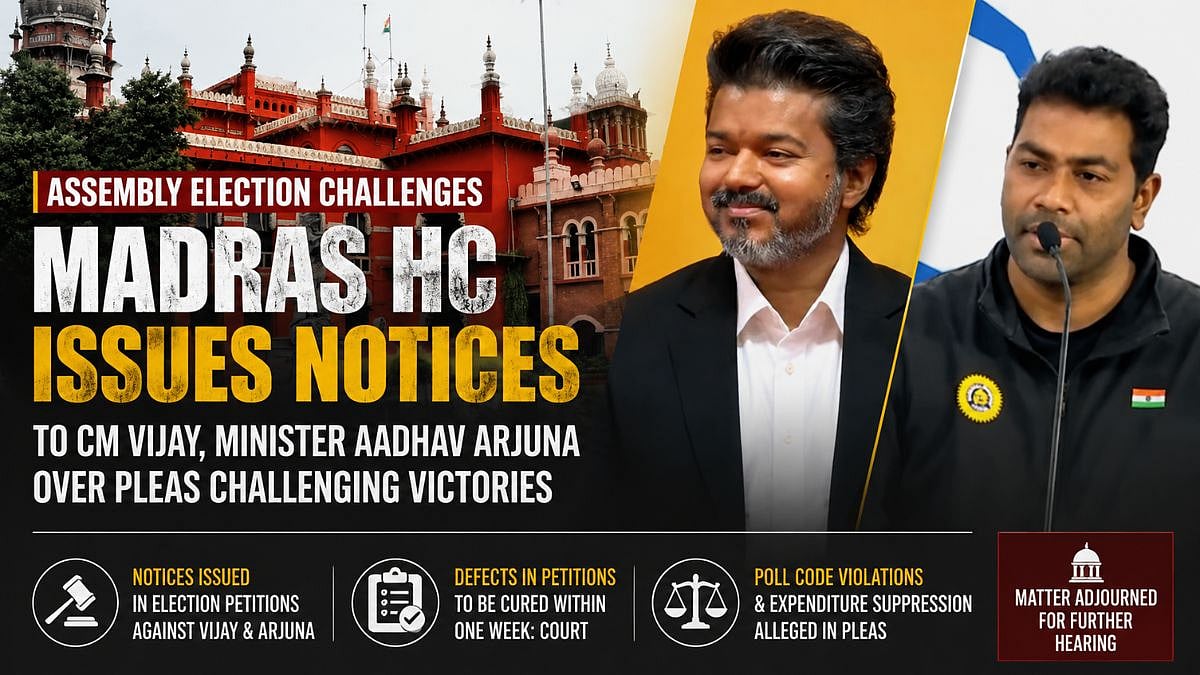
The Madras High Court issued notices to Tamil Nadu Chief Minister C. Joseph Vijay and Minister Aadhav Arjuna on Tuesday, regarding election petitions that challenge their victories in the 2026 Assembly elections. The notices were issued by Justice V. Lakshminarayanan in response to petitions questioning Vijay's victories from the Perambur and Tiruchirappalli East Assembly constituencies, as well as Arjuna's victory from the Villivakkam Assembly constituency.
However, the Court stated that the notices will only be served after the defects in the petitions are rectified. During the hearing, the Court granted the petitioners one week to cure these defects, which include issues relating to affidavits and Form 25. The Court emphasized the importance of procedural compliance and allowed private notice to be served in addition to the usual mode of service.
A total of four election petitions have been filed against Vijay, with three challenging his victory from Perambur and one questioning his election from Tiruchirappalli East. The petitions allege that Vijay and Tamilaga Vettri Kazhagam (TVK) functionaries involved minors in election campaigning, which is a violation of the Election Commission of India's direction. The petitioners claim that Vijay's speech on April 21, 2026, in which he allegedly asked children to persuade their parents to vote for TVK's symbol, is evidence of this violation.
The Court's decision to issue notices to Vijay and Arjuna is a significant development in the election petitions. The petitioners have alleged that Vijay and TVK functionaries engaged in corrupt practices, including the use of children in election campaigns. The Court's emphasis on procedural compliance suggests that it will carefully consider the petitions and ensure that all necessary requirements are met.
The outcome of these election petitions could have significant implications for Tamil Nadu politics. If the Court rules in favor of the petitioners, it could lead to a re-election in the affected constituencies. The case is likely to be closely watched by political observers and the public, as it raises important questions about the conduct of elections and the role of political parties in campaigning.
The next step in the case will be the rectification of the defects in the petitions, which is expected to be completed within one week. After that, the Court will proceed with serving the notices to Vijay and Arjuna, and the case will move forward. The Court's decision to allow private notice to be served in addition to the usual mode of service suggests that it is committed to expediting the case and ensuring that justice is served in a timely manner.
In conclusion, the Madras High Court's decision to issue notices to Vijay and Arjuna is a significant development in the election petitions. The case raises important questions about the conduct of elections and the role of political parties in campaigning, and its outcome could have significant implications for Tamil Nadu politics. The Court's emphasis on procedural compliance and its commitment to expediting the case suggest that it will carefully consider the petitions and ensure that justice is served in a timely manner.