Mumbai's Dual Conversations Exposed
Two contrasting narratives about Mumbai, one of hope and the other of despair. Which one do you hear?
'%3E%3Crect%20width%3D'96'%20height%3D'96'%20fill%3D'%23B3261E'%2F%3E%3Ccircle%20cx%3D'30'%20cy%3D'24'%20r%3D'44'%20fill%3D'%23fff'%20opacity%3D'.12'%2F%3E%3Ccircle%20cx%3D'60'%20cy%3D'74'%20r%3D'40'%20fill%3D'%23000'%20opacity%3D'.10'%2F%3E%3C%2Fg%3E%3Cg%20fill%3D'%23fff'%3E%3Crect%20x%3D'29'%20y%3D'49'%20width%3D'8'%20height%3D'19'%20rx%3D'1'%2F%3E%3Crect%20x%3D'39'%20y%3D'40'%20width%3D'9'%20height%3D'28'%20rx%3D'1'%2F%3E%3Crect%20x%3D'50'%20y%3D'45'%20width%3D'8'%20height%3D'23'%20rx%3D'1'%2F%3E%3Crect%20x%3D'60'%20y%3D'53'%20width%3D'7'%20height%3D'15'%20rx%3D'1'%2F%3E%3Crect%20x%3D'41'%20y%3D'34'%20width%3D'5'%20height%3D'6'%2F%3E%3C%2Fg%3E%3C%2Fsvg%3E)
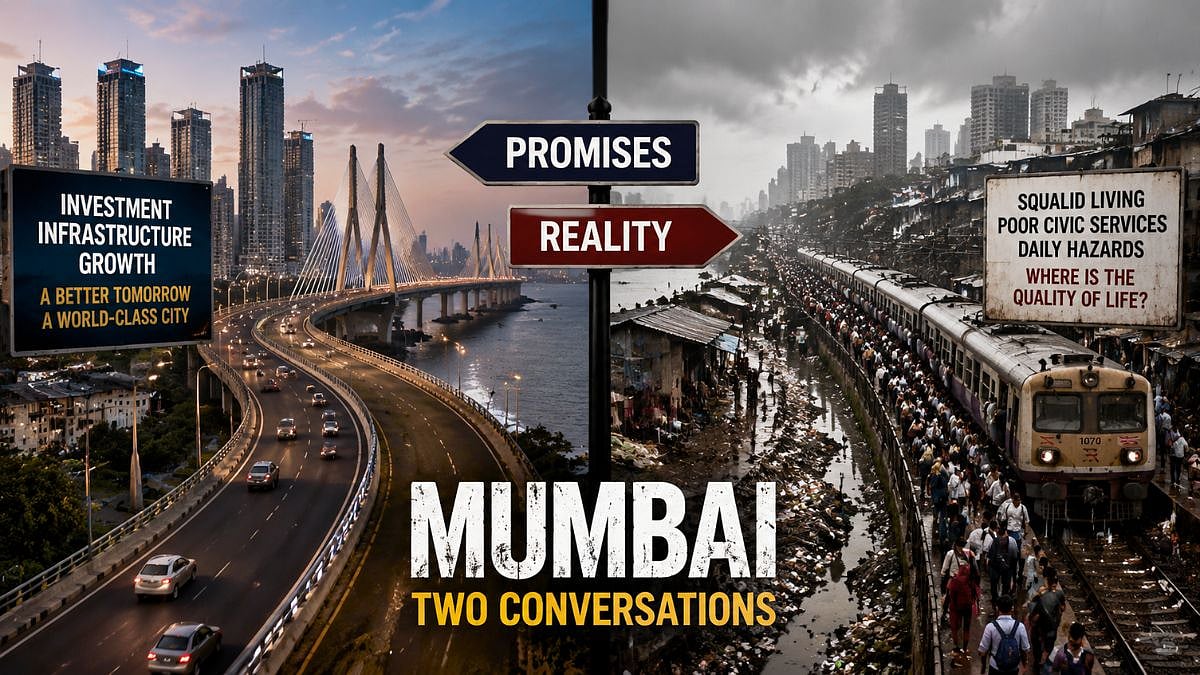
Mumbai, a city of stark contrasts, is home to two distinct conversations that rarely intersect. On one hand, there is the talk of grand infrastructure projects and investments, promising a 'better tomorrow' and a 'world-class city'. On the other hand, there is the harsh reality of squalid living conditions, inadequate civic services, and a bleak quality of life.
The first conversation is dominated by discussions of the next big investment, the next large infrastructure project, and the next huge proposal being considered by the state government and the Brihanmumbai Municipal Corporation (BMC). This narrative is often characterized by promises of a brighter future and assurances of a 'world-class city' that excites the aspirations of millions.
In contrast, the second conversation is a grim portrayal of the city's realities. It is a tale of overflowing garbage, stampede-like situations on railway platforms and bus stops, and a general lack of quality of life. This narrative is rarely heard in the rarefied spaces where Mumbai's wealthy elite reside, including its 96 billionaires and 1.42 lakh millionaires.
Recently, Maharashtra Chief Minister Devendra Fadnavis announced a Rs 13,000-crore flood control plan for Mumbai, which is part of a broader infrastructure push. The proposed expansion of the coastal road network is expected to cut travel time from south Mumbai to the proposed Virar offshore airport to just 50 minutes. Additionally, 27 of Mumbai's open grounds will have underground parking facilities, and a staggering Rs 12.26 lakh crore worth of infrastructure projects are either under implementation or in the pipeline across the Mumbai Metropolitan Region (MMR).
The Chief Minister's vision for the city is ambitious, with plans to raise MMR's GDP from $84 billion to $825 billion by 2047. Mumbai is poised to become the country's fintech and startup capital, with the city and the MMR emerging as Maharashtra's growth engine. However, what is strikingly absent from this narrative is any mention of how these infrastructure projects will translate into a better quality of life for the working millions in the city.
The chasm between these two conversations is wide, and it is in this space that millions of people struggle to live and work every day. The question remains, which conversation do you hear? Is it the one of hope and promise, or the one of despair and reality?
As the city continues to grow and evolve, it is essential to acknowledge the existence of these two conversations and to work towards bridging the gap between them. The people of Mumbai deserve a better quality of life, and it is the responsibility of the city's leaders to ensure that the benefits of infrastructure development are shared by all, not just the privileged few.
In conclusion, the dual conversations about Mumbai highlight the city's complexities and contradictions. While the city is poised for growth and development, it is crucial to remember that the true measure of success lies not in the scale of infrastructure projects, but in the quality of life of its citizens. As Mumbai continues to evolve, it is essential to prioritize the needs of its people and to work towards creating a more equitable and sustainable future for all.
The city's future is uncertain, but one thing is clear - the conversations about Mumbai will continue to evolve, and it is up to the city's leaders and citizens to ensure that the narrative of hope and promise is not just a distant dream, but a reality that is within reach for all.
Mumbai's story is one of contrasts, and it is up to us to write the next chapter. Will it be a tale of a 'world-class city' that is truly worthy of its name, or will it be a story of a city that is struggling to provide a decent quality of life for its citizens? The answer lies in the conversations we have, and the actions we take to shape the city's future.
As the city moves forward, it is essential to remember that the true spirit of Mumbai lies not in its infrastructure or its economy, but in the resilience and determination of its people. It is this spirit that has made Mumbai the city it is today, and it is this spirit that will shape its future.
In the end, the conversations about Mumbai are not just about the city; they are about the people who call it home. They are about the struggles and the triumphs, the hopes and the fears, and the dreams and the realities. They are about the city's ability to inspire and to frustrate, to uplift and to disappoint. They are about the human experience, and the complexities and contradictions that make Mumbai the city it is today.