Maharashtra Introduces New Aggregator Policy
New policy for Ola, Uber, Rapido, stricter safety rules, 80% fare for drivers
'%3E%3Crect%20width%3D'96'%20height%3D'96'%20fill%3D'%23B3261E'%2F%3E%3Ccircle%20cx%3D'30'%20cy%3D'24'%20r%3D'44'%20fill%3D'%23fff'%20opacity%3D'.12'%2F%3E%3Ccircle%20cx%3D'60'%20cy%3D'74'%20r%3D'40'%20fill%3D'%23000'%20opacity%3D'.10'%2F%3E%3C%2Fg%3E%3Cg%20fill%3D'%23fff'%3E%3Crect%20x%3D'29'%20y%3D'49'%20width%3D'8'%20height%3D'19'%20rx%3D'1'%2F%3E%3Crect%20x%3D'39'%20y%3D'40'%20width%3D'9'%20height%3D'28'%20rx%3D'1'%2F%3E%3Crect%20x%3D'50'%20y%3D'45'%20width%3D'8'%20height%3D'23'%20rx%3D'1'%2F%3E%3Crect%20x%3D'60'%20y%3D'53'%20width%3D'7'%20height%3D'15'%20rx%3D'1'%2F%3E%3Crect%20x%3D'41'%20y%3D'34'%20width%3D'5'%20height%3D'6'%2F%3E%3C%2Fg%3E%3C%2Fsvg%3E)
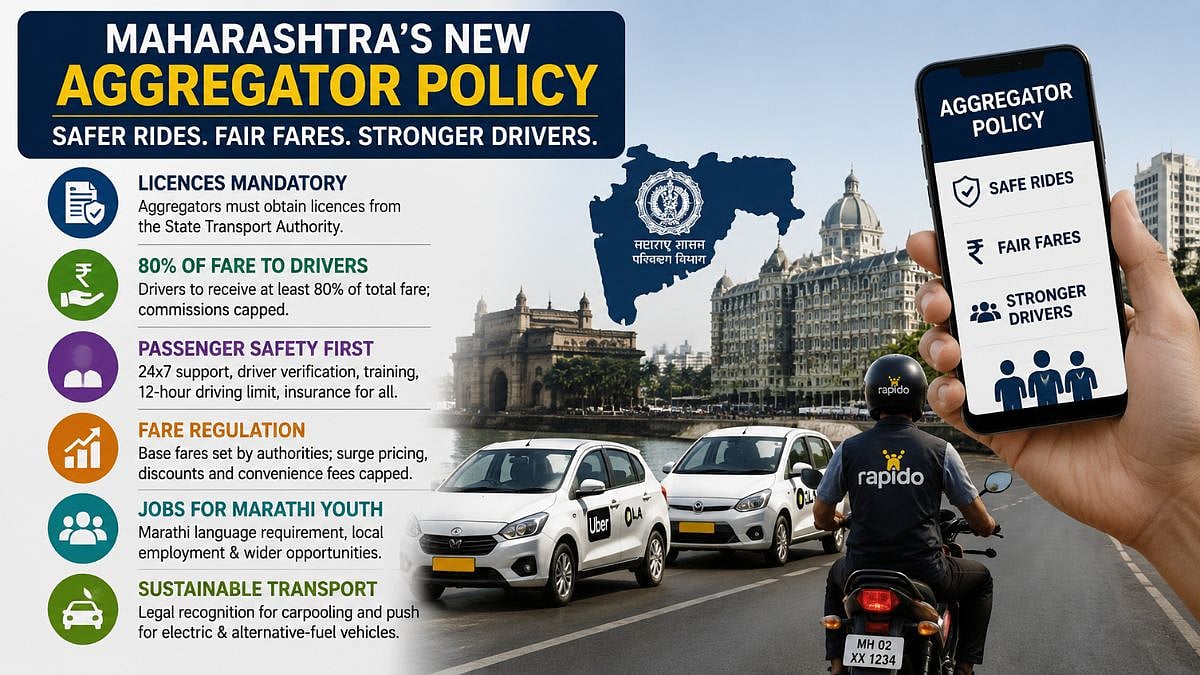
The Maharashtra government has introduced a new Aggregator Policy to regulate app-based taxi and bike taxi operators. The policy, notified on July 16, aims to make app-based transport services safer, more transparent, and accountable across the state.
The new policy makes licences mandatory for aggregators and guarantees drivers at least 80% of the fare. It also introduces tighter passenger safety norms, caps surge pricing, and gives legal recognition to carpooling. Transport Minister Pratap Sarnaik stated that the policy is designed to address the rising complaints over passenger safety, arbitrary fares, driver earnings, and poor grievance redressal.
Under the new policy, every aggregator must obtain a licence from the State Transport Authority and operate according to government-prescribed conditions. The state will also develop a central online portal to monitor aggregator-linked vehicles through GPS, verify drivers, and take action against violations.
Passenger safety has been placed at the centre of the policy. Every aggregator will be required to operate a 24x7 customer support centre, appoint a grievance redressal officer, and resolve complaints within a fixed timeframe. Drivers must hold a valid driving licence and badge, complete mandatory training, and will not be allowed to drive for more than 12 consecutive hours.
The policy also seeks to improve drivers' financial security by ensuring they receive at least 80% of the total fare, limiting the commission charged by aggregators. Base fares will be determined by the Regional Transport Authority, while surge pricing and excessive promotional discounts will be regulated. Convenience fees have also been capped to prevent overcharging.
To prevent the concentration of vehicle ownership, a single owner can register a maximum of 50 vehicles on one platform in Mumbai, Pune, Nashik, and Nagpur, and up to 25 vehicles in the rest of Maharashtra. The government said the measure is aimed at promoting wider participation instead of allowing a few large fleet operators to dominate the market.
The policy makes it mandatory for all commercial passenger transport drivers to obtain a badge by submitting the required documents, proof of Maharashtra domicile, and practical knowledge of Marathi. Women's safety has also been addressed by allowing female passengers using ride-pooling services to choose to travel only with women drivers or women co-passengers.
The government has also introduced a legal framework for non-commercial carpooling, allowing private vehicle owners to carpool with others. Aggregator apps and websites must be available in Marathi, Hindi, and English.
The introduction of the new Aggregator Policy is expected to have a significant impact on the app-based transport industry in Maharashtra, with a focus on improving passenger safety, driver welfare, and employment opportunities for Marathi-speaking youth. The policy is a step towards regulating the industry and providing a safer and more transparent experience for commuters.
The Maharashtra government's move to regulate app-based taxi and bike taxi operators is a welcome step, considering the rising number of commuters relying on these services every day. The policy's focus on passenger safety, driver welfare, and employment opportunities is expected to benefit both commuters and drivers, and promote a more accountable and transparent app-based transport industry in the state.
In conclusion, the new Aggregator Policy introduced by the Maharashtra government is a significant development in the app-based transport industry. The policy's emphasis on passenger safety, driver welfare, and employment opportunities is expected to have a positive impact on the industry and provide a safer and more transparent experience for commuters. The policy is a step towards regulating the industry and promoting a more accountable and transparent app-based transport system in Maharashtra.
The policy is also expected to create employment opportunities for Marathi-speaking youth and promote wider participation in the industry. The government's move to introduce a legal framework for non-commercial carpooling is also a welcome step, as it will allow private vehicle owners to carpool with others and reduce the number of vehicles on the road.
Overall, the new Aggregator Policy is a significant development in the app-based transport industry in Maharashtra, and is expected to have a positive impact on the industry and commuters alike.