Owaisi: UCC Targets Muslims' Religious Freedom
AIMIM president Asaduddin Owaisi criticizes UCC, says it violates Constitution.
'%3E%3Crect%20width%3D'96'%20height%3D'96'%20fill%3D'%231A5276'%2F%3E%3Ccircle%20cx%3D'30'%20cy%3D'24'%20r%3D'44'%20fill%3D'%23fff'%20opacity%3D'.12'%2F%3E%3Ccircle%20cx%3D'60'%20cy%3D'74'%20r%3D'40'%20fill%3D'%23000'%20opacity%3D'.10'%2F%3E%3C%2Fg%3E%3Cg%20fill%3D'%23fff'%3E%3Cpath%20d%3D'M31%2041%20L48%2031%20L65%2041%20Z'%2F%3E%3Crect%20x%3D'33'%20y%3D'43'%20width%3D'4'%20height%3D'17'%2F%3E%3Crect%20x%3D'41'%20y%3D'43'%20width%3D'4'%20height%3D'17'%2F%3E%3Crect%20x%3D'51'%20y%3D'43'%20width%3D'4'%20height%3D'17'%2F%3E%3Crect%20x%3D'59'%20y%3D'43'%20width%3D'4'%20height%3D'17'%2F%3E%3Crect%20x%3D'30'%20y%3D'62'%20width%3D'36'%20height%3D'4'%20rx%3D'1'%2F%3E%3C%2Fg%3E%3C%2Fsvg%3E)
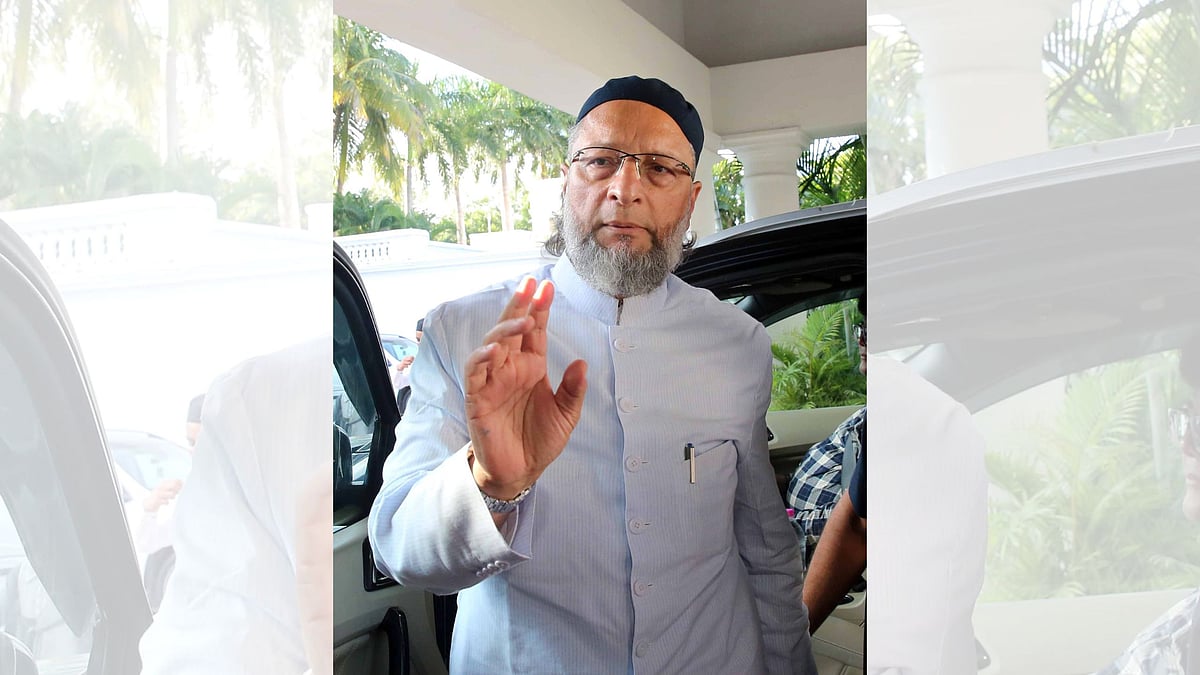
Asaduddin Owaisi, president of the All India Majlis-e-Ittehadul Muslimeen (AIMIM), stated on Tuesday that the Uniform Civil Code (UCC) is an attempt to undermine Muslims' religious freedom. He made this statement while speaking to the media in Bhopal, Madhya Pradesh.
Owaisi argued that the UCC is in direct conflict with the Constitution of India, specifically Articles 25, 26, 14, and 29, which guarantee freedom of religion, equality before the law, and safeguards for minority rights. He emphasized that the government cannot restrict freedom of religion by implementing a law like the UCC.
The AIMIM president claimed that the UCC has been introduced with the intention of targeting the 18 crore Muslims in the country. He pointed out that in Madhya Pradesh, where Muslims make up only 8-9% of the population, they are being forced to adopt laws such as the Hindu Marriage Act, Hindu Succession Act, and Indian Divorce Act.
Owaisi also discussed the upcoming Uttar Pradesh Assembly elections, expressing his desire to form an alliance to prevent the BJP from coming to power for a third time. He alleged that the BJP has intentionally destroyed madrasas, mosques, burial grounds, and mazars in areas where they hold power.
The AIMIM president's comments come at a time when the UCC is being debated across the country. The issue has sparked controversy, with some arguing that it is necessary for uniformity and others claiming that it infringes upon individual rights and freedoms.
In recent times, the UCC has been introduced in several states, including Madhya Pradesh. The move has been met with resistance from various sections of society, who argue that it is an attempt to impose a particular ideology on the population.
As the debate surrounding the UCC continues, Owaisi's comments are likely to add fuel to the fire. The issue is expected to be a major point of discussion in the upcoming elections, with various parties taking differing stances on the matter.
The UCC is a highly contentious issue, with far-reaching implications for the country. As such, it is essential to consider the perspectives of all stakeholders involved, including religious minorities, to ensure that any legislation introduced is fair and just.
In conclusion, Owaisi's statement highlights the concerns surrounding the UCC and its potential impact on religious freedom in India. The issue is complex and multifaceted, requiring careful consideration and nuanced discussion.
The controversy surrounding the UCC is a reminder of the importance of protecting individual rights and freedoms in a democratic society. As the country moves forward, it is essential to prioritize inclusivity, diversity, and social cohesion, ensuring that the rights of all citizens are respected and protected.
Ultimately, the UCC is a matter that requires careful deliberation and consideration. It is crucial to engage in open and honest discussions, taking into account the perspectives of all stakeholders, to ensure that any legislation introduced is fair, just, and respectful of individual rights and freedoms.
Frequently asked questions
What is the Uniform Civil Code (UCC)?
The Uniform Civil Code (UCC) is a law that aims to uniformize the personal laws of all citizens in India.
Why is Asaduddin Owaisi opposed to the UCC?
Asaduddin Owaisi is opposed to the UCC because he believes it targets Muslims and violates their religious freedom, as well as the Constitution of India.