Bombay HC Questions IMA's Right To Challenge Law On Homoeopaths Practising Allopathy
Bombay HC hears plea, Maharashtra government questions IMA's locus standi. IMA challenges law allowing homoeopaths to practise allopathy.
'%3E%3Crect%20width%3D'96'%20height%3D'96'%20fill%3D'%23B3261E'%2F%3E%3Ccircle%20cx%3D'30'%20cy%3D'24'%20r%3D'44'%20fill%3D'%23fff'%20opacity%3D'.12'%2F%3E%3Ccircle%20cx%3D'60'%20cy%3D'74'%20r%3D'40'%20fill%3D'%23000'%20opacity%3D'.10'%2F%3E%3C%2Fg%3E%3Cg%20fill%3D'%23fff'%3E%3Crect%20x%3D'29'%20y%3D'49'%20width%3D'8'%20height%3D'19'%20rx%3D'1'%2F%3E%3Crect%20x%3D'39'%20y%3D'40'%20width%3D'9'%20height%3D'28'%20rx%3D'1'%2F%3E%3Crect%20x%3D'50'%20y%3D'45'%20width%3D'8'%20height%3D'23'%20rx%3D'1'%2F%3E%3Crect%20x%3D'60'%20y%3D'53'%20width%3D'7'%20height%3D'15'%20rx%3D'1'%2F%3E%3Crect%20x%3D'41'%20y%3D'34'%20width%3D'5'%20height%3D'6'%2F%3E%3C%2Fg%3E%3C%2Fsvg%3E)
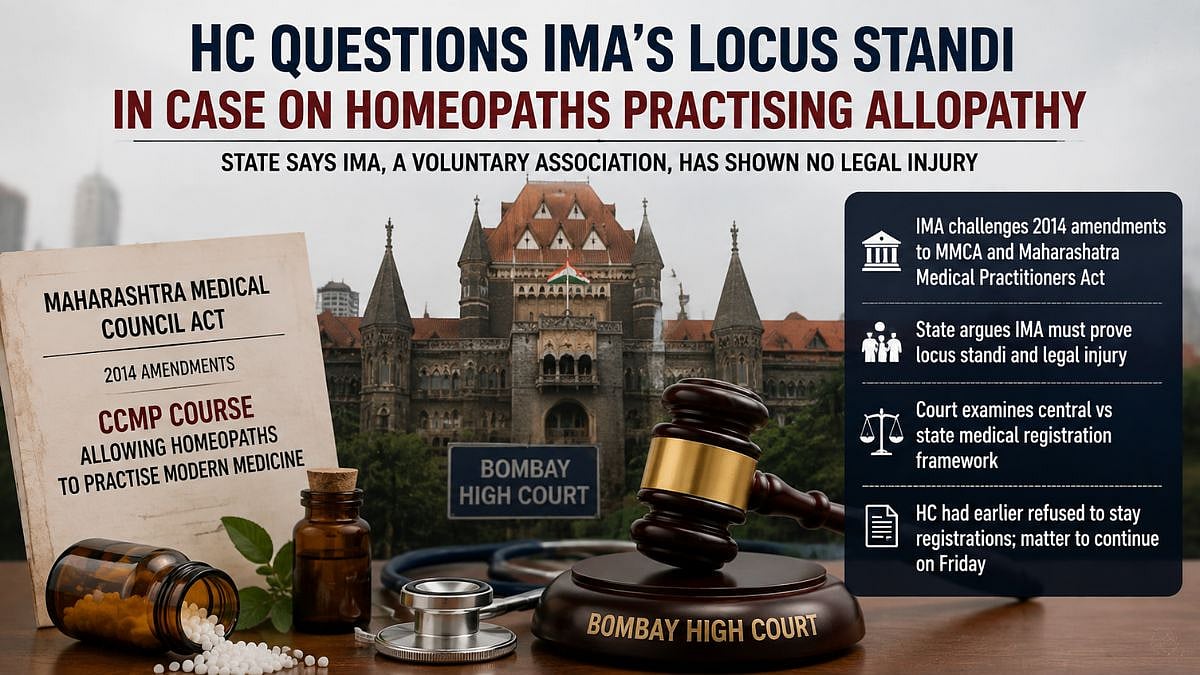
The Bombay High Court has questioned the Indian Medical Association's (IMA) right to challenge the Maharashtra law that allows homoeopathy practitioners who complete the Certificate Course in Modern Pharmacology (CCMP) to practise modern medicine in the state.
The court was hearing a plea by the IMA challenging the 2014 amendments to the Maharashtra Medical Council Act (MMCA) and the Maharashtra Medical Practitioners Act.
Advocate General Milind Sathe argued that the IMA, being a voluntary association of doctors, has failed to show how it has suffered any legal injury because of the amendments. The state said the association cannot challenge the constitutional validity of a law merely on the ground that it disagrees with its provisions.
The state pointed out that the challenge was not based on any alleged violation of the doctors' fundamental right to practise their profession. Instead, the IMA had primarily questioned the legislative competence of the state to make the amendments.
The Maharashtra government maintained that the court should not decide the validity of a law when the petitioner itself has not shown how it is affected by the legislation.
The IMA has challenged the legal framework permitting homoeopathy practitioners who complete the CCMP to practise allopathy. The state, however, contended that the Maharashtra law creates a separate state-level registration regime and that the provisions have existed as part of the state legislation since 1965.
The court examined the distinction between the central and state medical registers. The state argued that the Indian Medical Council Act regulates recognised qualifications for modern medicine at the central level, while registration to practise in Maharashtra is governed by the state law.
The state further pointed out that the Indian Medical Council, which was the statutory body under the earlier central law, has since been replaced by the National Medical Commission. It stressed that neither the statutory medical regulator nor the NMC was the petitioner in the present challenge.
The Bombay High Court's decision on the matter is awaited. The case has significant implications for the practice of medicine in Maharashtra, particularly with regards to the role of homoeopathy practitioners in the state's healthcare system.
The Maharashtra government's argument that the IMA lacks locus standi to challenge the law has raised questions about the association's ability to represent the interests of doctors in the state.
The case also highlights the complexities of the medical registration regime in India, with different laws and regulations governing the practice of medicine at the central and state levels.
In conclusion, the Bombay High Court's decision on the IMA's plea will have significant implications for the practice of medicine in Maharashtra and the role of homoeopathy practitioners in the state's healthcare system.
The court's ruling will provide clarity on the legislative competence of the state to make amendments to the Maharashtra Medical Council Act and the Maharashtra Medical Practitioners Act, and the validity of the law allowing homoeopathy practitioners to practise allopathy in the state.
Frequently asked questions
What is the IMA's challenge to the Maharashtra law about?
The IMA is challenging the law that allows homoeopathy practitioners who complete the CCMP to practise modern medicine in the state.
What is the Maharashtra government's argument in the case?
The Maharashtra government argues that the IMA lacks locus standi to challenge the law and that the court should not decide the validity of the law when the petitioner itself has not shown how it is affected by the legislation.