Pune Protesters Display 'Simon Come Back' Placard
A viral placard at a Pune protest references the historic 'Simon Go Back' slogan. Protesters demand student rights and criticize NEET exam irregularities.
'%3E%3Crect%20width%3D'96'%20height%3D'96'%20fill%3D'%23B3261E'%2F%3E%3Ccircle%20cx%3D'30'%20cy%3D'24'%20r%3D'44'%20fill%3D'%23fff'%20opacity%3D'.12'%2F%3E%3Ccircle%20cx%3D'60'%20cy%3D'74'%20r%3D'40'%20fill%3D'%23000'%20opacity%3D'.10'%2F%3E%3C%2Fg%3E%3Cg%20fill%3D'%23fff'%3E%3Crect%20x%3D'29'%20y%3D'49'%20width%3D'8'%20height%3D'19'%20rx%3D'1'%2F%3E%3Crect%20x%3D'39'%20y%3D'40'%20width%3D'9'%20height%3D'28'%20rx%3D'1'%2F%3E%3Crect%20x%3D'50'%20y%3D'45'%20width%3D'8'%20height%3D'23'%20rx%3D'1'%2F%3E%3Crect%20x%3D'60'%20y%3D'53'%20width%3D'7'%20height%3D'15'%20rx%3D'1'%2F%3E%3Crect%20x%3D'41'%20y%3D'34'%20width%3D'5'%20height%3D'6'%2F%3E%3C%2Fg%3E%3C%2Fsvg%3E)
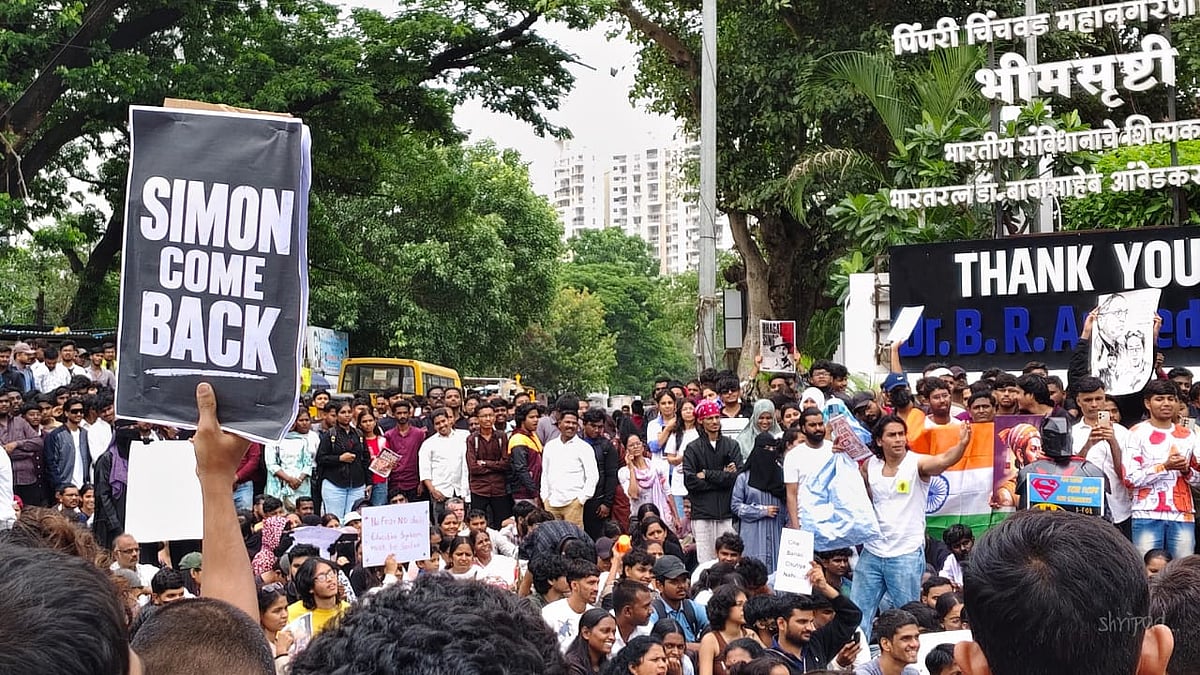
On Thursday, a protest was held at Bharat Ratna Dr Babasaheb Ambedkar Memorial Square in Pimpri, Pune, in solidarity with students protesting at Delhi's Jantar Mantar over alleged NEET examination irregularities and student rights. Among the various messages displayed during the protest was a placard reading 'Simon Come Back', which appeared to be a satirical reference to the historic 'Simon Go Back' slogan of India's freedom movement.
The protesters also held photographs of Dr Babasaheb Ambedkar and copies of the Constitution while raising slogans such as 'Jai Bhim', 'Jai Samvidhan', 'Inquilab Zindabad', and 'Modi Hatao, Desh Bachao'. The 'Simon Come Back' placard was seen as an ironic twist on the iconic 'Simon Go Back' freedom movement slogan, used by protesters to express political dissent during the rally.
The 'Simon Go Back' slogan became famous in 1928 when Indians protested against the Simon Commission, a British-appointed committee that had no Indian members despite being tasked with reviewing constitutional reforms. The commission faced nationwide protests wherever it travelled, with protesters claiming that the exclusion of Indians from the panel was a sign of disrespect towards the country.
The Simon Commission, officially known as the Indian Statutory Commission, was appointed by the British government under Prime Minister Stanley Baldwin in November 1927. It was chaired by Sir John Simon and comprised seven British Members of Parliament. The commission was sent to India to review the working of the Government of India Act, 1919, and recommend future constitutional reforms.
However, the complete exclusion of Indians from the panel sparked widespread anger across the country. Major political organisations, including the Indian National Congress and a large section of the Muslim League, boycotted the commission, arguing that Indians should have a decisive role in shaping their own constitutional future.
As the commission toured the country in 1928, it was greeted with black flags and protesters shouting 'Simon Go Back'. The protests were a significant moment in India's freedom movement, with the slogan becoming a rallying cry for the country's struggle for independence.
In the context of the current protest, the 'Simon Come Back' placard was seen as a way of expressing dissatisfaction with the present situation and demanding student rights. The protesters claimed that the placard was not a literal call for the return of the Simon Commission, but rather an ironic political message using a historic slogan to express their discontent.
The protest in Pune was one of several held across the country in solidarity with the students protesting at Delhi's Jantar Mantar. The students are demanding changes to the NEET examination system and greater rights for students. The protests have gained widespread attention and support, with many seeing them as an important moment in the country's ongoing struggle for social justice.
The use of the 'Simon Come Back' placard at the protest highlights the ongoing relevance of India's freedom movement and the continued importance of protesting against injustice. The protesters' demands for student rights and their criticism of the NEET exam irregularities are seen as part of a broader struggle for social justice and equality in the country.
In conclusion, the 'Simon Come Back' placard displayed at the Pune protest is a significant moment in the country's ongoing struggle for social justice. The protesters' use of a historic slogan to express their discontent with the present situation highlights the ongoing relevance of India's freedom movement and the importance of continued protest against injustice.
Frequently asked questions
What is the significance of the 'Simon Come Back' placard?
The 'Simon Come Back' placard is a satirical reference to the historic 'Simon Go Back' slogan of India's freedom movement, used to express political dissent and demand student rights.
What was the Simon Commission?
The Simon Commission was a British-appointed committee that reviewed constitutional reforms in India in 1928, sparking widespread protests due to its exclusion of Indian members.