Sensex Slips 0.1% As Crude Oil, US-Iran Tensions Weigh
Sensex and Nifty slip, crude oil prices rise, US-Iran tensions escalate.
'%3E%3Crect%20width%3D'96'%20height%3D'96'%20fill%3D'%230B6E4F'%2F%3E%3Ccircle%20cx%3D'30'%20cy%3D'24'%20r%3D'44'%20fill%3D'%23fff'%20opacity%3D'.12'%2F%3E%3Ccircle%20cx%3D'60'%20cy%3D'74'%20r%3D'40'%20fill%3D'%23000'%20opacity%3D'.10'%2F%3E%3C%2Fg%3E%3Cg%20fill%3D'none'%20stroke%3D'%23fff'%20stroke-width%3D'3.2'%20stroke-linecap%3D'round'%20stroke-linejoin%3D'round'%3E%3Cpolyline%20points%3D'31%2C59%2041%2C49%2049%2C54%2063%2C37'%2F%3E%3Cpolyline%20points%3D'55%2C37%2063%2C37%2063%2C45'%2F%3E%3C%2Fg%3E%3C%2Fsvg%3E)
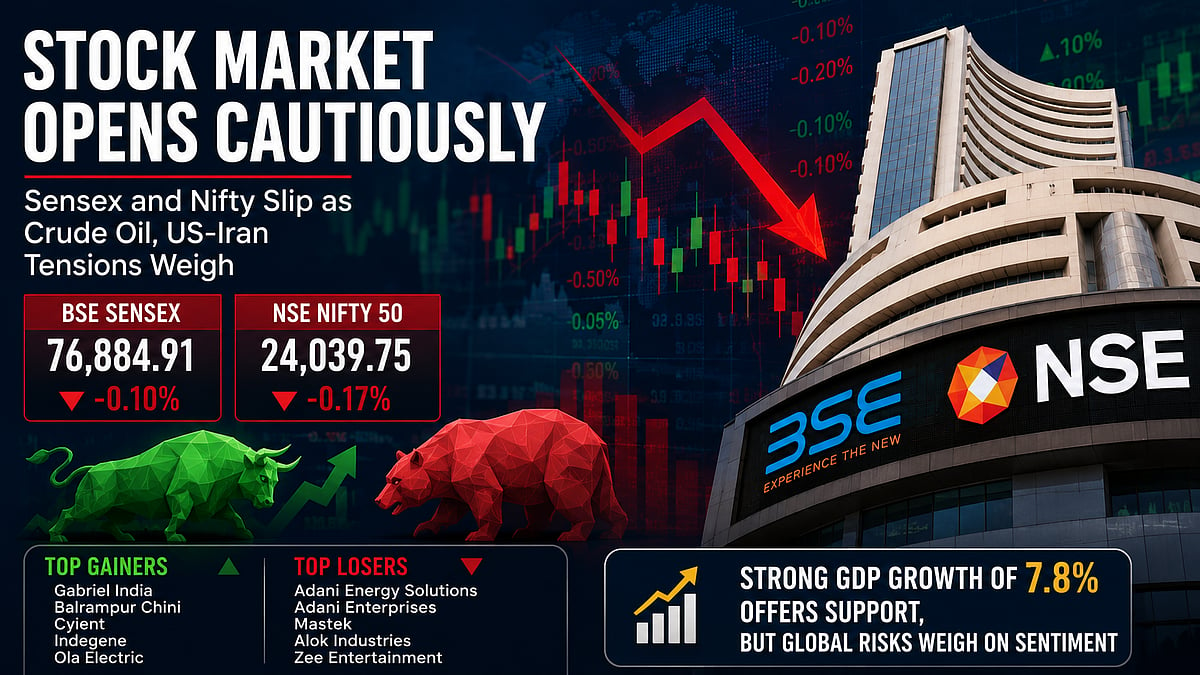
The Indian equity market opened cautiously on Tuesday, September 1, with the BSE Sensex down 0.1% at 76,884.91 and the NSE Nifty 50 slipping 0.17% to 24,039.75.
Despite strong domestic economic growth, concerns over rising crude oil prices and escalating US-Iran tensions weighed on the market. India's real GDP expanded 7.8% year-on-year during the April-June quarter of FY27, supported by investment, manufacturing, and consumer demand.
The growth figure was stronger than expectations and provided some support to equities. However, the positive domestic data was overshadowed by renewed geopolitical concerns. Rising tensions between the US and Iran have pushed crude oil prices above $90 per barrel, raising fresh worries for oil-importing India.
Selling pressure was visible across most sectors, with 12 of the 16 major sectoral indices trading lower in early deals. Banking stocks fell around 1%, while mid-cap and small-cap indices also remained under pressure.
Among broader-market gainers, Gabriel India, Balrampur Chini, Cyient, Indegene, and Ola Electric were trading higher. On the losing side, Adani Energy Solutions and Adani Enterprises witnessed sharp declines, while Mastek, Alok Industries, and Zee Entertainment were also among the notable laggards.
The Indian economy has been performing well, with strong GDP growth and investment. However, the market is sensitive to global cues, and the current geopolitical tensions are affecting investor sentiment. The rise in crude oil prices is also a concern for India, as it is a major oil-importing country.
The market is expected to remain volatile in the short term, with investors closely watching the developments in the US-Iran tensions and the crude oil prices. The strong domestic economic growth is a positive factor, but it may not be enough to offset the negative impact of the global cues.
Overall, trading on both the BSE and NSE began on a cautious footing, with geopolitical risks and elevated crude prices limiting the positive impact of India's stronger GDP growth. The market is likely to remain under pressure in the short term, with investors adopting a wait-and-watch approach.
The current situation highlights the importance of diversification and risk management in investment portfolios. Investors should be cautious and avoid making impulsive decisions based on short-term market fluctuations. A long-term perspective and a well-diversified portfolio can help investors navigate the current market volatility.
In conclusion, the Indian equity market opened cautiously on Tuesday, with the Sensex and Nifty slipping due to concerns over rising crude oil prices and escalating US-Iran tensions. The strong domestic economic growth provided some support, but it was not enough to offset the negative impact of the global cues. The market is expected to remain volatile in the short term, and investors should be cautious and adopt a long-term perspective.
The implications of the current market situation are significant for India, as the country is heavily dependent on oil imports. The rise in crude oil prices can have a negative impact on the economy, and the government may need to take measures to mitigate the effects. The market volatility can also affect investor sentiment, and it is essential to maintain a stable and positive investment environment.
The Indian government has been taking steps to promote economic growth and investment, and the strong GDP growth is a testament to these efforts. However, the current geopolitical tensions and the rise in crude oil prices are a concern, and the government may need to take additional measures to support the economy and maintain investor confidence.
In the long term, the Indian economy is expected to continue growing, driven by strong domestic demand and investment. The country has a large and growing consumer market, and it is an attractive destination for foreign investment. The government's efforts to promote economic growth and investment are likely to pay off in the long term, and the country is expected to emerge as a major economic power in the coming years.
The current market situation is a reminder of the importance of economic diversification and risk management. India needs to reduce its dependence on oil imports and promote domestic production to mitigate the effects of rising crude oil prices. The government should also take measures to promote investment and maintain a stable and positive investment environment.
In conclusion, the Indian equity market opened cautiously on Tuesday, with the Sensex and Nifty slipping due to concerns over rising crude oil prices and escalating US-Iran tensions. The strong domestic economic growth provided some support, but it was not enough to offset the negative impact of the global cues. The market is expected to remain volatile in the short term, and investors should be cautious and adopt a long-term perspective. The implications of the current market situation are significant for India, and the government may need to take measures to mitigate the effects and maintain investor confidence.
The Indian economy is expected to continue growing in the long term, driven by strong domestic demand and investment. The country has a large and growing consumer market, and it is an attractive destination for foreign investment. The government's efforts to promote economic growth and investment are likely to pay off in the long term, and the country is expected to emerge as a major economic power in the coming years.
The current market situation is a reminder of the importance of economic diversification and risk management. India needs to reduce its dependence on oil imports and promote domestic production to mitigate the effects of rising crude oil prices. The government should also take measures to promote investment and maintain a stable and positive investment environment.
Overall, the Indian equity market opened cautiously on Tuesday, with the Sensex and Nifty slipping due to concerns over rising crude oil prices and escalating US-Iran tensions. The strong domestic economic growth provided some support, but it was not enough to offset the negative impact of the global cues. The market is expected to remain volatile in the short term, and investors should be cautious and adopt a long-term perspective.
Frequently asked questions
What is the current Sensex level?
The BSE Sensex is down 0.1% at 76,884.91.
What is the current Nifty level?
The NSE Nifty 50 is down 0.17% at 24,039.75.