India Emerges as New Swing Supplier for Refined Oil Products
India's oil exports rise, refining capacity grows. Can it sustain?
'%3E%3Crect%20width%3D'96'%20height%3D'96'%20fill%3D'%230B6E4F'%2F%3E%3Ccircle%20cx%3D'30'%20cy%3D'24'%20r%3D'44'%20fill%3D'%23fff'%20opacity%3D'.12'%2F%3E%3Ccircle%20cx%3D'60'%20cy%3D'74'%20r%3D'40'%20fill%3D'%23000'%20opacity%3D'.10'%2F%3E%3C%2Fg%3E%3Cg%20fill%3D'none'%20stroke%3D'%23fff'%20stroke-width%3D'3.2'%20stroke-linecap%3D'round'%20stroke-linejoin%3D'round'%3E%3Cpolyline%20points%3D'31%2C59%2041%2C49%2049%2C54%2063%2C37'%2F%3E%3Cpolyline%20points%3D'55%2C37%2063%2C37%2063%2C45'%2F%3E%3C%2Fg%3E%3C%2Fsvg%3E)
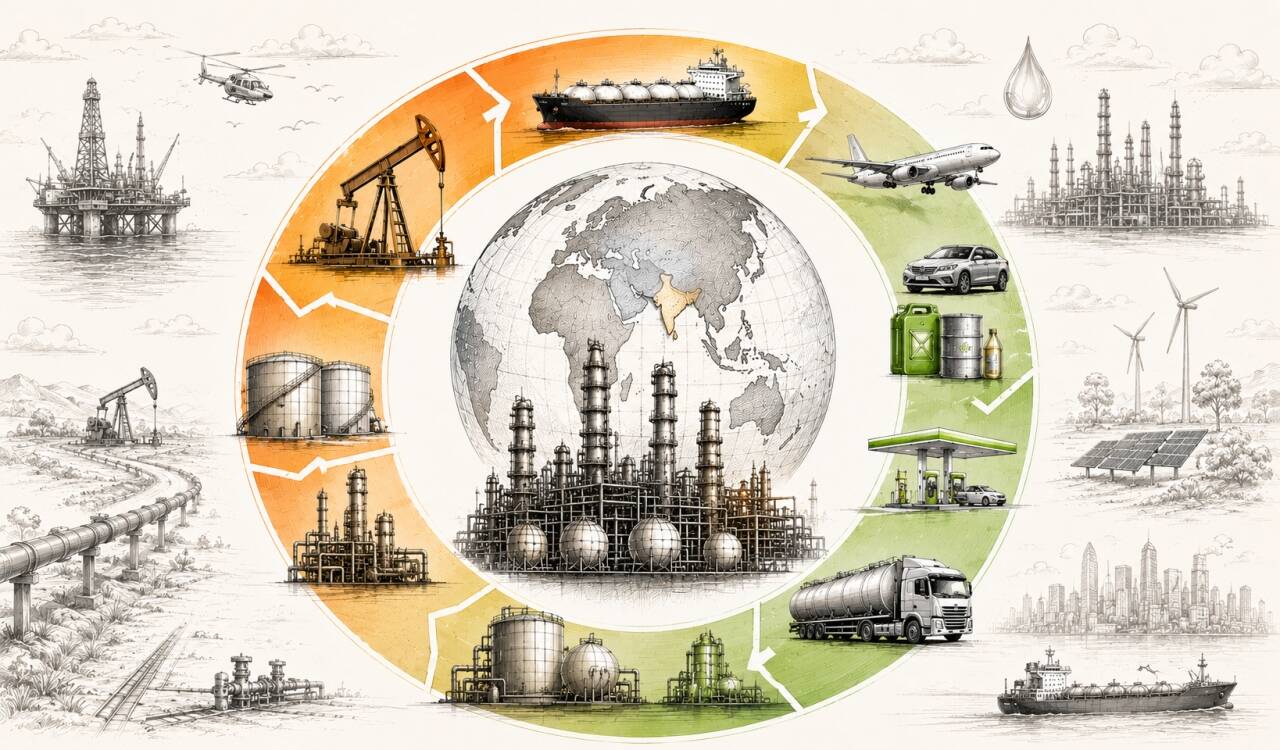
India has emerged as a significant 'swing supplier' for refined oil products, with a substantial increase in its exports to various destinations. This development is largely attributed to the country's considerable refining capacity, which stands at approximately 258.1 million tonnes across 23 refineries.
The growth in India's refining capacity has enabled it to become the fourth-largest refining centre globally, trailing only the US, China, and Russia. As a result, oil products now constitute a much larger share of India's exports to several countries.
India's refining sector has undergone significant expansion in recent years, driven by government initiatives and investments from major oil companies. The country's strategic location and extensive refining infrastructure have made it an attractive hub for oil exports.
The increase in India's oil exports has been driven by a combination of factors, including the growing demand for refined oil products in emerging markets and the country's competitive pricing. Additionally, India's refineries have been able to capitalize on the arbitrage opportunities in the global oil market, further boosting their exports.
However, sustaining this growth will depend on various factors, including the ability of Indian refineries to maintain their competitiveness, the stability of global oil prices, and the country's ability to navigate the complexities of the international oil market.
In the context of the global oil market, India's emergence as a swing supplier is significant, as it can help bridge the gap between supply and demand. The country's refining capacity and strategic location make it an important player in the regional oil market, and its growth is likely to have a positive impact on the global oil trade.
As India continues to expand its refining capacity and increase its oil exports, it is likely to face challenges from other major oil-producing countries. However, the country's strong refining infrastructure and competitive pricing are expected to help it maintain its position as a significant player in the global oil market.
In conclusion, India's emergence as a new swing supplier for refined oil products is a significant development, driven by its growing refining capacity and strategic location. While there are challenges ahead, the country's strong refining infrastructure and competitive pricing are likely to help it sustain its growth and maintain its position in the global oil market.
The implications of India's growth as a swing supplier are far-reaching, with potential benefits for the country's economy and its position in the global oil trade. As the country continues to navigate the complexities of the international oil market, its ability to sustain its growth and maintain its competitiveness will be crucial in determining its long-term success.
Frequently asked questions
What is India's current refining capacity?
India has approximately 258.1 million tonnes of installed refining capacity across 23 refineries.
What is India's position in the global refining market?
India is the fourth-largest refining centre globally, after the US, China, and Russia.