Motor Law Changes To Ease Minor Offences From August 15
New law simplifies minor traffic violations, lawyers raise concerns over road safety and due process.
'%3E%3Crect%20width%3D'96'%20height%3D'96'%20fill%3D'%23B3261E'%2F%3E%3Ccircle%20cx%3D'30'%20cy%3D'24'%20r%3D'44'%20fill%3D'%23fff'%20opacity%3D'.12'%2F%3E%3Ccircle%20cx%3D'60'%20cy%3D'74'%20r%3D'40'%20fill%3D'%23000'%20opacity%3D'.10'%2F%3E%3C%2Fg%3E%3Cg%20fill%3D'%23fff'%3E%3Crect%20x%3D'29'%20y%3D'49'%20width%3D'8'%20height%3D'19'%20rx%3D'1'%2F%3E%3Crect%20x%3D'39'%20y%3D'40'%20width%3D'9'%20height%3D'28'%20rx%3D'1'%2F%3E%3Crect%20x%3D'50'%20y%3D'45'%20width%3D'8'%20height%3D'23'%20rx%3D'1'%2F%3E%3Crect%20x%3D'60'%20y%3D'53'%20width%3D'7'%20height%3D'15'%20rx%3D'1'%2F%3E%3Crect%20x%3D'41'%20y%3D'34'%20width%3D'5'%20height%3D'6'%2F%3E%3C%2Fg%3E%3C%2Fsvg%3E)
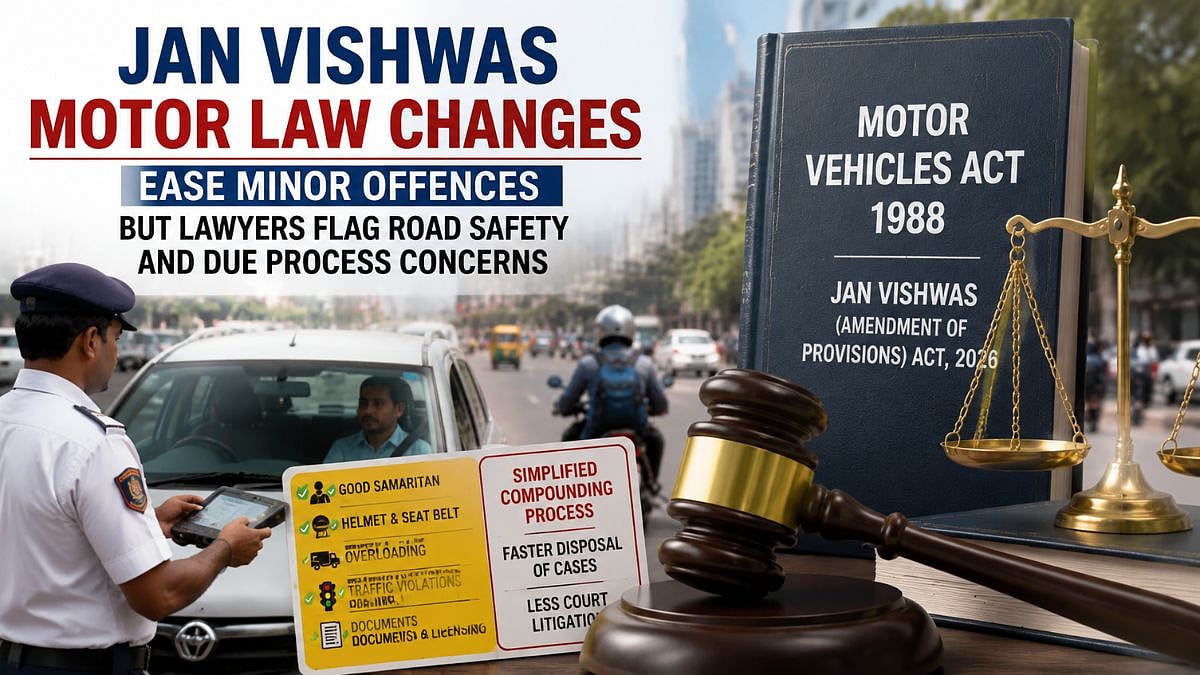
From August 15, several minor and technical violations under the Motor Vehicles Act will be dealt with through a simplified compounding mechanism instead of criminal proceedings. The Jan Vishwas (Amendment of Provisions) Act, 2026 aims to reduce the burden on motorists, transporters, and courts.
The Ministry of Road Transport and Highways has notified the implementation of the relevant provisions concerning the Motor Vehicles Act, 1988. The changes provide for wider compounding of offences and rationalisation of penalties, including violations covered under Section 177A relating to regulations made under Section 118 of the Act.
For vehicle owners and transporters, the change could mean quicker settlement of eligible offences through prescribed authorities and authorised digital platforms such as e-Challan, without having to go through prolonged criminal court proceedings. The reform covers a range of minor regulatory violations, including specified traffic-rule violations, lane discipline, traffic-sign violations, overloading, excess passengers, seat-belt violations, certain two-wheeler safety violations, and insurance- and licensing-related violations.
Lawyers have raised concerns over the relaxation of penalties for certain offences, stating that it should not extend to offences where the conduct poses a serious threat to other road users. They argue that the rights of the victim of such an offence should also be looked into and there should be a balance between the rights of the accused as well as the rights of the victim.
Adv. Tanaji Desai said that the Bill introduces certain liberal policies, but before any law is decriminalised or punishments are reduced or removed, the rights of the victim should also be considered. He also emphasized the need for widespread circulation of the law so that every common man is aware of it and no citizen is exploited for lack of legal knowledge.
Adv. Adnan Mookhtiar welcomed the decriminalisation of minor offences, stating that it promotes the reformative theory of punishment rather than the punitive theory of punishment. However, he cautioned that giving power to executive authorities to levy any form of punishment should not violate the fundamental rights of the person being punished.
The changes to the Motor Vehicles Act are expected to reduce the burden on courts, which are already overburdened. However, lawyers argue that the decision of whether the accused is innocent or guilty should be solely in the hands of a neutral body, the Judiciary.
The implementation of the Jan Vishwas (Amendment of Provisions) Act, 2026 is expected to have a significant impact on road safety and the justice system. While it aims to simplify minor traffic violations, it also raises concerns over the balance between the rights of the accused and the rights of the victim.
In conclusion, the changes to the Motor Vehicles Act are a step towards simplifying minor traffic violations, but it is crucial to ensure that the rights of all parties involved are protected and that the law is implemented in a fair and just manner.
The new law will come into effect on August 15, and it remains to be seen how it will be implemented and what impact it will have on road safety and the justice system in India.
The Ministry of Road Transport and Highways has taken a significant step towards reforming the Motor Vehicles Act, and it is now up to the authorities to ensure that the law is implemented in a way that balances the rights of all parties involved.
Overall, the changes to the Motor Vehicles Act are a welcome move towards simplifying minor traffic violations, but it is crucial to ensure that the rights of all parties involved are protected and that the law is implemented in a fair and just manner.
Frequently asked questions
What are the changes to the Motor Vehicles Act?
The changes provide for wider compounding of offences and rationalisation of penalties, including violations covered under Section 177A relating to regulations made under Section 118 of the Act.
When will the new law come into effect?
The new law will come into effect on August 15.