Bombay HC Flags Delays In RTE Reimbursements To Maharashtra Schools
Bombay HC flags delays, Maharashtra to overhaul system. 133 petitions filed in 7 months.
'%3E%3Crect%20width%3D'96'%20height%3D'96'%20fill%3D'%23B3261E'%2F%3E%3Ccircle%20cx%3D'30'%20cy%3D'24'%20r%3D'44'%20fill%3D'%23fff'%20opacity%3D'.12'%2F%3E%3Ccircle%20cx%3D'60'%20cy%3D'74'%20r%3D'40'%20fill%3D'%23000'%20opacity%3D'.10'%2F%3E%3C%2Fg%3E%3Cg%20fill%3D'%23fff'%3E%3Crect%20x%3D'29'%20y%3D'49'%20width%3D'8'%20height%3D'19'%20rx%3D'1'%2F%3E%3Crect%20x%3D'39'%20y%3D'40'%20width%3D'9'%20height%3D'28'%20rx%3D'1'%2F%3E%3Crect%20x%3D'50'%20y%3D'45'%20width%3D'8'%20height%3D'23'%20rx%3D'1'%2F%3E%3Crect%20x%3D'60'%20y%3D'53'%20width%3D'7'%20height%3D'15'%20rx%3D'1'%2F%3E%3Crect%20x%3D'41'%20y%3D'34'%20width%3D'5'%20height%3D'6'%2F%3E%3C%2Fg%3E%3C%2Fsvg%3E)
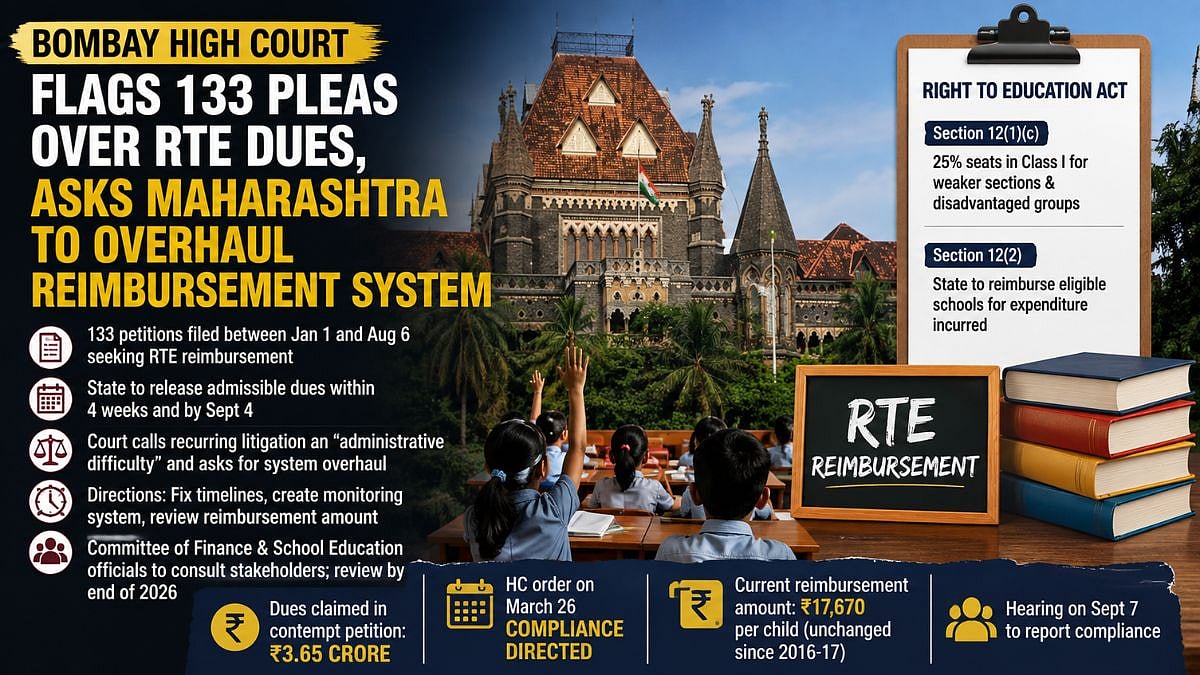
The Bombay High Court has expressed concern over the delays in reimbursing unaided schools in Maharashtra for educating children under the Right to Education (RTE) Act. The court noted that 133 petitions seeking payment have been filed in just over seven months this year.
The court was hearing a contempt petition filed by schools alleging non-compliance with its earlier order directing payment of their pending RTE reimbursement dues. The schools had claimed Rs 3.65 crore. The State assured the court that it would comply with the earlier order and release the admissible amount within four weeks.
The bench of Justices Riyaz Chagla and Farhan Dubash said that the recurring litigation is an “administrative difficulty” and that the State must overhaul its reimbursement mechanism and fix clear timelines for processing and releasing payments. The court observed that while Maharashtra has prescribed a procedure for submitting and verifying claims, there is no deadline for processing them at subsequent stages.
The RTE Act requires eligible unaided schools to reserve at least 25 per cent of Class I seats for children from weaker sections and disadvantaged groups and provide them free education. The State is then required to reimburse eligible schools for the expenditure incurred, subject to statutory conditions. However, the reimbursement amount has remained at Rs 17,670 per child since 2016-17, despite rising educational costs.
The court noted that this recurring litigation not only imposes avoidable hardship upon educational institutions but also results in unnecessary consumption of judicial time in matters which ought ordinarily to be resolved administratively. The bench asked the State to review the existing mechanism, including fixing timelines at every stage, creating a monitoring system, and examining the adequacy of the reimbursement amount.
The court's order highlights the need for the State to streamline its reimbursement process to ensure that schools are reimbursed in a timely manner. The delay in reimbursements has placed a financial burden on institutions, which continue to incur expenses while reimbursement claims remain pending for years.
The State's assurance to comply with the earlier order and release the admissible amount within four weeks is a positive step. However, the court's suggestion to overhaul the reimbursement mechanism and fix clear timelines for processing and releasing payments is crucial to preventing such delays in the future.
The Bombay High Court's order is a significant development in the implementation of the RTE Act in Maharashtra. The court's emphasis on the need for a streamlined reimbursement process and timely payment to schools is essential to ensure that the Act's objectives are met.
In conclusion, the Bombay High Court's order highlights the need for the State to take immediate action to address the delays in reimbursing unaided schools under the RTE Act. The court's suggestions to overhaul the reimbursement mechanism and fix clear timelines for processing and releasing payments are crucial to preventing such delays in the future and ensuring that the Act's objectives are met.
The State's response to the court's order will be crucial in determining the outcome of this case. The court has kept the matter for September 7 for reporting compliance, and it remains to be seen whether the State will be able to comply with the court's order and release the admissible amount within the specified timeframe.
The implementation of the RTE Act is a critical aspect of ensuring that children from weaker sections and disadvantaged groups have access to quality education. The court's order is a significant step towards ensuring that the Act's objectives are met, and it is essential that the State takes immediate action to address the delays in reimbursing unaided schools.
The court's order also highlights the need for greater transparency and accountability in the reimbursement process. The creation of a monitoring system and the examination of the adequacy of the reimbursement amount are essential steps towards ensuring that the reimbursement process is fair and efficient.
In the end, the Bombay High Court's order is a significant development in the implementation of the RTE Act in Maharashtra. The court's emphasis on the need for a streamlined reimbursement process and timely payment to schools is essential to ensure that the Act's objectives are met, and it is crucial that the State takes immediate action to address the delays in reimbursing unaided schools.
Frequently asked questions
What is the Right to Education Act
The Right to Education Act is a law that requires eligible unaided schools to reserve at least 25 per cent of Class I seats for children from weaker sections and disadvantaged groups and provide them free education.
How much is the reimbursement amount per child
The reimbursement amount per child is Rs 17,670, which has remained the same since 2016-17 despite rising educational costs.